
Close Menu
    Facebook X (Twitter) Instagram
    SciTechDaily
    • Biology
    • Chemistry
    • Earth
    • Health
    • Physics
    • Science
    • Space
    • Technology
    Facebook X (Twitter) Pinterest YouTube RSS
    SciTechDaily
    Home»Space»Further Evidence That Outskirts of Spiral Galaxies Host Massive Black Holes
    Space

    Further Evidence That Outskirts of Spiral Galaxies Host Massive Black Holes

    By Susan Gawlowicz, Rochester Institute of TechnologyJuly 27, 20181 Comment3 Mins Read
    Facebook Twitter Pinterest Telegram LinkedIn WhatsApp Email Reddit
    Share
    Facebook Twitter LinkedIn Pinterest Telegram Email Reddit
    Hunting Grounds for Dying Massive Stars
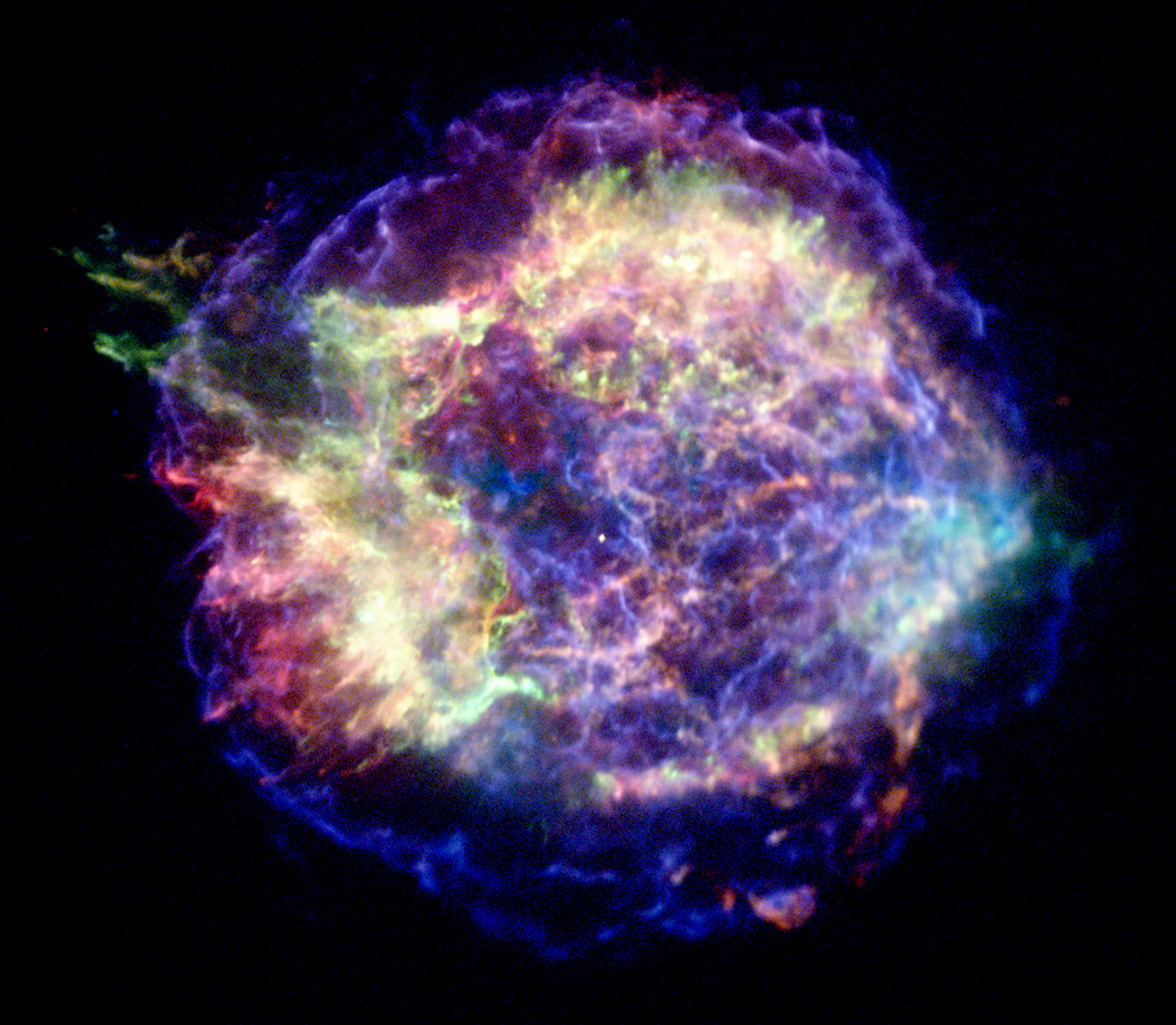
    This Chandra X-ray photograph shows Cassiopeia A, the youngest supernova remnant in the Milky Way. NASA/CXC/MIT/UMass Amherst/M.D.Stage et al.

    Findings from a Rochester Institute of Technology study provide further evidence that the outskirts of spiral galaxies host massive black holes. These overlooked regions are new places to observe gravitational waves created when the massive bodies collide, the authors report.

    The study winds back time on massive black holes by analyzing their visible precursors—supernovae with collapsing cores. The slow decay of these massive stars creates bright signatures in the electromagnetic spectrum before stellar evolution ends in black holes.

    Using data from the Lick Observatory Supernova Search, a survey of nearby galaxies, the team compared the supernovae rate in outer spiral galaxies with that of known hosts—dwarf/satellite galaxies—and found comparable numbers for typical spiral outskirts and typical dwarf galaxies, roughly two core-collapse supernovae per millennium.

    The study, “Supernova Rate beyond the Optical Radius,” will appear in an upcoming issue of Astrophysical Journal Letters.

    Low levels of elements heavier than hydrogen and helium found in dwarf/satellite galaxies create favorable conditions for massive black holes to form and create binary pairs. A similar galactic environment in the outer disks of spiral galaxies also creates likely hunting grounds for massive black holes, said Sukanya Chakrabarti, lead author and assistant professor in the RIT School of Physics and Astronomy.

    “If these core-collapse supernovae are the predecessors to the binary black holes detected by LIGO (Laser Interferometer Gravitational-wave Observatory), then what we’ve found is a reliable method of identifying the host galaxies of LIGO sources,” said Chakrabarti. “Because these black holes have an electromagnetic counterpart at an earlier stage in their life, we can pinpoint their location in the sky and watch for massive black holes.”

    The study’s findings complement Chakrabarti’s 2017 study, which showed that the outer parts of spiral galaxies could contribute to LIGO detection rates. The regions form stars at a comparable rate to dwarf galaxies and are low in heavy element content, creating a conducive home for massive black holes. The current study isolates potential candidates within these favorable galactic environments.

    “We see now that these are both important contributors,” Chakrabarti said. “The next step is to do deeper surveys to see if we can improve the rate.”

    Co-author Brennan Dell, a recent graduate from RIT’s computer science program, analyzed the data with Chakrabarti during his undergraduate co-op.

    “This work may help us determine which galaxies to be on the lookout for electromagnetic counterparts of massive black holes,” Dell said.

    Reference: “The Supernova Rate beyond the Optical Radius” by Sukanya Chakrabarti, Brennan Dell, Or Graur, Alexei V. Filippenko, Benjamin T. Lewis and Christopher F. McKee, 3 August 2018, The Astrophysical Journal Letters.
    DOI: 10.3847/2041-8213/aad0a4

    NASA and National Science Foundation awards funded Chakrabarti’s study and contributions from co-authors Dell and Benjamin Lewis at RIT’s Center for Computational Relativity and Gravitation; additional co-authors include Or Graur from Harvard-Smithsonian Center for Astrophysics; Alexei Filippenko at University of California, Berkeley, who leads the Lick Observatory Supernova Search; and Christopher McKee at the University of California, Berkeley.

    Never miss a breakthrough: Join the SciTechDaily newsletter.
    Follow us on Google and Google News.

    Astronomy Astrophysics Black Hole Cosmology Popular Rochester Institute of Technology
    Share. Facebook Twitter Pinterest LinkedIn Email Reddit

    Related Articles

    Was the James Webb Telescope Broken? The Real Culprit Was a Monster Black Hole

    Gravitational Waves Expose Hidden Dark Matter Around Black Holes

    “Cannibal Stars” and Black Holes May Have Formed in the Universe’s First Second

    Webb Telescope Spots Oldest Black Hole, Shattering Cosmic Records

    Chandra Reveals Evidence of Multiple Eruptions From a Black Hole

    New Research Mathematically Proves Quantum Effects Stop the Formation of Black Holes

    Simulations Re-Create the Complex Dynamics Near a Black Hole

    NASA Study Bridges the Gap Between Theory and Black Hole Observations

    NASA Data Suggests Black Holes Abundant Among the Earliest Stars

    1 Comment

    1. Hamtaro on July 27, 2018 10:32 am

      Great work. But I feel like there is some terminology issues in this article, among stellar-mass, intermediate-mass, and super-massive black holes.

      Reply
    Leave A Reply Cancel Reply

    • Facebook
    • Twitter
    • Pinterest
    • YouTube

    Don't Miss a Discovery

    Subscribe for the Latest in Science & Tech!

    Trending News

    Largest-Ever Study Finds Medicinal Cannabis Ineffective for Anxiety, Depression, PTSD

    250-Million-Year-Old Egg Solves One of Evolution’s Biggest Mysteries

    Living With Roommates Might Be Changing Your Gut Microbiome Without You Knowing

    Century-Old Cleaning Chemical Linked to 500% Increased Risk of Parkinson’s Disease

    What if Your Memories Never Happened? Physicists Take a New Look at the Boltzmann Brain Paradox

    One of the Universe’s Largest Stars May Be Getting Ready To Explode

    Scientists Discover Enzyme That Could Supercharge Ozempic-Like Weight Loss Drugs

    Popular Sweetener Linked to DNA Damage – “It’s Something You Should Not Be Eating”

    Follow SciTechDaily
    • Facebook
    • Twitter
    • YouTube
    • Pinterest
    • Newsletter
    • RSS
    SciTech News
    • Biology News
    • Chemistry News
    • Earth News
    • Health News
    • Physics News
    • Science News
    • Space News
    • Technology News
    Recent Posts
    • Scientists Prove There Are Just Six Degrees of Separation in a Social Network
    • Bee Bacteria Could Fix a Major Flaw in Plant-Based Milk
    • Scientists Discover a Surprising Way To Make Bread Healthier and More Nutritious
    • Natural Compounds Boost Bone Implant Success While Killing Bacteria and Cancer Cells
    • After 60 Years, Scientists Uncover Unexpected Brain Effects of Popular Diabetes Drug Metformin
    Copyright © 1998 - 2026 SciTechDaily. All Rights Reserved.
    • Science News
    • About
    • Contact
    • Editorial Board
    • Privacy Policy
    • Terms of Use

    Type above and press Enter to search. Press Esc to cancel.