
Close Menu
    Facebook X (Twitter) Instagram
    SciTechDaily
    • Biology
    • Chemistry
    • Earth
    • Health
    • Physics
    • Science
    • Space
    • Technology
    Facebook X (Twitter) Pinterest YouTube RSS
    SciTechDaily
    Home»Space»Astronomers Discover Thin Gap on the Most Fundamental Map in Stellar Astronomy
    Space

    Astronomers Discover Thin Gap on the Most Fundamental Map in Stellar Astronomy

    By LaTina Emerson, Georgia State UniversityJuly 27, 2018No Comments3 Mins Read
    Facebook Twitter Pinterest Telegram LinkedIn WhatsApp Email Reddit
    Share
    Facebook Twitter LinkedIn Pinterest Telegram Email Reddit
    Astronomers Discover Thin Gap on Stellar Family Portrait
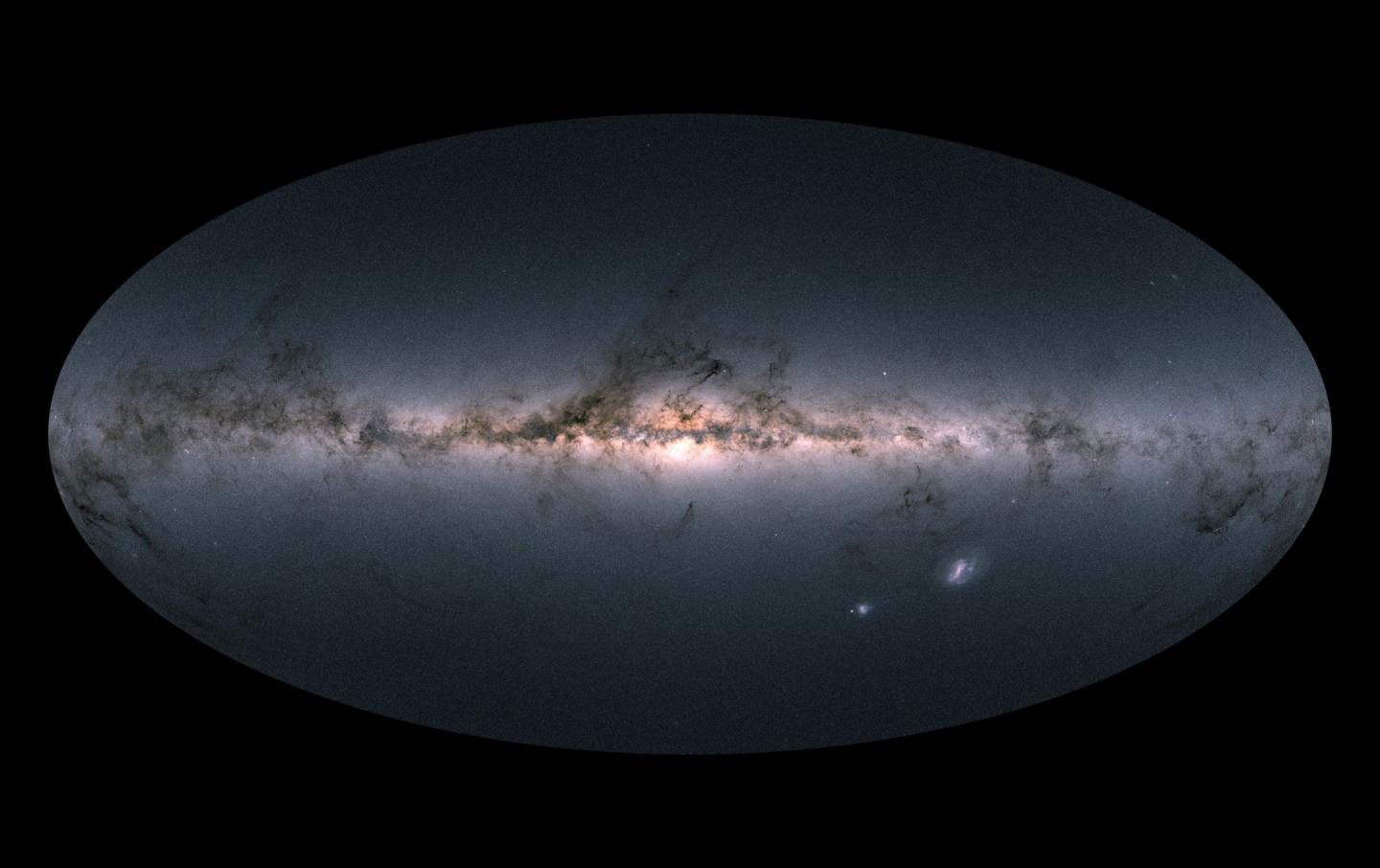
    The European Space Agency’s Gaia mission has produced the richest star map of our galaxy to date. Satellite: Gaia, ESA/Gaia/DPAC

    A thin gap has been discovered on the Hertzsprung-Russell Diagram (HRD), the most fundamental of all maps in stellar astronomy, a finding that provides new information about the interior structures of low mass stars in the Milky Way Galaxy, according to a study led by astronomers at Georgia State University.

    Just as a graph can be made of people with different heights and weights, astronomers compare stars using their luminosities and temperatures. The HRD is a “family portrait” of the stars in the Galaxy, where stars such as the Sun, Altair, Alpha Centauri, Betelgeuse, the north star Polaris and Sirius can be compared. The newly discovered gap cuts diagonally across the HRD and indicates where a crucial internal change occurs in the structures of stars. The gap outlines where stars transition from being larger and mostly convective with a thin radiative layer to being smaller and fully convective.

    Radiation and convection are two ways to transfer energy from inside a star to its surface. Radiation transfers energy through space, and convection is the transfer of energy from one place to another by the movement of fluid.

    The researchers estimate that stars above the gap contain more than about one-third the mass of the Sun, and those below have less mass. Because different types of stars have different masses, this feature reveals where different types of interior structures are on the HRD. The gap occurs in the middle of the region of “red dwarf” stars, which are much smaller and cooler than the Sun, but compose three of every four stars in the solar neighborhood. The findings are published in the journal The Astrophysical Journal Letters.

    “We were pretty excited to see this result, and it provides us new insights into the structures and evolution of stars,” said Dr. Wei-Chun Jao, first author of the study and a staff astronomer in the Department of Physics and Astronomy at Georgia State.

    In 2013, the European Space Agency (ESA) launched the Gaia spacecraft to make a census of the stars in the Milky Way Galaxy and to create a three-dimensional map. In April 2018, the ESA released results of this mission, revealing an unprecedented map of more than one billion stars in the Galaxy, a 10,000-fold increase in the number of stars with accurate distances. The research team led by Georgia State plotted nearly 250,000 of the closest stars in the Gaia data on the HRD to reveal the gap. Georgia State’s researchers have studied the distances to nearby stars for years, which enabled them to interpret the results and notice this thin gap.

    The team is now working to pinpoint why the gap is present. Using results from a theoretical computer model that simulates the activity inside the stars, it appears the gap is caused by a slight shrinking in size if a star is convective all the way through.

    Co-authors of the study include Drs. Todd Henry and Douglas Gies of Georgia State and Dr. Nigel Hambly of the University of Edinburgh, Royal Observatory.

    The study is funded by the National Science Foundation.

    Reference: “A Gap in the Lower Main Sequence Revealed by Gaia Data Release 2” by Wei-Chun Jao, Todd J. Henry, Douglas R. Gies and Nigel C. Hambly, 3 July 2018, The Astrophysical Journal Letters.
    DOI: 10.3847/2041-8213/aacdf6

    Never miss a breakthrough: Join the SciTechDaily newsletter.
    Follow us on Google and Google News.

    Astronomy Cosmology Georgia State University
    Share. Facebook Twitter Pinterest LinkedIn Email Reddit

    Related Articles

    View the First Detailed Image of the Surface of a Giant Star Outside Our Solar System

    Dark Matter Filament in Galaxy Supercluster Directly Measured

    ESA’s Euclid Mission Receives Final Approval

    Calculations Show the Ideal Time to Study the Cosmos

    New Model May Rule Out the Presence of Dark Matter

    Lyman-Alpha Blobs are Some of the Largest Individual Objects in the Observable Universe

    Links Between Core Collapse Supernovae and Star Formation Established

    The Bolshoi Simulation: Boxing the Universe

    Baryon Oscillation Spectroscopic Survey Measures the Universe’s Expansion and Dark Energy

    Leave A Reply Cancel Reply

    • Facebook
    • Twitter
    • Pinterest
    • YouTube

    Don't Miss a Discovery

    Subscribe for the Latest in Science & Tech!

    Trending News

    Scientists May Have Found the Key to Jupiter and Saturn’s Moon Mystery

    Scientists Uncover Brain Changes That Link Pain to Depression

    Saunas May Do More Than Raise Body Temperature – They Activate Your Immune System

    Exercise in a Pill? Metformin Shows Surprising Effects in Cancer Patients

    Hidden Oceans of Magma Could Be Protecting Alien Life

    New Study Challenges Alzheimer’s Theories: It’s Not Just About Plaques

    Artificial Sweeteners May Harm Future Generations, Study Suggests

    Splashdown! NASA Artemis II Returns From Record-Breaking Moon Mission

    Follow SciTechDaily
    • Facebook
    • Twitter
    • YouTube
    • Pinterest
    • Newsletter
    • RSS
    SciTech News
    • Biology News
    • Chemistry News
    • Earth News
    • Health News
    • Physics News
    • Science News
    • Space News
    • Technology News
    Recent Posts
    • This Strange Material Can Turn Superconductivity on and off Like a Switch
    • Scientists Discover Game-Changing New Way To Treat High Cholesterol
    • Breakthrough Drug Delays Rheumatoid Arthritis for Years After Treatment Ends
    • This Small Change to Your Exercise Routine Could Be the Secret to Living Longer
    • Physicists Discover a Strange New Kind of One-Dimensional Particle
    Copyright © 1998 - 2026 SciTechDaily. All Rights Reserved.
    • Science News
    • About
    • Contact
    • Editorial Board
    • Privacy Policy
    • Terms of Use

    Type above and press Enter to search. Press Esc to cancel.