
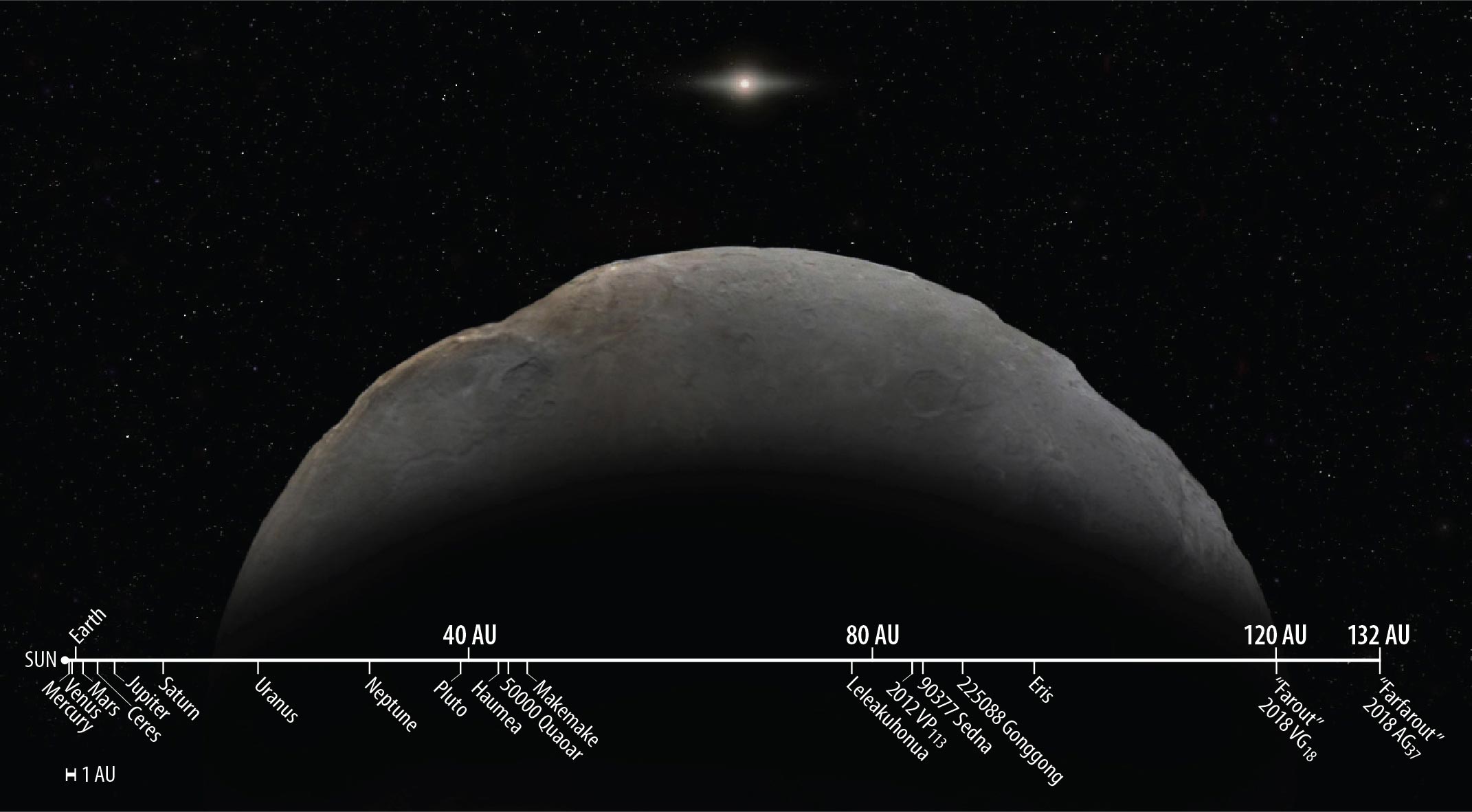
Farfarout, now the most distant known object in the solar system, offers a rare look into the complex gravitational interactions and history of the outer solar system.
A team, including an astronomer from the University of Hawaiʻi Institute for Astronomy (IfA), have confirmed a planetoid that is almost four times farther from the Sun than Pluto, making it the most distant object ever observed in our solar system. The planetoid, nicknamed “Farfarout,” was first detected in 2018, and the team has now collected enough observations to pin down the orbit. The Minor Planet Center has now given it the official designation of 2018 AG37.
Farfarout’s name distinguished it from the previous record holder “Farout,” found by the same team of astronomers in 2018. The team includes UH Mānoa’s David Tholen, Scott S. Sheppard of the Carnegie Institution for Science, and Chad Trujillo of Northern Arizona University, who have an ongoing survey to map the outer solar system beyond Pluto.
Journey Around the Sun
Farfarout’s current distance from the Sun is 132 astronomical units (au); 1 au is the distance between the Earth and Sun. For comparison, Pluto is only 34 au from the Sun. The newly discovered object has a very elongated orbit that takes it out to 175 au at its most distant, and inside the orbit of Neptune, to around 27 au, when it is closest to the Sun.
Farfarout’s journey around the Sun takes about a thousand years, crossing the giant planet Neptune’s orbit every time. This means Farfarout has probably experienced strong gravitational interactions with Neptune over the age of the solar system, and is the reason why it has such a large and elongated orbit.
“A single orbit of Farfarout around the Sun takes a millennium,” said Tholen. “Because of this long orbital period, it moves very slowly across the sky, requiring several years of observations to precisely determine its trajectory.”
Discovered on Maunakea
Farfarout will be given an official name after its orbit is better determined over the next few years. It was discovered at the Subaru 8-meter telescope located atop Maunakea in Hawaiʻi, and recovered using the Gemini North and Magellan telescopes in the past few years to determine its orbit based on its slow motion across the sky.
Farfarout is very faint, and based on its brightness and distance from the Sun, the team estimates its size to be about 400 km across, putting it on the low end of being a dwarf planet, assuming it is an ice-rich object.
“The discovery of Farfarout shows our increasing ability to map the outer solar system and observe farther and farther towards the fringes of our solar system,” said Sheppard. “Only with the advancements in the last few years of large digital cameras on very large telescopes has it been possible to efficiently discover very distant objects like Farfarout. Even though some of these distant objects are quite large, being dwarf planet in size, they are very faint because of their extreme distances from the Sun. Farfarout is just the tip of the iceberg of solar system objects in the very distant solar system.”
Interacting With Neptune
Because Neptune strongly interacts with Farfarout, its orbit and movement cannot be used to determine if there is another unknown massive planet in the very distant solar system, since these interactions dominate Farfarout’s orbital dynamics. Only those objects whose orbits stay in the very distant solar system, well beyond Neptune’s gravitational influence, can be used to probe for signs of an unknown massive planet. These include Sedna and 2012 VP113, which, although they are currently closer to the Sun than Farfarout (at around 80 au), they never approach Neptune and thus would be most influenced by the possible Planet X instead.
“Farfarout’s orbital dynamics can help us understand how Neptune formed and evolved, as Farfarout was likely thrown into the outer solar system by getting too close to Neptune in the distant past,” said Trujillo. “Farfarout will likely interact with Neptune again since their orbits continue to intersect.”
Never miss a breakthrough: Join the SciTechDaily newsletter.
Follow us on Google and Google News.
7 Comments
Wow, The 132au is 40.8au short of 1 light day, And My study shows be that all Solar Systems are less than .01 light years or 632.4au…
Have you been able to track the orbit of the moon as it goes about determining the tidal tables… or is that just to far far out. Excuse me, too.
Imagine, the 45 minutes, it takes for a satellite to orbit the earth or is that 45 seconds, start thinking about the point of pur existence and then you might see one.. as in the center of… the fusion core and it series of reflections in the heavens of such greater density and radiation that it would be fathomable, excuse the mumbles, of our computers to si.ulate if you look at the proton and its angular velocity or spin on its axis being a cube, appearing hexagonal, like a euclidean rectangle in 3d, height 1, width 1, length 2, with the seat of sigma, 5 x 5, meaning at its midst, offering the symbol of eternity, pie, and producing the greater light and the lesser. Now that would be far far out… isn’t it so… that it’s not only logical its practical and sustainable. A three dimensional axis with its perpendicular axis, producing spin, and enough force to move the heavens away from our earth’s xore, and giving us some breathing space. Ahh… the sea of tranquility. Said He, when He saw that it was good. The force of the proton must be equal to or greater than the matter to be moved, delta. Alpha, beta, gamma,,, one to see by day and the other to see by night, the one seventh of the other 285714.
There’s a jump to superstition in there.
Does this mean that Neptune will be downgraded and lose its “Planet” status? Since Neptune shares its orbit with FarFarOut and does not “own” its current orbit around the sun, by the International Astronomical Union’s (IAU) standards, Neptune should no longer be considered a planet. Am I right?
? No, the three requirements are explicit on “clearing the orbit” by being the dominant mass.
That is because it means the planets are mature and in stable orbits (so in principle it can be applied to exoplanet that are > 5 million years old). And so there is a qualitative difference to objects like asteroids or Farfarfout, objects that do not manage that. (And in fact that is why Farfarout is so far, far out.)
[It also means poor astronomers have only a handful of planet names to register and memorize instead of hundreds of thousands of asteroids and other debris.]
A thousand years from now every planet or at least one of it’s moons will be populated