
Close Menu
    Facebook X (Twitter) Instagram
    SciTechDaily
    • Biology
    • Chemistry
    • Earth
    • Health
    • Physics
    • Science
    • Space
    • Technology
    Facebook X (Twitter) Pinterest YouTube RSS
    SciTechDaily
    Home»Physics»Scientists Switch On and Off Magnetism Using Quantum Mechanics
    Physics

    Scientists Switch On and Off Magnetism Using Quantum Mechanics

    By University College LondonJune 15, 20121 Comment3 Mins Read
    Facebook Twitter Pinterest Telegram LinkedIn WhatsApp Email Reddit
    Share
    Facebook Twitter LinkedIn Pinterest Telegram Email Reddit
    magnetism switches on and off in Quantum bar magnets in a transparent salt
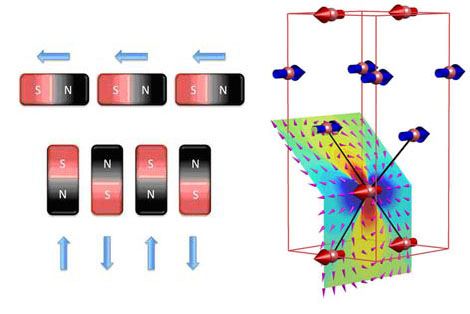
    Right: Bar magnets line up parallel when they are end-to-end, and antiparallel when they are adjacent to each other. Left: Antiferromagnetic arrangement of the spins (colored arrows) in the magnetic salt used by the Swiss-German-US-London team. Credit: University College London

    In a newly published study, an international team of scientists described how they used quantum mechanics to switch on and off the magnetism in a transparent salt.

    Scientists have managed to switch on and off the magnetism of a new material using quantum mechanics, making the material a test bed for future quantum devices.

    The international team of researchers led from the Laboratory for Quantum Magnetism (LQM) in Switzerland and the London Center for Nanotechnology (LCN), found that the material, a transparent salt, did not suffer from the usual complications of other real magnets, and exploited the fact that its quantum spins – which are like tiny atomic magnets — interact according to the rules of large bar magnets.

    The study is published in Science.

    Anybody who has played with toy bar magnets at school will remember that opposite poles attract, lining up parallel to each other when they are placed end to end, and anti-parallel when placed adjacent to each other.

    As conventional bar magnets are simply too large to reveal any quantum mechanical nature, and most materials are too complex for the spins to interact like true bar magnets, the transparent salt is the perfect material to see what’s going on at the quantum level for a dense collection of tiny bar magnets.

    The team were able to image all the spins in the special salt, finding that the spins are parallel within pairs of layers, while for adjacent layer pairs, they are antiparallel, as large bar magnets placed adjacent to each other would be. The spin arrangement is called “antiferromagnetic”. In contrast, for ferromagnets such as iron, all spins are parallel.

    By warming the material to only 0.4 degrees Celsius above the absolute “zero” of temperature where all classical (non-quantum) motion ceases, the team found that the spins lose their order and point in random directions, as iron does when it loses its ferromagnetism when heated to 870 Celsius, much higher than room temperature because of the strong and complex interactions between electron spins in this very common solid.

    The team also found that they could achieve the same loss of order by turning on quantum mechanics with an electromagnet containing the salt. Thus, physicists now have a new toy, a collection of tiny bar magnets, which naturally assume an antiferromagnetic configuration and for which they can dial in quantum mechanics at will.

    “Understanding and manipulating magnetic properties of more traditional materials such as iron have of course long been key to many familiar technologies, from electric motors to hard drives in digital computers,” said Professor Gabriel Aeppli, UCL Director of the LCN.

    “While this may seem esoteric, there are deep connections between what has been achieved here and new types of computers, which also rely on the ability to tune quantum mechanics to solve hard problems, like pattern recognition in images.”

    Reference: “Dipolar Antiferromagnetism and Quantum Criticality in LiErF4” by Conradin Kraemer, Neda Nikseresht, Julian O. Piatek, Nikolay Tsyrulin, Bastien Dalla Piazza, Klaus Kiefer, Bastian Klemke, Thomas F. Rosenbaum, Gabriel Aeppli, Ché Gannarelli, Karel Prokes, Andrey Podlesnyak, Thierry Strässle, Lukas Keller, Oksana Zaharko, Karl W. Krämer and Henrik M. Rønnow, 15 June 2012, Science.
    DOI: 10.1126/science.1221878

    Never miss a breakthrough: Join the SciTechDaily newsletter.
    Follow us on Google and Google News.

    Magnetism Nanotechnology Quantum Mechanics University College London
    Share. Facebook Twitter Pinterest LinkedIn Email Reddit

    Related Articles

    Major Quantum Computing Advance: Scientists Break 25-Year Barrier in Chip Fabrication

    Efficient Quantum-Mechanical Interface Leads to a Strong Interaction Between Light and Matter

    Researchers Confirm Theory of “Superballistic” Electron Flow

    Newly Discovered Phenomenon Shows Electrons Can Move Much Faster Than Expected

    Third Law of Thermodynamics Restored in Thin Films of Spin Ice

    New Quantum Dots Design for Solotronics

    UCL Researchers Use Quantum Mechanics to Explain the Efficiency of Photosynthesis

    Discovery of Magnetic Field That Can Flip Heat Flow

    Ultrashort Pulses of Infrared Light Trigger Changes in Magnetism

    1 Comment

    1. HARRY PINEDA on February 14, 2015 11:55 am

      IF YOU THINKING ABOUT IT TO FIND A PLANET HAS THIS MAGNETS AND TO GO TO CHECK MOST HAVE LIFE

      Reply
    Leave A Reply Cancel Reply

    • Facebook
    • Twitter
    • Pinterest
    • YouTube

    Don't Miss a Discovery

    Subscribe for the Latest in Science & Tech!

    Trending News

    New “Nanozyme Hypothesis” Could Rewrite the Story of Life’s Origins

    Anatomy Isn’t Finished: The Human Body Still Holds Secrets

    “Pretty Close to Home”: The Hidden Earthquake Threat Beneath Seattle

    The Surprising Reason You Might Want To Sleep Without a Pillow

    Scientists Say This Natural Hormone Reverses Obesity by Targeting the Brain

    35-Million-Year-Old Mystery: Strange Arachnid Discovered Preserved in Amber

    Is AI Really Just a Tool? It Could Be Altering How You See Reality

    JWST Reveals a “Forbidden” Planet With a Baffling Composition

    Follow SciTechDaily
    • Facebook
    • Twitter
    • YouTube
    • Pinterest
    • Newsletter
    • RSS
    SciTech News
    • Biology News
    • Chemistry News
    • Earth News
    • Health News
    • Physics News
    • Science News
    • Space News
    • Technology News
    Recent Posts
    • Saturn’s Magnetic Shield Isn’t What Scientists Expected
    • Hidden Oceans of Magma Could Be Protecting Alien Life
    • After Decades of Searching, Astronomers Finally Track Down the Universe’s Missing Hydrogen
    • Scientists Capture Hidden Electron Patterns Inside Quantum Materials
    • New Study Challenges Alzheimer’s Theories: It’s Not Just About Plaques
    Copyright © 1998 - 2026 SciTechDaily. All Rights Reserved.
    • Science News
    • About
    • Contact
    • Editorial Board
    • Privacy Policy
    • Terms of Use

    Type above and press Enter to search. Press Esc to cancel.