
Close Menu
    Facebook X (Twitter) Instagram
    SciTechDaily
    • Biology
    • Chemistry
    • Earth
    • Health
    • Physics
    • Science
    • Space
    • Technology
    Facebook X (Twitter) Pinterest YouTube RSS
    SciTechDaily
    Home»Space»Hubble Captures Image of Compact Blue Dwarf Galaxy UGC 5497
    Space

    Hubble Captures Image of Compact Blue Dwarf Galaxy UGC 5497

    By NASAJune 15, 2012No Comments2 Mins Read
    Facebook Twitter Pinterest Telegram LinkedIn WhatsApp Email Reddit
    Share
    Facebook Twitter LinkedIn Pinterest Telegram Email Reddit
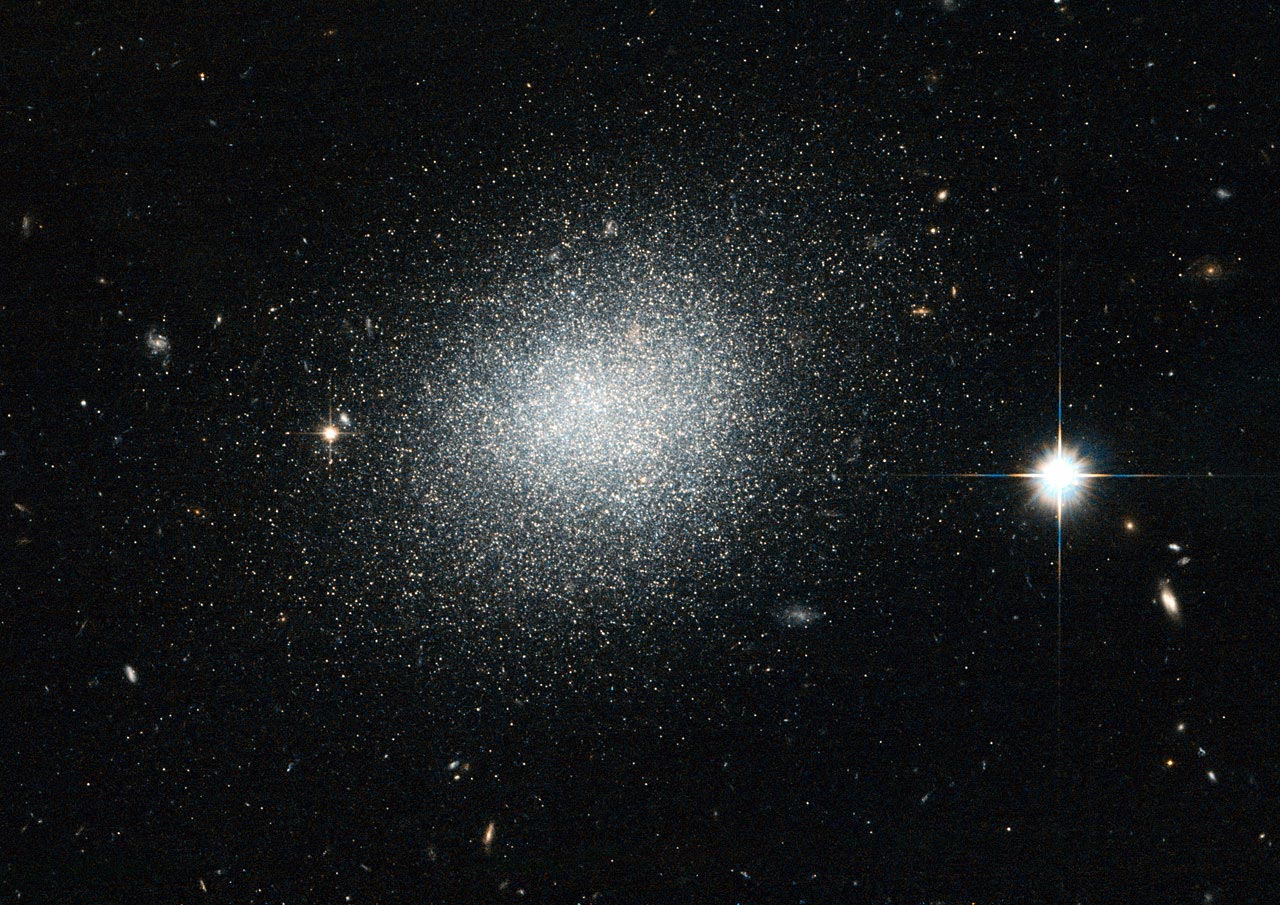
    Galaxy UGC 5497
    Hubble Space Telescope image of dwarf galaxy UGC 5497, filed with with fast-burning stars that will someday explode as supernovae. Credit: ESA/NASA

    Located about 12 million light-years away in the constellation Ursa Major, galaxy UGC 5497 is a compact blue dwarf galaxy with fast-burning stars that will someday explode as supernovae.

    The NASA/ESA Hubble Space Telescope has captured this view of the dwarf galaxy UGC 5497, which looks a bit like salt sprinkled on black velvet in this image.

    The object is a compact blue dwarf galaxy that is infused with newly formed clusters of stars. The bright, blue stars that arise in these clusters help to give the galaxy an overall bluish appearance that lasts for several million years until these fast-burning stars explode as supernovae.

    UGC 5497 is considered part of the M 81 group of galaxies, which is located about 12 million light-years away in the constellation Ursa Major (The Great Bear). UGC 5497 turned up in a ground-based telescope survey back in 2008 looking for new dwarf galaxy candidates associated with Messier 81.

    According to the leading cosmological theory of galaxy formation, called Lambda Cold Dark Matter, there should be far more satellite dwarf galaxies associated with big galaxies like the Milky Way and Messier 81 than are currently known. Finding previously overlooked objects such as this one has helped cut into the expected tally — but only by a small amount.

    Astrophysicists, therefore, remain puzzled over the so-called “missing satellite” problem.

    The field of view in this image, which is a combination of visible and infrared exposures from Hubble’s Advanced Camera for Surveys, is approximately 3.4 by 3.4 arcminutes.

    Never miss a breakthrough: Join the SciTechDaily newsletter.
    Follow us on Google and Google News.

    Astronomy Astrophysics European Space Agency Galaxy Hubble Space Telescope NASA
    Share. Facebook Twitter Pinterest LinkedIn Email Reddit

    Related Articles

    Hubble’s Newest Discovery Isn’t a Star, It’s a Window Into the Dark Universe

    Astronomers Have Seen Signs of “Life” at the Center of Messier 110

    Hubble Reveals Some of the Earliest Known Galaxies

    Hubble Views Abell 2261, An Elliptical Galaxy With an Unusually Large Core

    Hubble Image of Peculiar Galaxy Pair Arp 116

    Hubble Helps Solve the Mystery of Why Ultra-Faint Dwarf Galaxies Contain Few Stars

    A Spiral Within a Spiral, Galaxy ESO 498-G5

    Hubble Captures New Image of Messier 9

    Hubble Observes Rare Blue Stars in Andromeda’s Core

    Leave A Reply Cancel Reply

    • Facebook
    • Twitter
    • Pinterest
    • YouTube

    Don't Miss a Discovery

    Subscribe for the Latest in Science & Tech!

    Trending News

    Monster Storms on Jupiter Unleash Lightning Beyond Anything on Earth

    Scientists Create “Liquid Gears” That Spin Without Touching

    The Simple Habit That Could Help Prevent Cancer

    Millions Take These IBS Drugs, But a New Study Finds Serious Risks

    Scientists Unlock Hidden Secrets of 2,300-Year-Old Mummies Using Cutting-Edge CT Scanner

    Bread Might Be Making You Gain Weight Even Without Eating More Calories

    Scientists Discover Massive Magma Reservoir Beneath Tuscany

    Europe’s Most Active Volcano Just Got Stranger – Here’s Why Scientists Are Rethinking It

    Follow SciTechDaily
    • Facebook
    • Twitter
    • YouTube
    • Pinterest
    • Newsletter
    • RSS
    SciTech News
    • Biology News
    • Chemistry News
    • Earth News
    • Health News
    • Physics News
    • Science News
    • Space News
    • Technology News
    Recent Posts
    • Scientists Were Wrong About This Strange “Rule-Breaking” Particle
    • Webb Space Telescope Uncovers Unexpected Ice Clouds on a Jupiter-Like World
    • 289-Million-Year-Old Reptile Mummy Reveals Origin of Human Breathing System
    • New Brain Discovery Challenges Long-Held Theory of Teenage Brain Development
    • Sharks Are Overheating as Warming Oceans Push Them to the Edge
    Copyright © 1998 - 2026 SciTechDaily. All Rights Reserved.
    • Science News
    • About
    • Contact
    • Editorial Board
    • Privacy Policy
    • Terms of Use

    Type above and press Enter to search. Press Esc to cancel.