
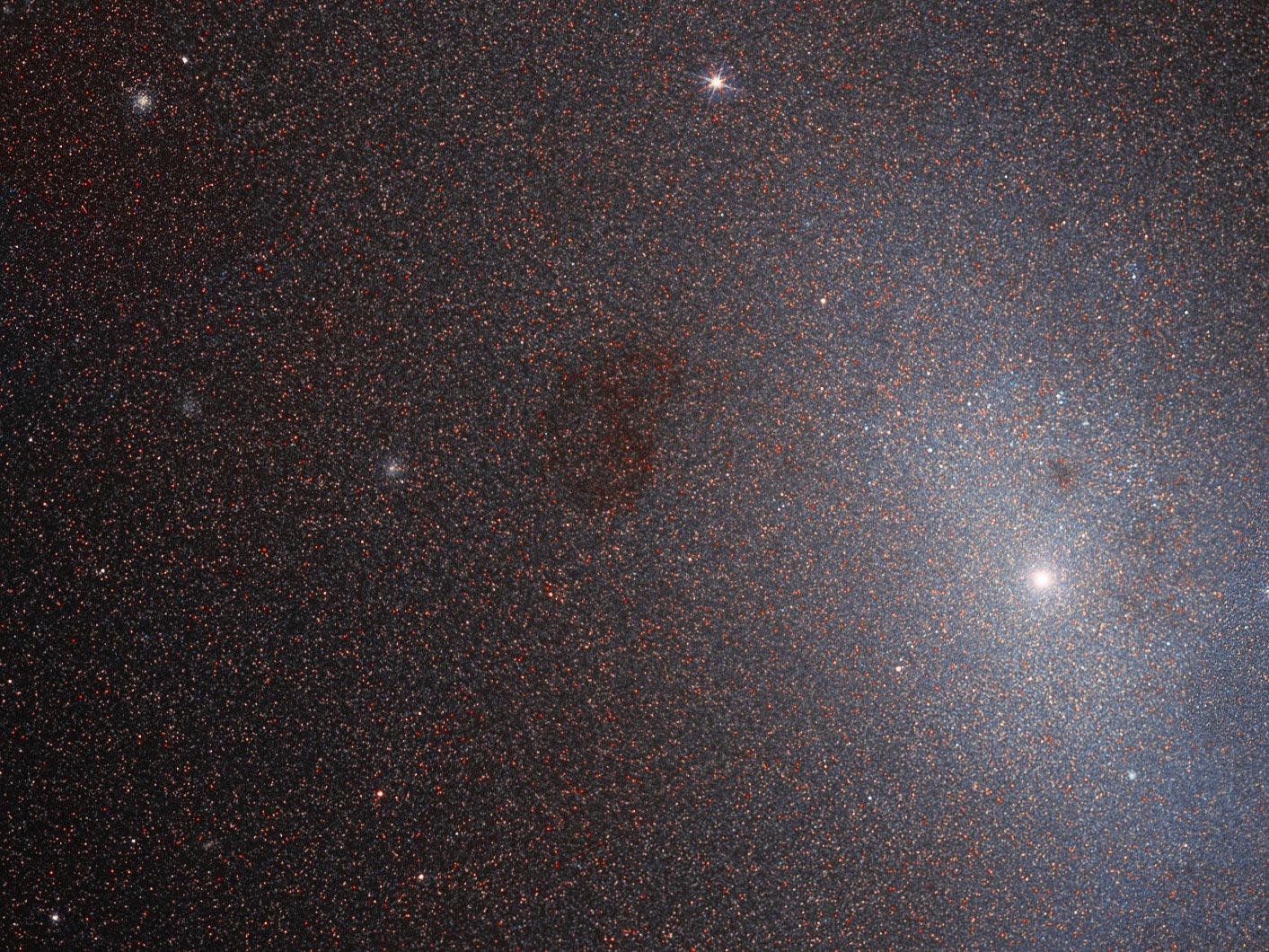
Many of the best-loved galaxies in the cosmos are remarkably large, close, massive, bright, or beautiful, often with an unusual or intriguing structure or history. However, it takes all kinds to make a universe — as demonstrated by this Hubble image of Messier 110.
Messier 110 may not look like much, but it is a fascinating near neighbor of our home galaxy, and an unusual example of its type. It is a member of the Local Group, a gathering of galaxies comprising the Milky Way and a number of the galaxies closest to it. Specifically, Messier 110 is one of the many satellite galaxies encircling the Andromeda galaxy, the nearest major galaxy to our own, and is classified as a dwarf elliptical galaxy, meaning that it has a smooth and almost featureless structure. Elliptical galaxies lack arms and notable pockets of star formation — both characteristic features of spiral galaxies. Dwarf ellipticals are quite common in groups and clusters of galaxies, and are often satellites of larger galaxies.
Because they lack stellar nurseries and contain mostly old stars, elliptical galaxies are often considered “dead” when compared to their spiral relatives. However, astronomers have spotted signs of a population of young, blue stars at the center of Messier 110 — hinting that it may not be so “dead” after all.
Messier 110 is featured in Hubble’s Messier catalog, which includes some of the most fascinating celestial objects that can be observed from Earth’s Northern Hemisphere. See the NASA-processed image and other Messier objects in Hubble’s Messier Catalog.
M110 is an elliptical galaxy, which means that it has a smooth and nearly featureless structure. Elliptical galaxies do not have arms or regions of star formation. They are oftentimes considered “dead” compared to spiral galaxies, and the stars in elliptical galaxies are often older than those in other galaxies. However, there is evidence that a population of young blue stars exists at the center of M110. This small elliptical galaxy has approximately 10 billion stars, as well as at least eight globular clusters (the brightest of which can be seen with large telescopes).
This Hubble observation was taken in visible and near-infrared light with the Wide Field and Planetary Camera 2. The core of M110 is seen toward the lower right of the image, with the galaxy’s globular clusters and numerous stars shown as points of light throughout the frame. Also featured in this Hubble image are large clouds of gas and dust, seen as dark splotches (one large region is located near the middle of the image and another, smaller one appears above the galaxy’s core). Hubble took these observations of M110 to study the development of globular clusters located in the galaxy.
Credit: Image courtesy of Stellarium
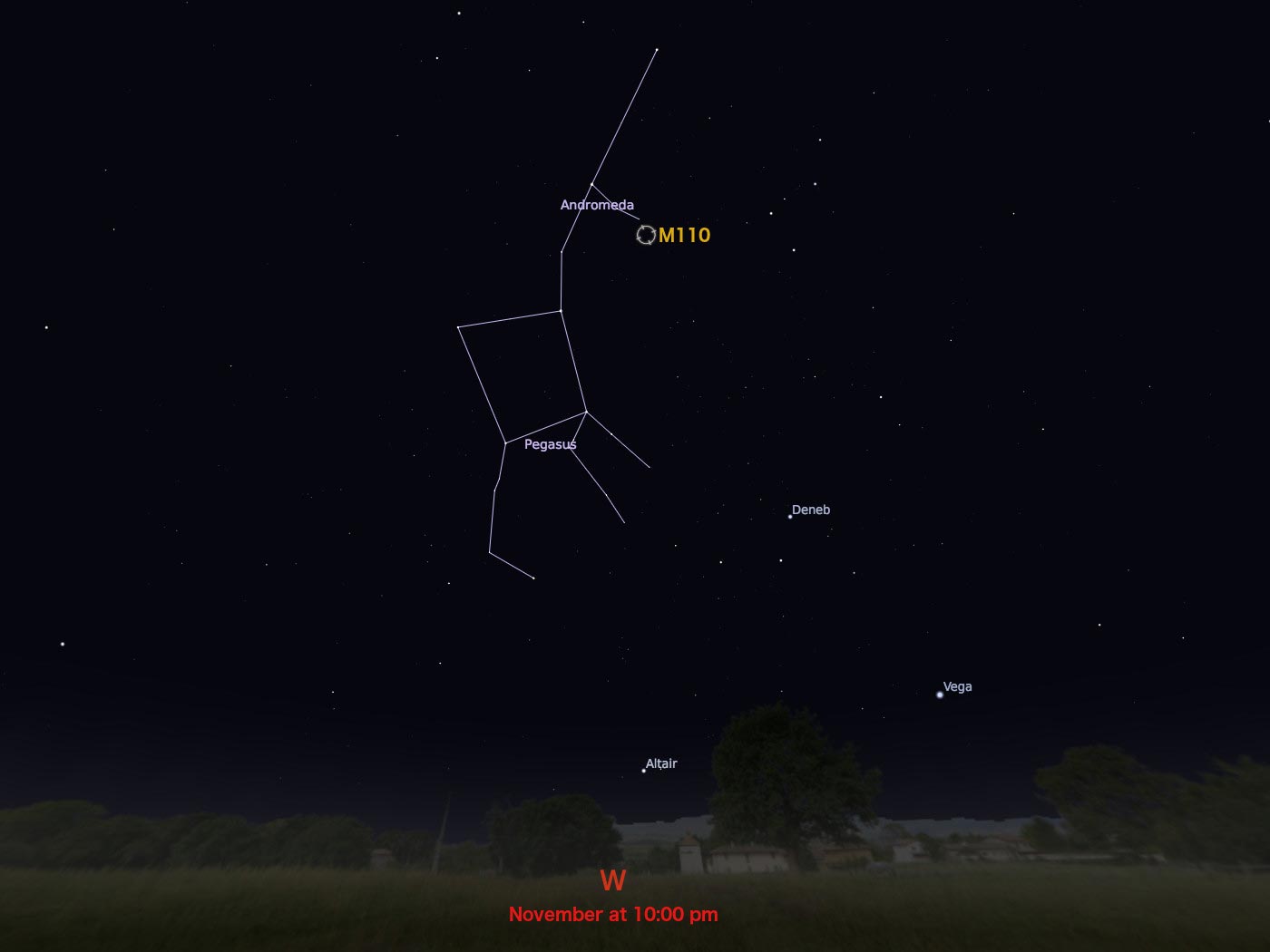
With a telescope, M110 is fairly easy to spot near the core of the much larger and brighter Andromeda galaxy. Smaller telescopes will only reveal a faint, diffuse patch of light, while larger telescopes will unveil an oval shape with a brighter core. The best time to view M110 is during November.
Never miss a breakthrough: Join the SciTechDaily newsletter.
Follow us on Google and Google News.
10 Comments
The information given is very useful to common citizens of the World. We are thankful to NASA FOR exploring the universe for mankind.
Good Morning
A solid yawn at the lame click bate provided for this article. Stars are not life dipwad.
I agree with the click bait comment, but that is what a title is for. In astronomical terms, the “birth” of stars in an elliptical galaxy is an indication that the galaxy in question is perhaps not as “dead” as might be expected and having “Life” in quotation marks in the title should be a good indication of the special use of the term. Finally, the need to call an editor or writer a “dipwad” is an indication that the person doing the naming is perhaps a lower form of life than those they have chosen to deride.
Exactly. Can you imagine what the title would actually be if we found extraterrestrial biological life?
Come on, retard. It’s very common to describe planets and stars as living or dead. Didn’t the quotes give it away for you?
Do you think this is the title if we found sentient life outside our planet?
next time i suggest “life” in quotes for clarity.
Very enjoyable article. But that title’s really unsuitable. First time i read it, i thought you’re talking about exoplanet lifes or something like that.
It’s super click-baitey not sure how people on this thread can debate that.
What nonsense title – cheap tabloid style.
The clickbait. If there was actually biological life on the galaxy, it would be a whole lot different…