
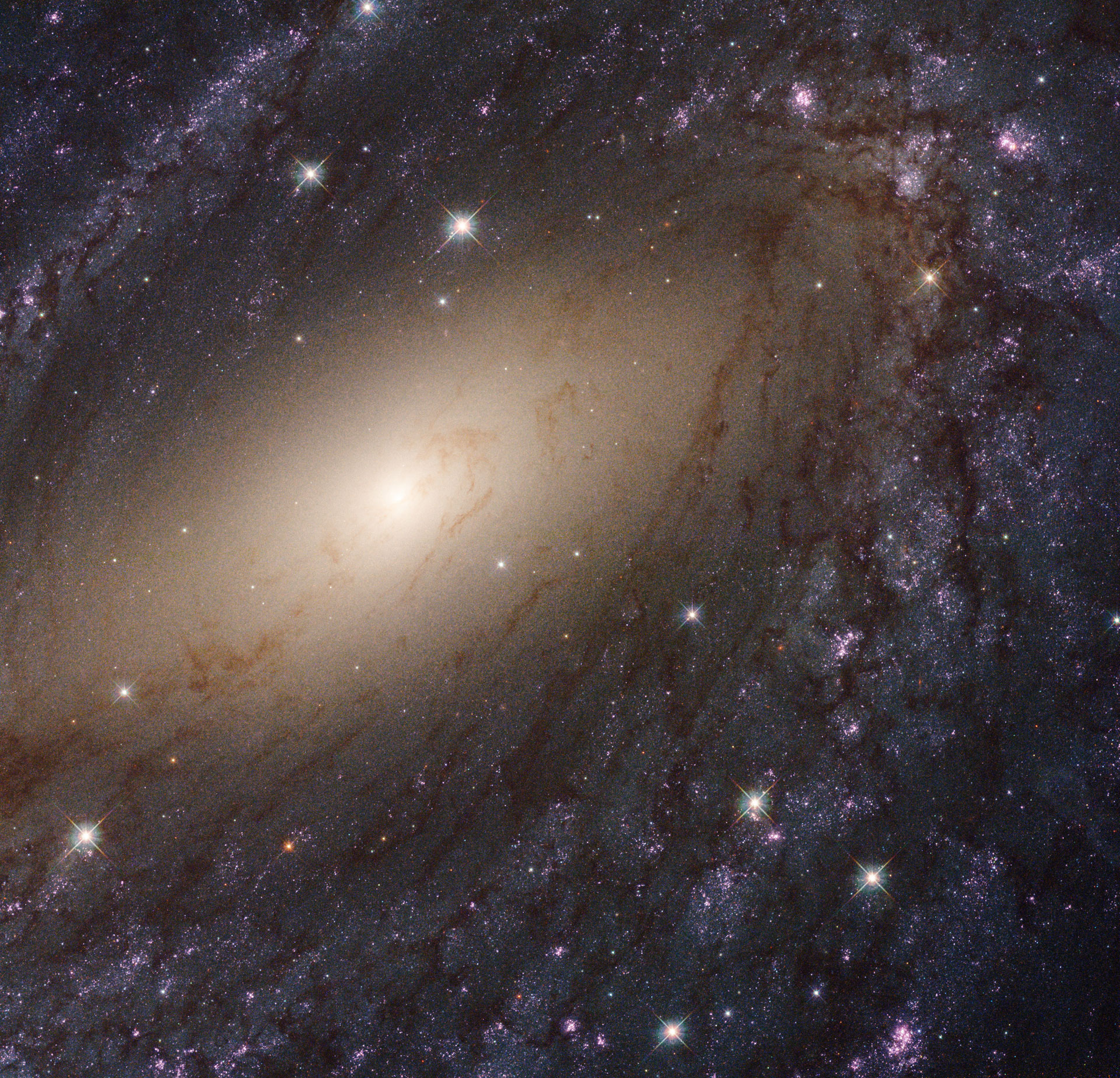
The image is a composite using both ultraviolet light and visible light, gathered with Hubble’s Wide Field Camera 3 and Advanced Camera for Surveys. Credit: NASA, ESA, and the LEGUS team
Using the unparalleled sharpness and ultraviolet observational capabilities of the NASA/ESA Hubble Space Telescope, an international team of astronomers has created the most comprehensive high-resolution ultraviolet-light survey of star-forming galaxies in the local Universe. The catalog contains about 8000 clusters and 39 million hot blue stars.
Ultraviolet light is a major tracer of the youngest and hottest stars. These stars are short-lived and intensely bright. Astronomers have now finished a survey called LEGUS (Legacy ExtraGalactic UV Survey) that captured the details of 50 local galaxies within 60 million light-years of Earth in both visible and ultraviolet light.
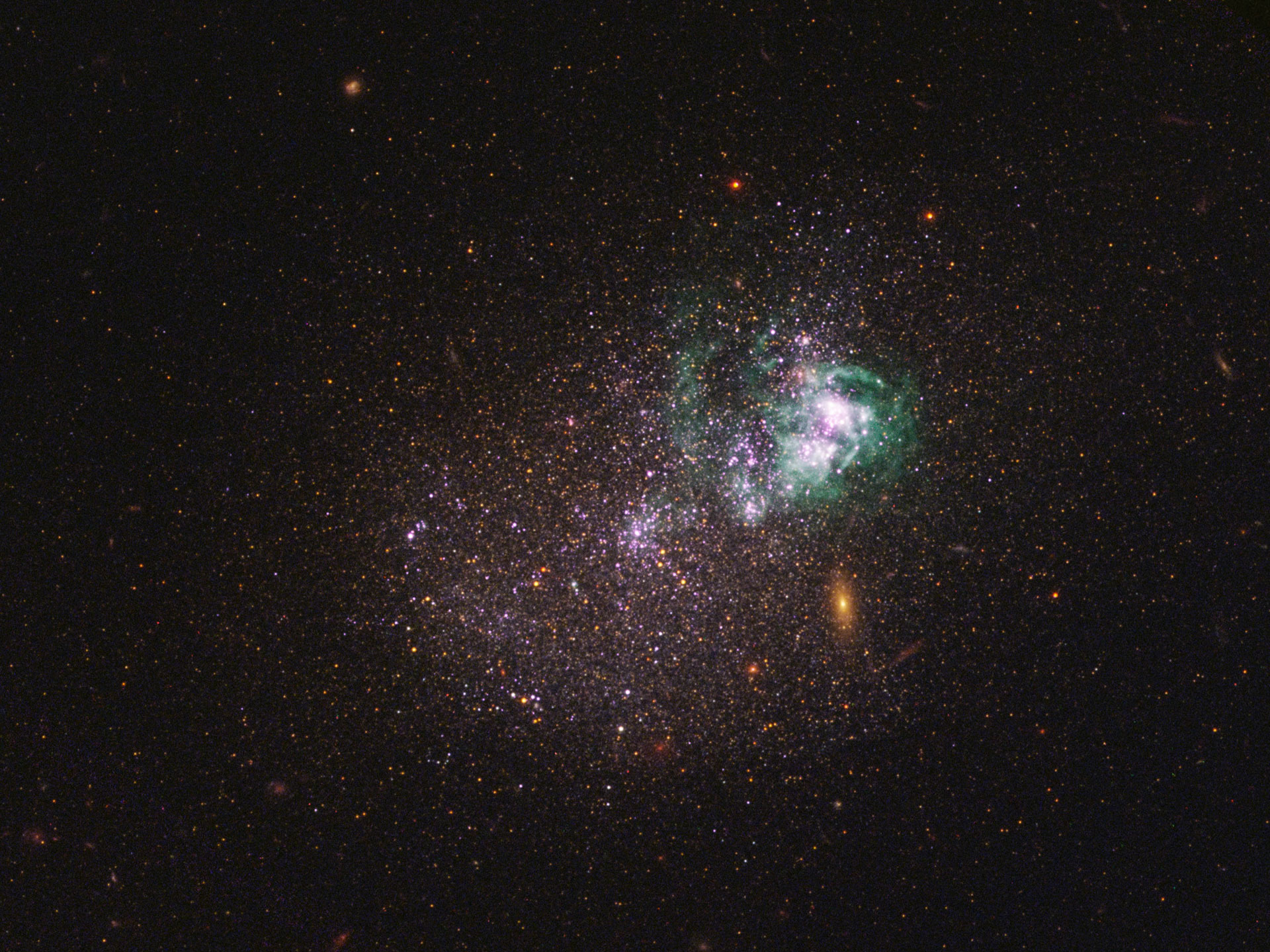
The image is a composite using both ultraviolet light and visible light, gathered with Hubble’s Wide Field Camera 3 and Advanced Camera for Surveys. Credit: NASA, ESA, and the LEGUS team
The LEGUS team carefully selected its targets from among 500 candidate galaxies compiled from ground-based surveys. They chose the galaxies based on their mass, star-formation rate, and their abundances of elements heavier than hydrogen and helium. Because of the proximity of the selected galaxies, Hubble was able to resolve them into their main components: stars and star clusters. With the LEGUS data, the team created a catalog with about 8000 young clusters and it also created a star catalog comprising about 39 million stars that are at least five times more massive than our Sun.
The data, gathered with Hubble’s Wide Field Camera 3 and Advanced Camera for Surveys, provide detailed information on young, massive stars and star clusters, and how their environment affects their development. As such, the catalog offers an extensive resource for understanding the complexities of star formation and galaxy evolution.
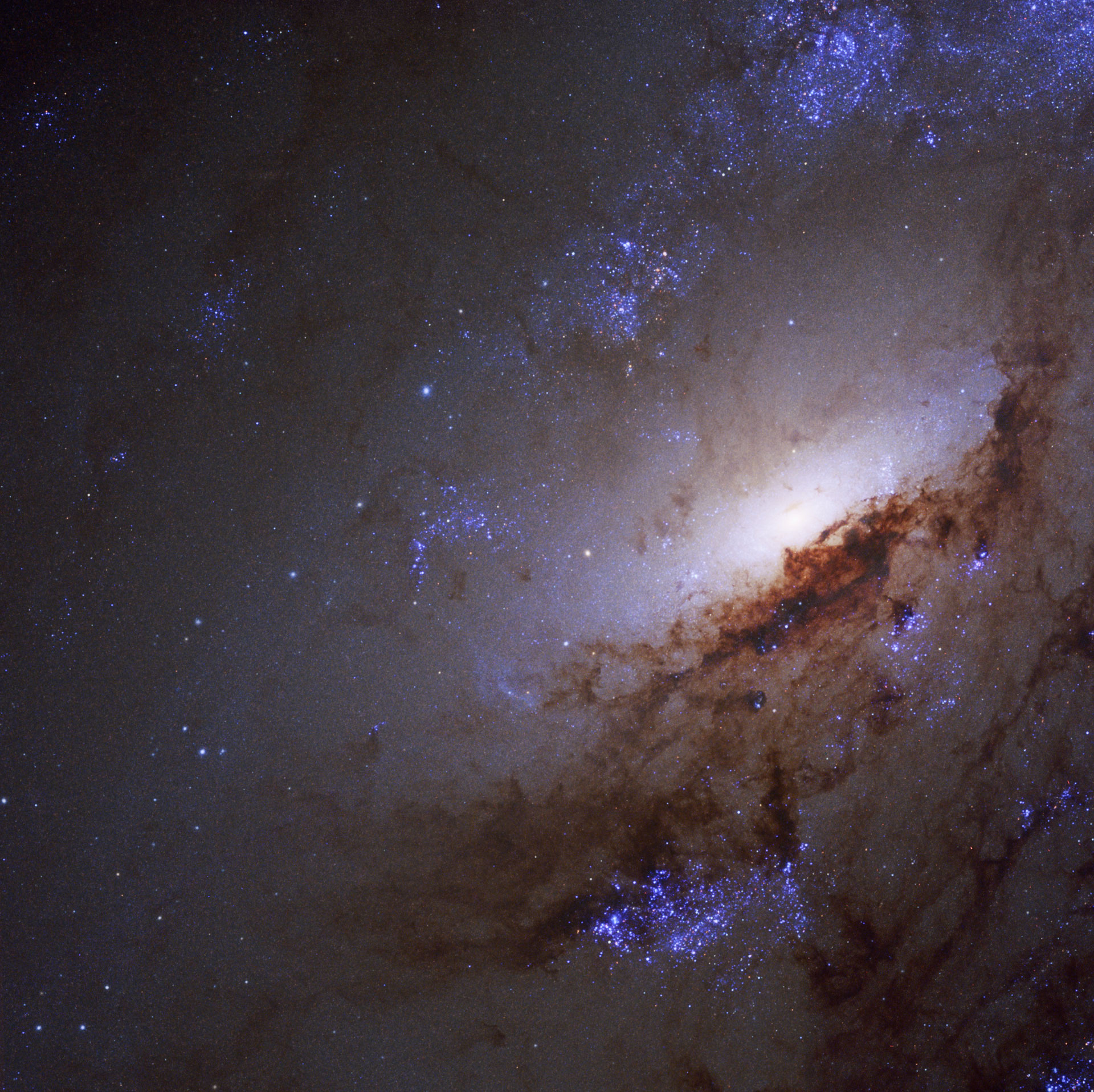
Despite carrying his name, Messier 106 was neither discovered nor cataloged by the renowned 18th-century astronomer Charles Messier. Discovered by his assistant, Pierre Méchain, the galaxy was never added to the Messier catalog in his lifetime. Along with six other objects discovered but not logged by the pair, Messier 106 was posthumously added to the catalog in the 20th century.
An image of this galaxy was already released back in 2013 (heic1302). This newly-processed image now also shows ultraviolet radiation Hubble captured from the galaxy. Credit: NASA, ESA, and the LEGUS team
One of the key questions the survey may help astronomers answer is the connection between star formation and the major structures, such as spiral arms, that make up a galaxy. These structured distributions are particularly visible in the youngest stellar populations.
By resolving the fine details of the studied galaxies, while also studying the connection to larger galactic structures, the team aims to identify the physical mechanisms behind the observed distribution of stellar populations within galaxies.
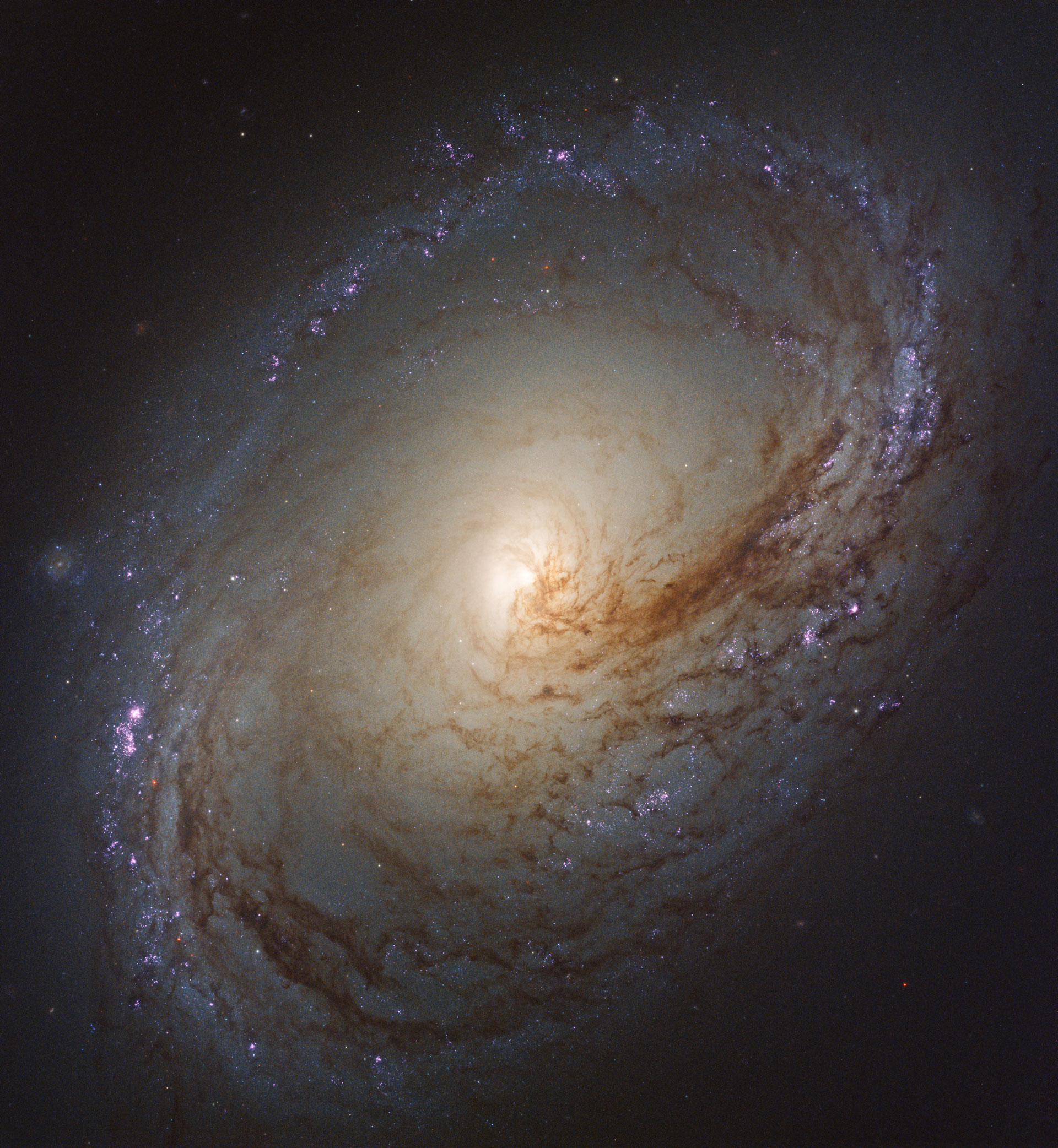
A wave of star formation is occurring along the dark filaments that make up the spiral arms. The fledgling stars illuminate the surrounding hydrogen gas, making the stars appear pink. Star birth begins at the inner spiral arms and moves outward. The milky white regions in the center of these galaxies represent the glow of countless stars.
An image of this galaxy was already released back in 2015 (potw1535a). This newly-processed image now also shows ultraviolet radiation Hubble captured from the galaxy. Credit: NASA, ESA, and the LEGUS team
Figuring out the final link between gas and star formation is key to fully understanding galaxy evolution. Astronomers are studying this link by looking at the effects of the environment on star clusters, and how their survival is linked to their surroundings.
LEGUS will not only allow astronomers to understand the local Universe. It will also help interpret views of distant galaxies, where the ultraviolet light from young stars is stretched to infrared wavelengths due to the expansion of space. The NASA/ESA/CSA James Webb Space Telescope and its ability to observe in the far infrared will complement the LEGUS views.
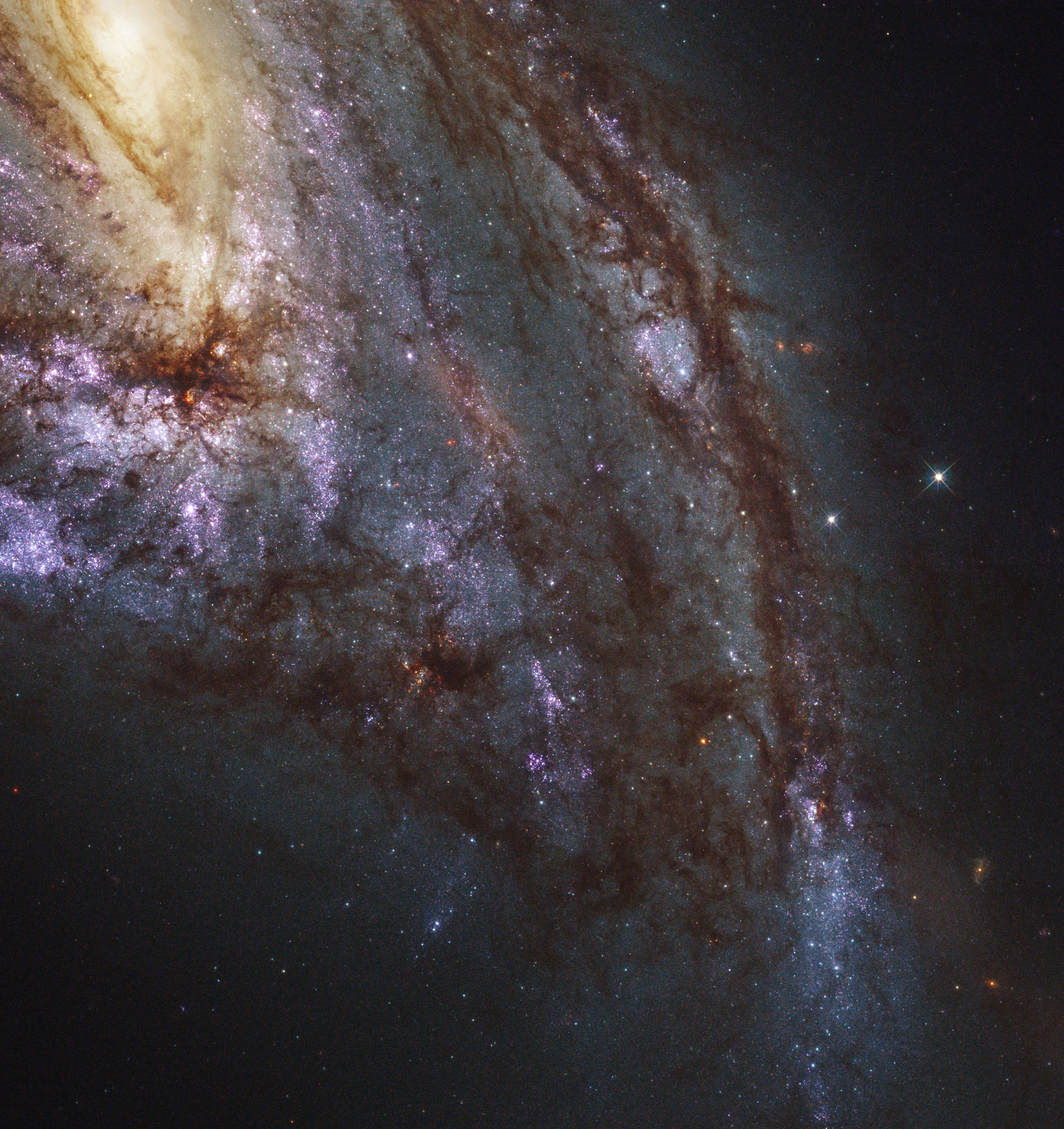
Like all the galaxies in LEGUS, Messier 66 is undergoing vigorous star and star-cluster formation. One of the goals of LEGUS is to sample star-forming regions across each galaxy. Because the galaxies are relatively close to Earth, Hubble can resolve individual stars.
An image of this galaxy was already released back in 2010 (heic1006). This newly-processed image now also shows ultraviolet radiation Hubble captured from the galaxy. Credit: NASA, ESA, and the LEGUS team
Links
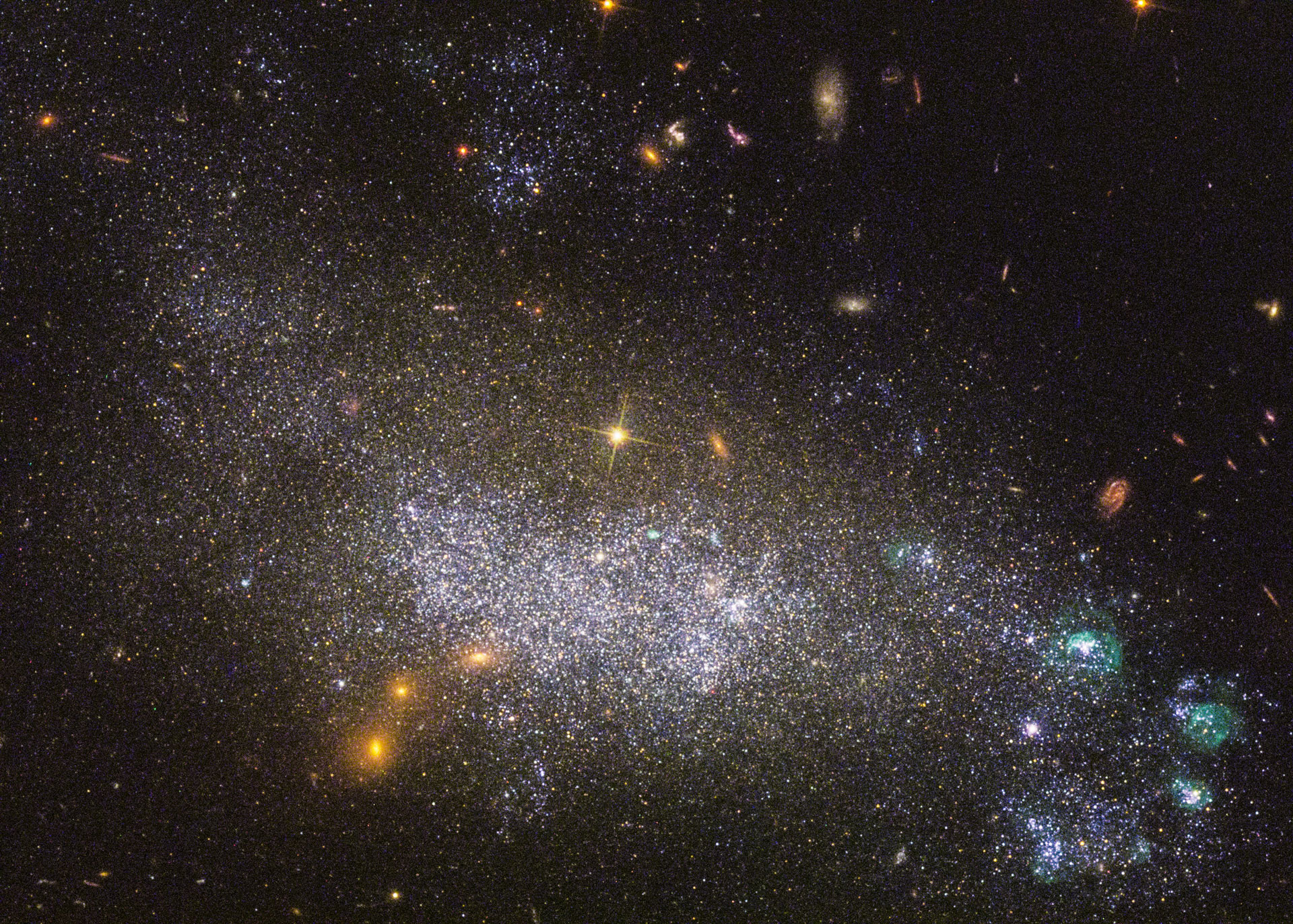
In UGC 5340, a pocket of rapid star birth appears in the lower right corner. This region of star formation was probably triggered by a gravitational interaction with an unseen companion galaxy. But star formation is present across the entire body of UGC 5340, and the relatively young stars are responsible for the galaxy’s blue-white color.
An image of this galaxy was already released back in 2014 (heic1421). This newly-processed image now also shows ultraviolet radiation Hubble captured from the galaxy. Credit: NASA, ESA, and the LEGUS team
Never miss a breakthrough: Join the SciTechDaily newsletter.
Follow us on Google and Google News.
2 Comments
Star formation is one of the least comprehended phenomenon in astrophysics. Is there a general theory of star formation? No, there is not. There is a number of models based on computer simulations which include supersonic hydrodynamics with non-ideal MHD turbulence influenced by gravity. They include the line and continuum radiative processes of the energy transfer; a number of chemical processes with dissociation, recombination and ionization, with uncertain nomenclature of atoms and molecules, unknown magnetic fields and formation and destruction of dust particles. In addition there is macrophysics that is an environment in the molecular clouds, clumps and cores; inclusion in the multiple systems, collisions among stellar systems; jets and outflows; radiation pressure.
Nebadon, the Local Universe