
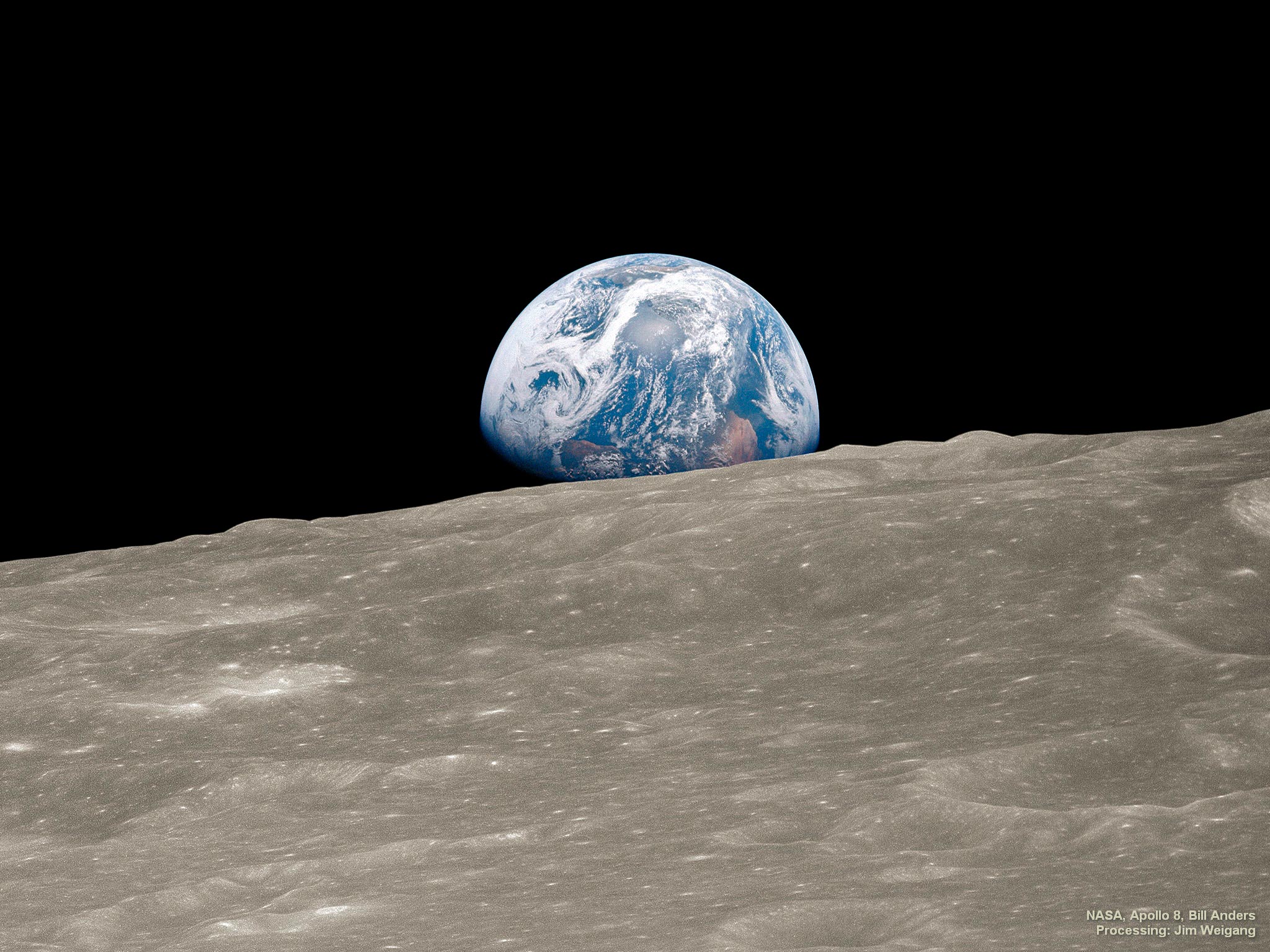
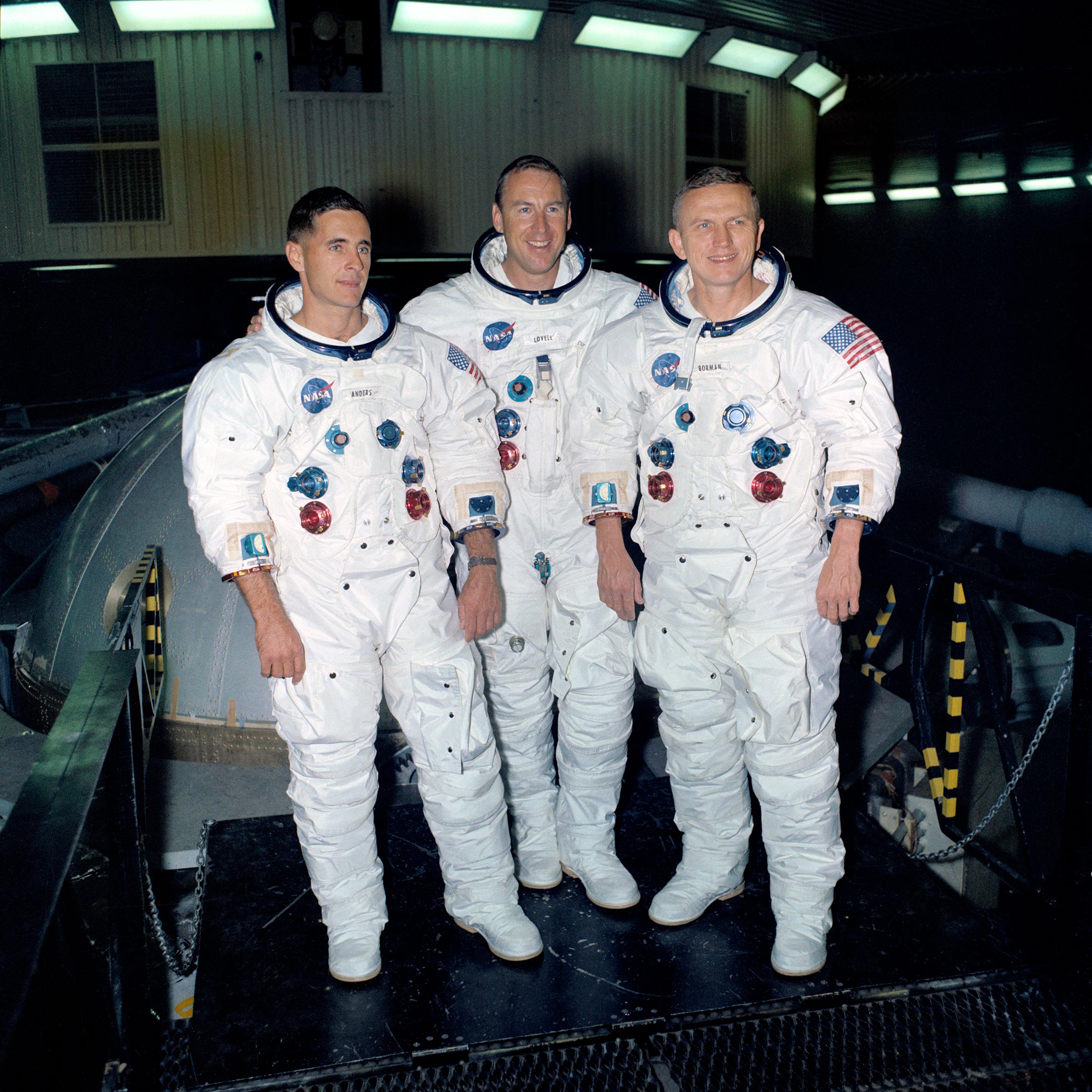
On December 24, 1968, Apollo 8 astronauts Frank Borman, Jim Lovell, and Bill Anders became the first humans to witness the Earth rising above the moon’s barren surface. Now we can relive the astronauts’ experience, thanks to data from NASA’s Lunar Reconnaissance Orbiter.
Video Transcript:
[ music ] On December 24th, 1968, Apollo 8 astronauts Frank Borman, Jim Lovell, and Bill Anders became the first humans to orbit the Moon, and the first to witness the magnificent sight called “Earthrise.” Now, we can see this historic event exactly as the astronauts saw it, thanks to new data from NASA’s Lunar Reconnaissance Orbiter, or LRO. LRO’s superb global lunar maps, combined with the astronauts’ own photographs, reveal where Apollo 8 was over the Moon, and even its precise orientation in space, when the astronauts first saw the Earth rising above the Moon’s barren horizon.
[ music ] It happened a few minutes after 10:30 am Houston time, as Apollo 8 was coming around from the far side of the Moon for the fourth time. Mission Commander Frank Borman was in the left-hand seat, preparing to turn the spacecraft to a new orientation according to the flight plan. Navigator Jim Lovell was in the spacecraft’s lower equipment bay, about to make sightings on lunar landmarks with the onboard sextant, and Bill Anders was in the right-hand seat, observing the Moon through his side window, and taking pictures with a Hasselblad still camera, fitted with a 250-mm telephoto lens.
Meanwhile, a second Hasselblad with an 80-mm lens was mounted in Borman’s front-facing window, the so-called rendezvous window, photographing the Moon on an automatic timer: a new picture every twenty seconds. These photographs, matched with LRO’s high-resolution terrain maps, show that Borman was still turning Apollo 8 when the Earth appeared. It was only because of the timing of this rotation that the Earthrise, which had happened on Apollo 8’s three previous orbits, but was unseen by the astronauts, now came into view in Bill Anders’s side window.
Here’s what it looked like, as recreated from LRO data by Goddard’s Scientific Visualization Studio. You’ll hear the astronauts’ voices as captured by Apollo 8’s onboard tape recorder, beginning with Frank Borman announcing the start of the roll maneuver, and you’ll see the rising Earth move from one window to another as Apollo 8 turns.
Borman: All right, we’re gonna roll. Ready… Set…
Anders: The impact crater with uh — at uh — just prior to the subsolar point on the south side, in the floor of it, uh, [unintelligible], there is one dark hole. But I couldn’t get a quick enough look at it to see if it might be anything volcanic.
Anders: Oh my God, look at that picture over there! There’s the Earth comin’ up. Wow, is that pretty!
Borman: Hey don’t take that, it’s not scheduled.
[shutter click]
Anders: You got a color film, Jim? Hand me a roll of color, quick, would you?
Lovell: Oh man, that’s great.
Anders: Hurry.
Lovell: Where is it?
Anders: Quick
Lovell: Down here?
Anders: Just grab me a color. A color exterior. Hurry up. Got one?
Lovell: Yeah, I’m looking’ for one. C 368.
Anders: Anything. Quick.
Lovell: Here.
Anders: Well, I think we missed it.
Lovell: Hey, I got it right here [in the hatch window].
Anders: Let me get it out this one, it’s a lot clearer.
Lovell: Bill, I got it framed, it’s very clear right here!
[shutter click]
Lovell: Got it?
Anders: Yep.
Lovell: Take several, take several of ’em! Here, give it to me!
Anders: Wait a minute, just let me get the right setting here now, just calm down.
Lovell: Take –
Anders: Calm down, Lovell!
Lovell: Well, I got it right — aw, that’s a beautiful shot…Two-fifty at f/11.
[shutter click]
Anders: Okay.
Lovell: Now vary-vary the exposure a little bit.
Anders: I did, I took two of ’em here.
Lovell: You sure you got it now?
Anders: Yeah, we’ll get — well, it’ll come up again, I think.
[ music ] For the astronauts, seeing the Earthrise was an unexpected and electrifying experience, and one of the three photographs taken by Bill Anders became an iconic image of the 20th century.
In 2018, the International Astronomical Union commemorated the event by naming a 25 mile diameter crater “Anders’ Earthrise.” A smaller crater was given the name, “Eight Homeward.” Both craters are visible in the iconic Earthrise photograph.
I’m Andrew Chaikin, author of “A Man on the Moon.”
[ music ][Satellite passing by: Beeping rhythmically]
About Apollo 8
Apollo 8, a significant milestone in space exploration, was the second crewed mission in NASA’s Apollo program and the first to leave Earth’s orbit. Launched on December 21, 1968, the mission was crewed by astronauts Frank Borman, James Lovell, and William Anders. This mission marked a series of firsts: it was the first human spaceflight to reach the Moon, the first to orbit it, and the first to return to Earth after orbiting another celestial body.
The primary objectives of Apollo 8 were to test human spaceflight capabilities beyond low Earth orbit and to demonstrate translunar injection, lunar orbiting, and safe return to Earth. The mission achieved a significant psychological victory in the Space Race, capturing the world’s attention and demonstrating the United States’ capability to reach the Moon.
One of the most iconic moments of Apollo 8 was the “Earthrise” photograph taken by William Anders, showing Earth rising over the lunar horizon. This image became a powerful symbol of the mission and is considered one of the most significant photographs of the 20th century. The crew also made a Christmas Eve broadcast where they read from the Book of Genesis, which was watched by millions around the world.
Apollo 8 safely splashed down in the Pacific Ocean on December 27, 1968, and its success paved the way for Apollo 11, which would fulfill the goal of landing humans on the Moon the following year. The mission’s achievements and legacy continue to be celebrated as pivotal moments in human space exploration.
Never miss a breakthrough: Join the SciTechDaily newsletter.
Follow us on Google and Google News.
1 Comment
Hello, I already said that in Iran, when the text I write is filtered by the dirty regime, all the sites are translated into sentences and the text that I translate using Google Translate, the words are removed and the dictation and spelling are corrupted,maybe this is because of the translation software, but Dear administrators of this very good and interesting scientific website, can you correct the text that I put in the comments, because you are completely familiar with the subject of my articles.In the end, I would like to thank you administrators of this scientific and technical website.I have more than 40 in Iran.For years, I have been working in the field of astronomy and geology, and I am a poet and author of books on astronomy and new religions and the author of the book Nature of the Spirit.