
Close Menu
    Facebook X (Twitter) Instagram
    SciTechDaily
    • Biology
    • Chemistry
    • Earth
    • Health
    • Physics
    • Science
    • Space
    • Technology
    Facebook X (Twitter) Pinterest YouTube RSS
    SciTechDaily
    Home»Space»Solar Telescope Mounted on a Rocket Detects Super-Fine Strands on the Sun
    Space

    Solar Telescope Mounted on a Rocket Detects Super-Fine Strands on the Sun

    By NASA’s Goddard Space Flight CenterApril 18, 20201 Comment2 Mins Read
    Facebook Twitter Pinterest Telegram LinkedIn WhatsApp Email Reddit
    Share
    Facebook Twitter LinkedIn Pinterest Telegram Email Reddit
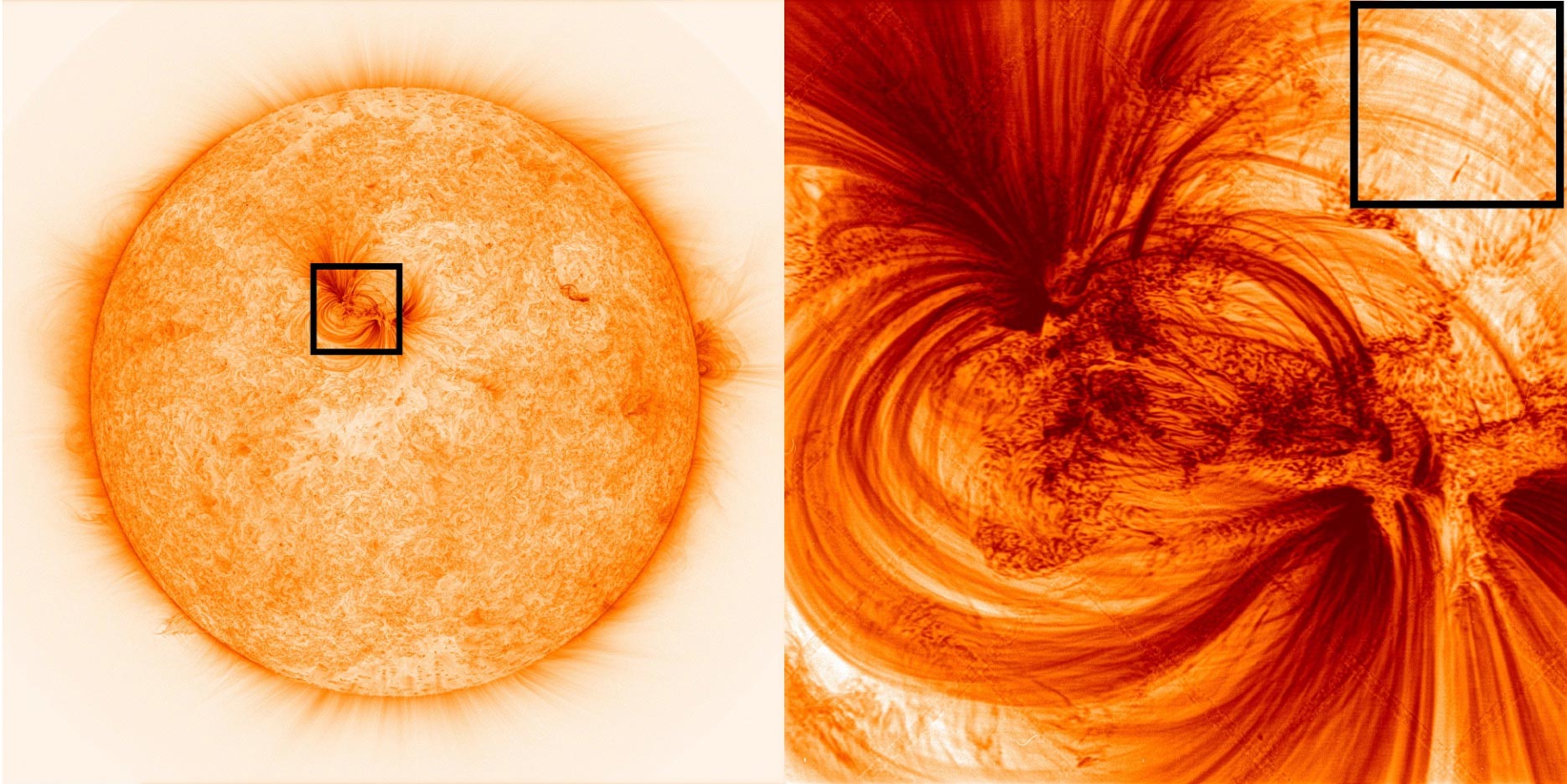
    Sun Active Region 12712
    The Hi-C telescope zoomed in on Active Region 12712, capturing fine threads of solar material. Credit: NASA/University of Central Lancashire

    New images from a NASA sounding rocket provide the highest-resolution views ever captured of the Sun’s outer atmosphere, or corona, revealing fine strands of million-degree solar material.

    HI-C Sounding Rocket
    Waiting for launch: NASA’s HI-C mission, sitting in the front of this image. Credit: NASA

    The images show loops as thin as 125 miles (201 kilometers) across in areas that appear dim and fuzzy in other Sun-watching telescopes. It’s the first direct observation of the strands thought to combine and make up larger loops on the Sun. They also provide visual evidence that the staggeringly hot material that fills the Sun’s corona — which is some 300 times hotter than its surface — has definite structure on fine scales, rather than being a homogenous soup of particles.

    The images were captured by NASA’s High-Resolution Coronal Imager, or Hi-C mission. Hi-C is a solar telescope mounted on a sounding rocket, a sub-orbital rocket that makes brief flights into space before falling back to Earth. Hi-C captured these images on its third flight from the White Sands Missile Range in New Mexico on May 29, 2018. The Hi-C mission is led by principal investigator Amy Winebarger of NASA’s Marshall Space Flight Center in Huntsville, Alabama. The images were published in the Astrophysical Journal on April 7, 2020.

    Reference: “Is the High-Resolution Coronal Imager Resolving Coronal Strands? Results from AR 12712” by Thomas Williams, Robert W. Walsh, Amy R. Winebarger, David H. Brooks, Jonathan W. Cirtain, Bart De Pontieu, Leon Golub, Ken Kobayashi, David E. McKenzie, Richard J. Morton, Hardi Peter, Laurel A. Rachmeler, Sabrina L. Savage, Paola Testa, Sanjiv K. Tiwari, Harry P. Warren and Benjamin J. Watkinson, 7 April 2020, Astrophysical Journal.
    DOI: 10.3847/1538-4357/ab6dcf

    Never miss a breakthrough: Join the SciTechDaily newsletter.
    Follow us on Google and Google News.

    Astronomy NASA NASA Goddard Space Flight Center Sun
    Share. Facebook Twitter Pinterest LinkedIn Email Reddit

    Related Articles

    NASA Detects Bizarre Solar Radio Burst That Wouldn’t Stop

    Touch the Sun With NASA’s Revolutionary “Solar Stones”

    Helium Structures Found in Sun’s Atmosphere by NASA Sounding Rocket

    Data From Solar Dynamics Observatory Helps NASA Predict Big Solar Flares

    “Campfires” Spotted on Sun in First Solar Orbiter Images – Closest Pictures Ever of the Sun

    Incredible 10-Year Time Lapse of Sun From NASA’s Solar Dynamics Observatory [Video]

    10 Amazing Discoveries About the Sun From NASA’s Solar Dynamics Observatory

    Magnetic Explosions Observed on Sun – Unlike Anything Seen Before [Video]

    NASA Captures Image of an M6.5 Class Flare

    1 Comment

    1. Live Wire on April 18, 2020 11:23 am

      Sooner or later these guys are going to have to own up to what is just so painfully painfully obvious, even though it will turn current mainstream beliefs about the sun and by extension the universe on it’s head:

      https://www.thunderbolts.info/wp/2020/02/27/sun-wind/

      Reply
    Leave A Reply Cancel Reply

    • Facebook
    • Twitter
    • Pinterest
    • YouTube

    Don't Miss a Discovery

    Subscribe for the Latest in Science & Tech!

    Trending News

    Could Low Vitamin D Be Making Your Pain Worse?

    Scientists Discover Once-Weekly Workout That Melts Belly Fat Surprisingly Effectively

    Scientists Just Tested a Thruster Powerful Enough for Human Missions to Mars

    Doctors Say Your Ice Pack Might Be Making Injuries Worse

    Scientists Discover 43-Foot Sea Reptile Twice the Size of a Great White Shark

    Bees and Birds Are Drinking Alcohol From Flowers

    Scientists Discover How Obesity May Trigger Alzheimer’s Disease

    Scientists Confirm Alcohol Causes Widespread Health Damage

    Follow SciTechDaily
    • Facebook
    • Twitter
    • YouTube
    • Pinterest
    • Newsletter
    • RSS
    SciTech News
    • Biology News
    • Chemistry News
    • Earth News
    • Health News
    • Physics News
    • Science News
    • Space News
    • Technology News
    Recent Posts
    • It’s Alive? Surprising Discovery Changes What We Know About Fog
    • Simple Family Routines May Be the Secret to a Smoother Start at School
    • Brain Study Overturns Long-Held Beliefs About How Humans Learn Speech
    • Ancient Goose Fossil Challenges Long-Held Theories About New Zealand Birds
    • A Tiny Bright-Blue Octopus Found in the Galápagos Is Completely New to Science
    Copyright © 1998 - 2026 SciTechDaily. All Rights Reserved.
    • Science News
    • About
    • Contact
    • Editorial Board
    • Privacy Policy
    • Terms of Use

    Type above and press Enter to search. Press Esc to cancel.