
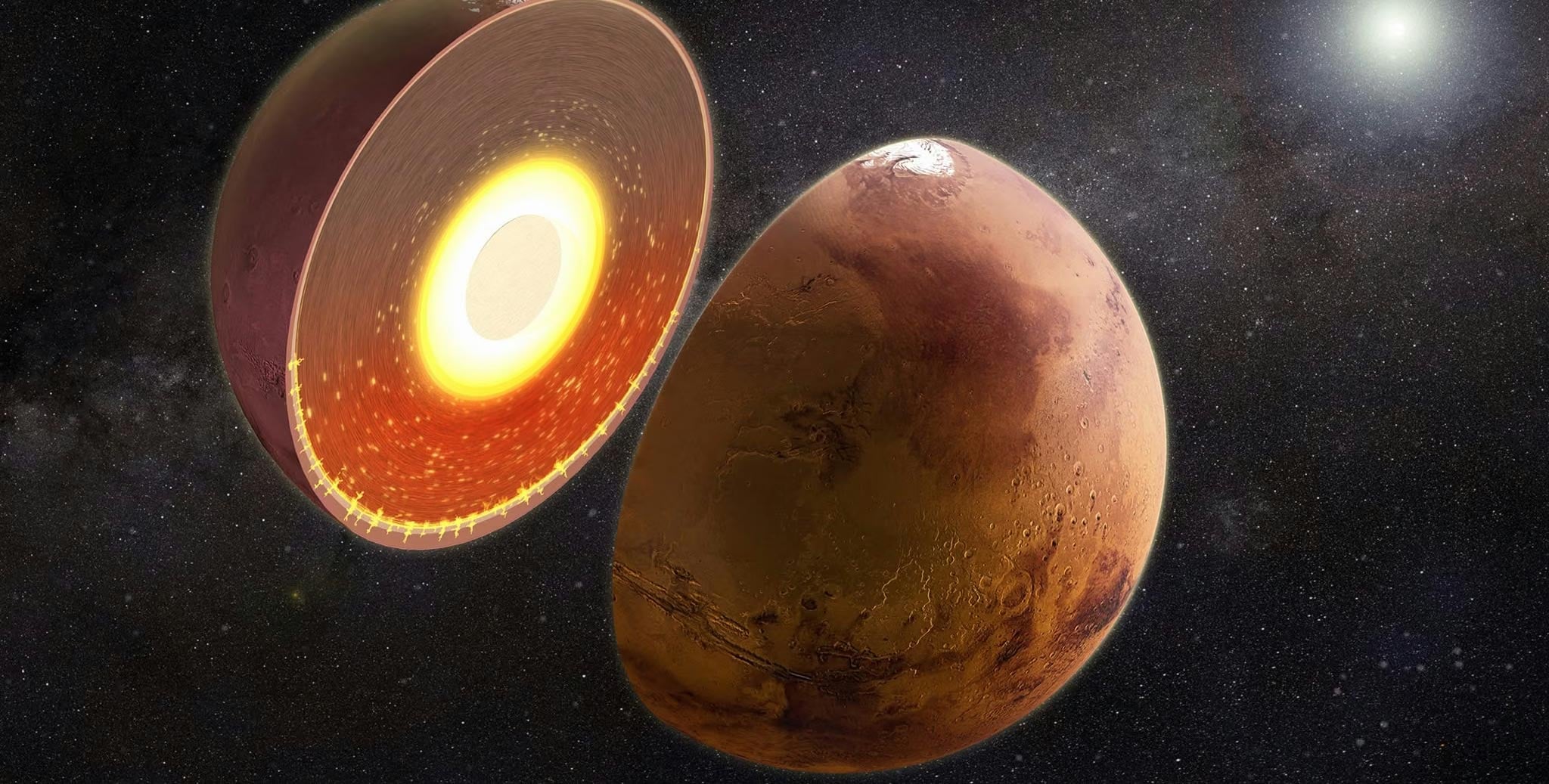
Scientists have found a vast hidden heat imbalance inside Mars, with the southern interior hundreds of degrees hotter than the north and possibly partially molten.
Scientists have discovered a major temperature imbalance deep inside Mars, with the planet’s southern interior appearing dramatically hotter than the north.
Gravity measurements suggest that the interior beneath Mars’s southern hemisphere is about 200 to 400 degrees Celsius warmer than the northern half and is partially molten. The unexpected finding provides new clues about the Red Planet’s geological history and about periods when Mars may have had conditions capable of supporting life.
The research was led by Caltech alumnus Alexander Berne (PhD ’26), now a postdoctoral associate at the University of Arizona. The findings were published August 27 in the journal Nature.
Gravity Reveals What Lies Inside Mars
While completing his graduate studies at Caltech, Berne developed a model that uses small variations in gravity to infer the hidden structure inside a planetary body. He and his collaborators later applied the method to Mars.
The researchers analyzed decades of observations from three missions—Mars Global Surveyor, Mars Odyssey, and Mars Reconnaissance Orbiter. They tracked extremely small changes in the velocities of the spacecraft and used those measurements to reconstruct Mars’s gravitational field.
The Sun’s gravitational pull on Mars changes over seasonal timescales because the planet follows a slightly elliptical orbit and rotates on a tilted axis. A method known as tidal tomography examines how those gravitational effects change over time. Those measurements can then be used to build a model of the planet’s interior.
“Scientists usually assume that the interiors of planetary bodies are generally spherically symmetric, but this is not necessarily true,” Berne says. “As we get more gravity data, we can determine the three-dimensional intricacies of a planet’s interior structure. These inferences in turn give us a blueprint for designing future missions and scientific exploration of these worlds. Understanding the interior structure of planetary bodies helps us unravel the processes that shaped their formation and evolution.”
Mars Is Uneven on the Surface and Below
Scientists have long known that Mars looks very different from north to south. Its southern hemisphere is dominated by high terrain, mountains, and heavily cratered landscapes, while much of the northern hemisphere consists of lower and flatter plains.
The new results indicate that this dramatic contrast continues far beneath the surface. Mars’s interior is also thermally asymmetric—the southern hemisphere is hundreds of degrees hotter than the north.
That discovery may help scientists explain several other unusual observations on Mars.
Hidden Heat Could Explain Martian Mysteries
Iron-rich minerals in the southern hemisphere contain unusual magnetic signatures. A major thermal anomaly in the southern mantle could indicate that Mars once had a magnetic field strong enough to produce differences in magnetism between the planet’s northern and southern regions.
The findings may also help explain results from NASA’s InSight mission. InSight previously found that seismic waves lose energy more quickly in the south. A hotter interior could account for that behavior because temperature affects how seismic energy travels through planetary material.
“The dichotomy that we see between north and south is important to understand because it gives information about processes that may have influenced the hydrology of Mars, including the formation of basins that may have held water,” says Amirhossein Bagheri, a postdoctoral scholar at Caltech and co-author on the paper. Bagheri is also a former member of the InSight team.
Understanding this north-south difference could therefore provide clues not only about Mars’s interior, but also about how water once moved across the planet and where it may have collected.
What Made Southern Mars So Hot?
Scientists do not yet know what produced the thermal anomaly.
Several possible explanations remain under consideration. One involves a giant impact that released heat from the north. Another possibility is that spontaneous convection occurred in the southern Martian mantle in the past. Thick geological structures could also have prevented heat from escaping efficiently, allowing excess warmth to remain trapped below the surface.
Determining which process was responsible could help researchers reconstruct major events in Mars’s geological evolution.
Reference: “Tidal tomography reveals a thermal anomaly beneath Mars’s crustal dichotomy” by Alexander Berne, Nicholas Wagner, Isamu Matsuyama, Sander Goossens, Antonio Genova, Marc Rovira-Navarro, Amirhossein Bagheri, Chuan Qin, Angela Marusiak, Douglas Hemingway, Harriet C. P. Lau, Kar Wai Cheng, Shijie Zhong and Francis Nimmo, 26 August 2026, Nature.
DOI: 10.1038/s41586-026-10893-x
In addition to Berne and Bagheri, co-authors are Nicholas Wagner and Harriet Lau of Brown University, Isamu Matsuyama and Angela Marusiak of the University of Arizona, Sander Goossens of NASA Goddard Space Flight Center, Karwai Cheng of the Institute of Astronomy and Astrophysics at Academia Sinica in Taiwan, Antonio Genova of the University of Rome in Italy, Marc Rovira-Navarro of the Delft University of Technology in the Netherlands, Chuan Qin of UCLA, Douglas Hemingway of the University of Texas at Austin, Shijie Zhong of the University of Colorado Boulder, and Francis Nimmo of UC Santa Cruz.
Funding was provided by NASA.
Never miss a breakthrough: Join the SciTechDaily newsletter.
Follow us on Google and Google News.
1 Comment
Shows what a wound happened to the whole of the north