

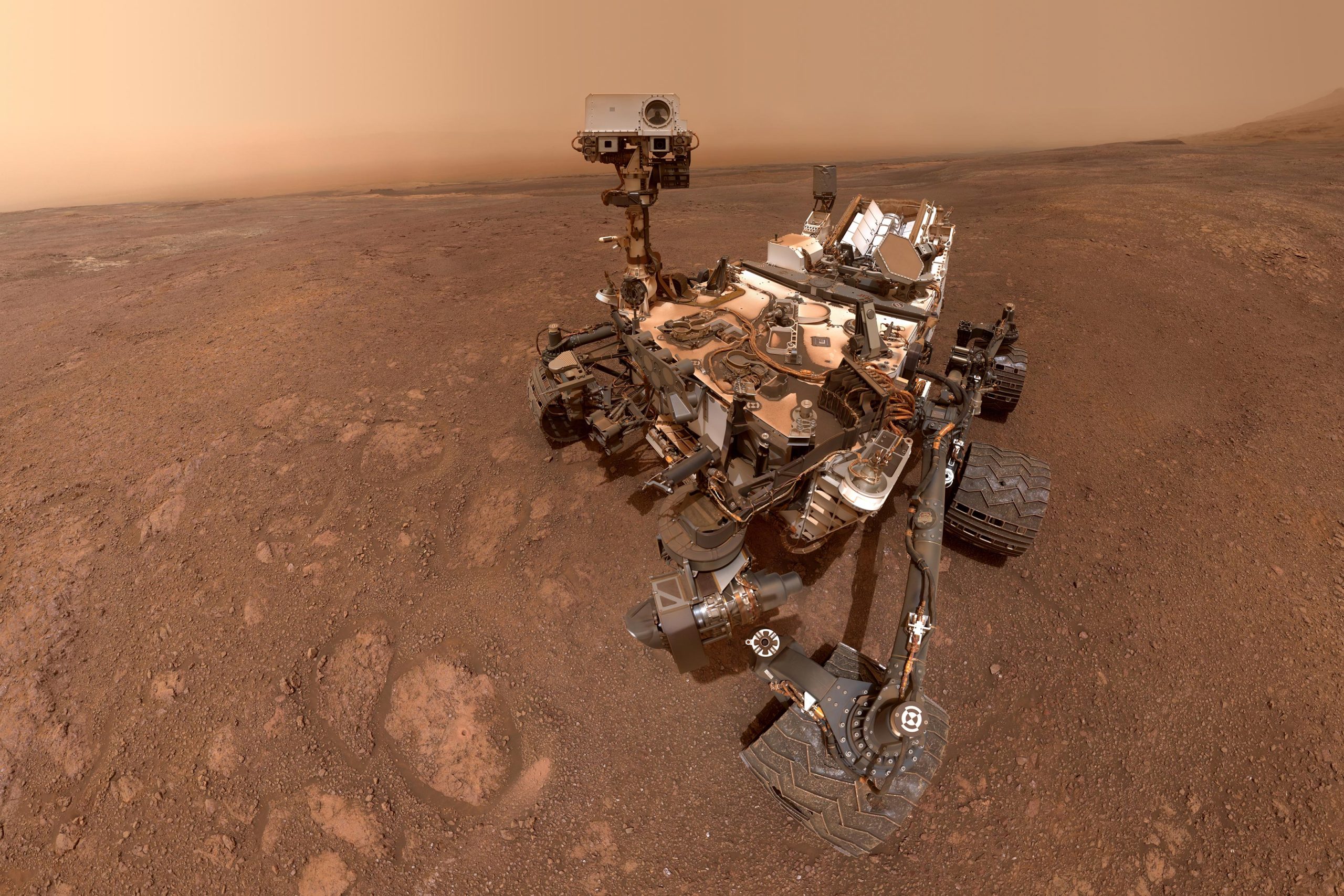
An analysis led by the University of Chicago of Mars Science Laboratory Curiosity rover data may explain why the planet was likely a harsh desert for most of its recent past.
One of the major unanswered questions in planetary science is clearly etched into the Martian landscape.
The deep canyons on Mars, shaped by ancient rivers, indicate that the planet was once warm enough to support flowing liquid water. But how did it transform into the cold, dry desert we see today? And what caused this dramatic shift?
A new study led by Edwin Kite, a planetary scientist at the University of Chicago, offers a new explanation for this long-standing mystery. Published in Nature on July 2, the research presents a model suggesting that Mars experienced temporary warm periods triggered by gradual increases in the sun’s brightness. However, due to the planet’s unique conditions, these warm phases were short-lived, and Mars consistently reverted to its dry, inhospitable state. Unlike Earth, which has remained steadily habitable, Mars appears to follow a natural pattern that favors desert-like conditions over time.
The study builds on findings from NASA’s Mars Science Laboratory Curiosity mission that were announced in April: the rover finally found rocks rich in carbonate minerals, which could explain where Mars’ atmosphere went.
“For years, we’ve had this huge unanswered question for why Earth has managed to keep its habitability while Mars lost it,” said Kite, an associate professor of geophysical sciences who is a participating scientist for the Curiosity mission. “Our models suggest that periods of habitability on Mars have been the exception, rather than the rule, and that Mars generally self-regulates as a desert planet.”
A ‘golden age’ of Mars science
Mars has almost the same makeup as Earth—it’s a rocky planet, with plenty of carbon and water, near enough to the sun to be warmed but not cooked by it—and yet today it’s a frozen desert, while Earth teems with life. For years, scientists have been searching for an answer to why you are reading this from Earth and not Mars.
The mystery deepened when we were able to see river-carved valleys and old lakebeds on the surface of Mars, showing the planet at some point did have a climate that was warm enough for liquid water.
“Fortunately, Mars preserves a trace of that environmental catastrophe in the rocks on its surface,” Kite said. “And today we’re in a golden age of Mars science, with two plutonium-powered rovers on the surface and an international fleet of spacecraft in orbit that allow us to deeply explore the planet for these traces.”
When it comes to keeping a planet balmy and mild, it isn’t enough just to start out that way—there need to be mechanisms for stability over time that can respond to changes on and around the planet.
Scientists think that Earth does this through a finely balanced system that moves carbon from sky to rock and back again. Carbon dioxide in the atmosphere warms the planet, but warmer temperatures also speed up reactions that lock up carbon dioxide into rock, which eventually counteracts the temperature rise. Eventually, carbon leaks back out into the atmosphere via volcanic eruptions. Over millions of years, this cycle appears to have kept Earth relatively stable and hospitable for life.
On Mars, the researchers suggested, a similar cycle could also take place—but a self-limiting one.
It hinges on the fact that our sun’s brightness rises very, very slowly over time—about 8 percent per billion years. As the sun brightens, the scientists hypothesize, liquid water begins running on Mars. But then this water starts causing carbon dioxide to get locked into rocks, as it does on Earth, which swings the planet back to cold and barren desert.
“In contrast to Earth, where there are always some volcanoes erupting, Mars right now is volcanically dormant, and the average rate of volcanic outgassing on Mars is slow,” explained Kite. “So in that situation, you don’t really have a balance between carbon dioxide in and carbon dioxide out, because if you have even a little bit of liquid water, you’re going to draw down carbon dioxide through carbonate formation.”
The group built extensive models showing how these swings could happen. They suggest that Mars experiences short periods of liquid water, followed by 100-million-year-long periods of desert. Needless to say, a 100-million-year-long gap in habitability is bad for life.
A Martian mystery
The explanation was made possible by Curiosity’s discovery, announced earlier this year, of carbonate-rich rocks on Mars’ surface. This had been a missing piece of the puzzle for years, the scientists explained.
To have had liquid water, Mars had to have a thicker atmosphere made up of a greenhouse gas like carbon dioxide. But today there’s very little atmosphere, leaving a puzzle of where the carbon went.
“People have been looking for a tomb for the atmosphere for years,” said Kite.
The simplest explanation would be that it was drawn down into rocks, as it is on Earth, but the first rover tests hadn’t turned up any evidence of carbonate-rich rocks.
It took Curiosity’s journey up a Martian mountain named Mt. Sharp to finally find these carbonate rocks. As it continues, further tests will show whether the carbonate is as widespread as researchers suspect.
“It really is something you cannot know until you have a rover on the surface,” said study coauthor Benjamin Tutolo, a professor at the University of Calgary. “The chemistry and mineralogy measurements they provide really are essential in our continuing quest to understand how and why planets stay habitable, in order to search for other hospitable worlds out in the universe.”
Reference: “Carbonate formation and fluctuating habitability on Mars” by Edwin S. Kite, Benjamin M. Tutolo, Madison L. Turner, Heather B. Franz, David G. Burtt, Thomas F. Bristow, Woodward W. Fischer, Ralph E. Milliken, Abigail A. Fraeman and Daniel Y. Zhou, 2 July 2025, Nature.
DOI: 10.1038/s41586-025-09161-1
UChicago postdoctoral researcher Madison L. Turner was also a co-author on the study, in addition to co-authors with the University of Calgary, NASA Goddard Space Flight Center, NASA Ames Research Center, California Institute of Technology, Brown University, and the Jet Propulsion Laboratory.
Never miss a breakthrough: Join the SciTechDaily newsletter.
Follow us on Google and Google News.
8 Comments
Must go Mars & restart cycle, cobble Colonia Martialis, prohibit Fascism.
What has that got to do with Mars history? And, assuming the model is correct, the water is gone.
Mars does not currently have a global magnetosphere like Earth. A huge contributing factor ! Also, given Mars’ extremely thin atmosphere—only about 1% of Earth’s—a glass of water would begin to boil at temperatures as low as 50°F (10°C).
Hardly ground breaking news. Basically, high school science !
That was not a significant part of the model. It was the relatively low frequency of volcanoes that did the difference.
This seems like an agenda searching for supporting crumbs of support. These maroons gotta go.
You mean the comment morons that seem to have an agenda searching for ways to criticize science? Yes, they should preferably go away.
I work with automated machinery and just the complexity of it all is so great. Maybe NASA could use and old school electrician to help with the job of building the next rover. Nice article.
I’m still wondering how Rover snaps a selfie with clearly no part of him holding camera which must be behind the view!!!