
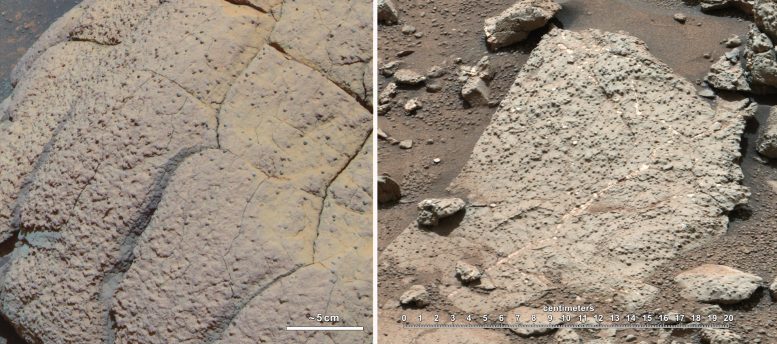
Researchers have identified sulfur, nitrogen, hydrogen, oxygen, phosphorus, and carbon in the powder rock sample obtained by NASA’s Curiosity rover, suggesting that Mars could have supported life.
An analysis of a rock sample collected by NASA’s Curiosity rover shows ancient Mars could have supported living microbes.
Scientists identified sulfur, nitrogen, hydrogen, oxygen, phosphorus, and carbon — some of the key chemical ingredients for life — in the powder Curiosity drilled out of a sedimentary rock near an ancient stream bed in Gale Crater on the Red Planet last month.
“A fundamental question for this mission is whether Mars could have supported a habitable environment,” said Michael Meyer, lead scientist for NASA’s Mars Exploration Program at the agency’s headquarters in Washington. “From what we know now, the answer is yes.”
Clues to this habitable environment come from data returned by the rover’s Sample Analysis at Mars (SAM) and Chemistry and Mineralogy (CheMin) instruments. The data indicate the Yellowknife Bay area the rover is exploring was the end of an ancient river system or an intermittently wet lake bed that could have provided chemical energy and other favorable conditions for microbes. The rock is made up of a fine-grained mudstone containing clay minerals, sulfate minerals and other chemicals. This ancient wet environment, unlike some others on Mars, was not harshly oxidizing, acidic or extremely salty.
The patch of bedrock where Curiosity drilled for its first sample lies in an ancient network of stream channels descending from the rim of Gale Crater. The bedrock also is fine-grained mudstone and shows evidence of multiple periods of wet conditions, including nodules and veins.
Curiosity’s drill collected the sample at a site just a few hundred yards away from where the rover earlier found an ancient streambed in September 2012.
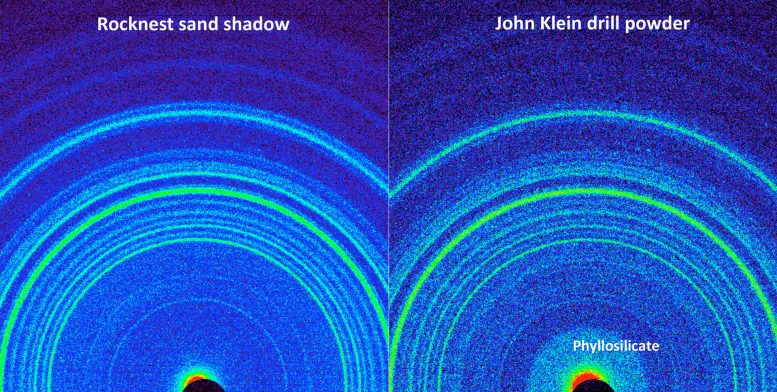
“Clay minerals make up at least 20 percent of the composition of this sample,” said David Blake, principal investigator for the CheMin instrument at NASA’s Ames Research Center in Moffett Field, California.
These clay minerals are a product of the reaction of relatively fresh water with igneous minerals, such as olivine, also present in the sediment. The reaction could have taken place within the sedimentary deposit, during transport of the sediment, or in the source region of the sediment. The presence of calcium sulfate along with the clay suggests the soil is neutral or mildly alkaline.
Scientists were surprised to find a mixture of oxidized, less-oxidized, and even non-oxidized chemicals, providing an energy gradient of the sort many microbes on Earth exploit to live. This partial oxidation was first hinted at when the drill cuttings were revealed to be gray rather than red.
“The range of chemical ingredients we have identified in the sample is impressive, and it suggests pairings such as sulfates and sulfides that indicate a possible chemical energy source for micro-organisms,” said Paul Mahaffy, principal investigator of the SAM suite of instruments at NASA’s Goddard Space Flight Center in Greenbelt, Maryland.
An additional drilled sample will be used to help confirm these results for several of the trace gases analyzed by the SAM instrument.
“We have characterized a very ancient, but strangely new ‘gray Mars’ where conditions once were favorable for life,” said John Grotzinger, Mars Science Laboratory project scientist at the California Institute of Technology in Pasadena, California. “Curiosity is on a mission of discovery and exploration, and as a team we feel there are many more exciting discoveries ahead of us in the months and years to come.”
Scientists plan to work with Curiosity in the “Yellowknife Bay” area for many more weeks before beginning a long drive to Gale Crater’s central mound, Mount Sharp. Investigating the stack of layers exposed on Mount Sharp, where clay minerals and sulfate minerals have been identified from orbit, may add information about the duration and diversity of habitable conditions.
NASA’s Mars Science Laboratory Project has been using Curiosity to investigate whether an area within Mars’ Gale Crater ever has offered an environment favorable for microbial life. Curiosity, carrying 10 science instruments, landed seven months ago to begin its two-year prime mission. NASA’s Jet Propulsion Laboratory in Pasadena, California, manages the project for NASA’s Science Mission Directorate in Washington.
Never miss a breakthrough: Join the SciTechDaily newsletter.
Follow us on Google and Google News.