
Close Menu
    Facebook X (Twitter) Instagram
    SciTechDaily
    • Biology
    • Chemistry
    • Earth
    • Health
    • Physics
    • Science
    • Space
    • Technology
    Facebook X (Twitter) Pinterest YouTube RSS
    SciTechDaily
    Home»Space»NASA’s Curiosity Rover Drills and Collects First Martian Bedrock Sample
    Space

    NASA’s Curiosity Rover Drills and Collects First Martian Bedrock Sample

    By JPLFebruary 11, 2013No Comments4 Mins Read
    Facebook Twitter Pinterest Telegram LinkedIn WhatsApp Email Reddit
    Share
    Facebook Twitter LinkedIn Pinterest Telegram Email Reddit
    Curiosity-Collects-First-Martian-Bedrock-Sample
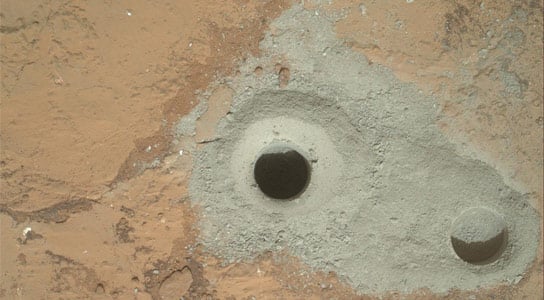
    At the center of this image from NASA’s Curiosity rover is the hole in a rock called “John Klein” where the rover conducted its first sample drilling on Mars. The drilling took place on February 8, 2013, or Sol 182, Curiosity’s 182nd Martian day of operations. Several preparatory activities with the drill preceded this operation, including a test that produced the shallower hole on the right two days earlier, but the deeper hole resulted from the first use of the drill for rock sample collection. Credit: NASA/JPL-Caltech/MSSS

    New images show that NASA’s Curiosity rover has successfully drilled and collected a rock powder sample from the Martian bedrock to be analyzed.

    NASA’s Curiosity rover has, for the first time, used a drill carried at the end of its robotic arm to bore into a flat, veiny rock on Mars and collect a sample from its interior. This is the first time any robot has drilled into a rock to collect a sample on Mars.

    The fresh hole, about 0.63 inch (1.6 centimeters) wide and 2.5 inches (6.4 centimeters) deep in a patch of fine-grained sedimentary bedrock, can be seen in images and other data Curiosity beamed to Earth Saturday. The rock is believed to hold evidence about long-gone wet environments. In pursuit of that evidence, the rover will use its laboratory instruments to analyze rock powder collected by the drill.

    “The most advanced planetary robot ever designed is now a fully operating analytical laboratory on Mars,” said John Grunsfeld, NASA associate administrator for the agency’s Science Mission Directorate. “This is the biggest milestone accomplishment for the Curiosity team since the sky-crane landing last August, another proud day for America.”
    Curiosity-rover's-drill-in-action
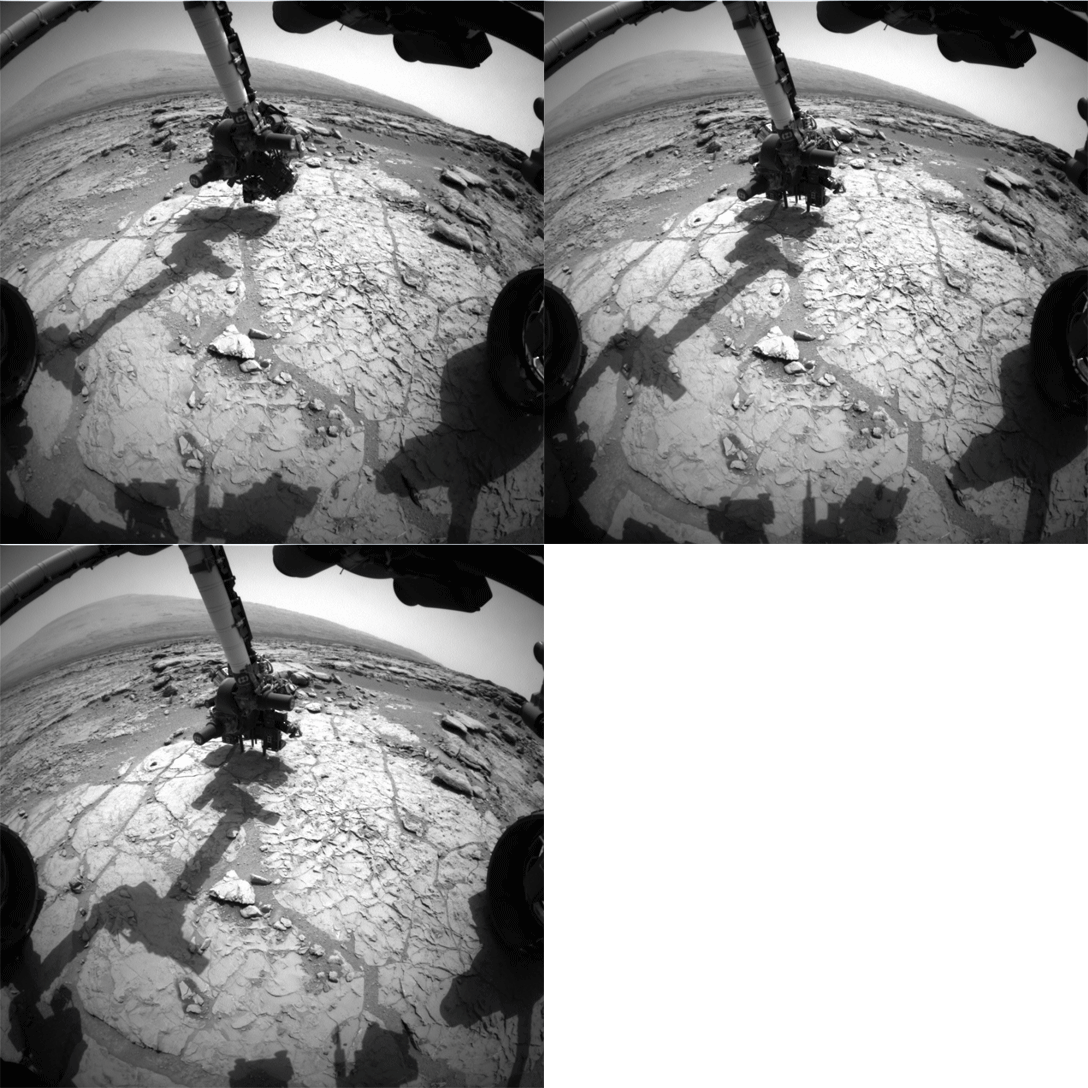
    An animated set of three images from NASA’s Curiosity rover shows the rover’s drill in action on February 8, 2013, or Sol 182, Curiosity’s 182nd Martian day of operations. This was the first use of the drill for rock sample collection. The target was a rock called “John Klein,” in the Yellowknife Bay region of Gale Crater on Mars. Credit: NASA/JPL-Caltech

    For the next several days, ground controllers will command the rover’s arm to carry out a series of steps to process the sample, ultimately delivering portions to the instruments inside.

    “We commanded the first full-depth drilling, and we believe we have collected sufficient material from the rock to meet our objectives of hardware cleaning and sample drop-off,” said Avi Okon, drill cognizant engineer at NASA’s Jet Propulsion Laboratory, Pasadena, California.

    Rock powder generated during drilling travels up flutes on the bit. The bit assembly has chambers to hold the powder until it can be transferred to the sample-handling mechanisms of the rover’s Collection and Handling for In-Situ Martian Rock Analysis (CHIMRA) device.

    Before the rock powder is analyzed, some will be used to scour traces of material that may have been deposited onto the hardware while the rover was still on Earth, despite thorough cleaning before launch.

    “We’ll take the powder we acquired and swish it around to scrub the internal surfaces of the drill bit assembly,” said JPL’s Scott McCloskey, drill systems engineer. “Then we’ll use the arm to transfer the powder out of the drill into the scoop, which will be our first chance to see the acquired sample.”

    “Building a tool to interact forcefully with unpredictable rocks on Mars required an ambitious development and testing program,” said JPL’s Louise Jandura, chief engineer for Curiosity’s sample system. “To get to the point of making this hole in a rock on Mars, we made eight drills and bored more than 1,200 holes in 20 types of rock on Earth.”

    Inside the sample-handling device, the powder will be vibrated once or twice over a sieve that screens out any particles larger than six-thousandths of an inch (150 microns) across. Small portions of the sieved sample will fall through ports on the rover deck into the Chemistry and Mineralogy (CheMin) instrument and the Sample Analysis at Mars (SAM) instrument. These instruments then will begin the much-anticipated detailed analysis.

    The rock Curiosity drilled is called “John Klein” in memory of a Mars Science Laboratory deputy project manager who died in 2011. Drilling for a sample is the last new activity for NASA’s Mars Science Laboratory Project, which is using the car-size Curiosity rover to investigate whether an area within Mars’ Gale Crater has ever offered an environment favorable for life.

    JPL manages the project for NASA’s Science Mission Directorate in Washington.

    Never miss a breakthrough: Join the SciTechDaily newsletter.
    Follow us on Google and Google News.

    Astronomy Curiosity Rover JPL Mars NASA Planetary Science Popular
    Share. Facebook Twitter Pinterest LinkedIn Email Reddit

    Related Articles

    Curiosity Fails to Detect Methane on Mars

    Curiosity Discovers More Hydration of Minerals Near Clay-Bearing Rocks

    NASA Completes Computer Swap for Curiosity Rover

    Mineralogy of Martian Soil Is Similar to Soils of Volcanic Origin in Hawaii

    Curiosity Prepares to Take Its First Scoop of Soil for Analysis

    Curiosity Finds Ancient Streambed on Mars

    NASA’s Curiosity Readies for First Drive on Mars

    Color HiRISE Image of Curiosity Rover on Mars

    Mission Engineers Prepare for Curiosity’s Landing on Mars

    Leave A Reply Cancel Reply

    • Facebook
    • Twitter
    • Pinterest
    • YouTube

    Don't Miss a Discovery

    Subscribe for the Latest in Science & Tech!

    Trending News

    Artificial Sweeteners May Harm Future Generations, Study Suggests

    Splashdown! NASA Artemis II Returns From Record-Breaking Moon Mission

    What If Consciousness Exists Beyond Your Brain

    Scientists Finally Crack the 100-Million-Year Evolutionary Mystery of Squid and Cuttlefish

    Beyond “Safe Levels”: Study Challenges What We Know About Pesticides and Cancer

    Researchers Have Found a Dietary Compound That Increases Longevity

    Scientists Baffled by Bizarre “Living Fossil” From 275 Million Years Ago

    Your IQ at 23 Could Predict Your Wealth at 27, Study Finds

    Follow SciTechDaily
    • Facebook
    • Twitter
    • YouTube
    • Pinterest
    • Newsletter
    • RSS
    SciTech News
    • Biology News
    • Chemistry News
    • Earth News
    • Health News
    • Physics News
    • Science News
    • Space News
    • Technology News
    Recent Posts
    • Scientists Break Optical Limits With Quantum Dot-Powered Nanoscopy
    • Scientists Shrink a Lab Spectrometer to the Size of a Grain of Sand
    • Quantum Reality Gets Stranger: Physicists Put a Lump of Metal in Two Places at Once
    • 34-Million-Year-Old Snake Found in Wyoming Rewrites Our Understanding of Evolution
    • Prehistoric “Vomit Fossil” Reveals Never-Before-Seen Flying Reptile
    Copyright © 1998 - 2026 SciTechDaily. All Rights Reserved.
    • Science News
    • About
    • Contact
    • Editorial Board
    • Privacy Policy
    • Terms of Use

    Type above and press Enter to search. Press Esc to cancel.