
Discovery of a Lystrosaurus embryo inside an egg proves early mammal relatives laid eggs and survived mass extinction through rapid development and resilient reproductive strategies.
A new fossil discovery is offering fresh insight into one of Earth’s most remarkable survival stories while resolving a long-standing mystery. Lystrosaurus, a tough, plant-eating ancestor of mammals, became widespread after the End-Permian Mass Extinction around 252 million years ago.
This event was the most severe extinction in Earth’s history. While many species disappeared, Lystrosaurus endured and even flourished despite extreme heat, environmental instability, and long periods of drought.
New research published in PLOS ONE has now revealed a finding that reshapes how scientists understand this species. An international team led by Professor Julien Benoit, Professor Jennifer Botha (Evolutionary Studies Institute, University of the Witwatersrand, South Africa), and Dr. Vincent Fernandez (ESRF—The European Synchrotron, France) identified an egg containing a Lystrosaurus embryo dating to about 250 million years ago.
This is the first confirmed egg ever found from a mammal ancestor, answering a long-standing question: Did the ancestors of mammals lay eggs?
The answser is a clear yes.
First Evidence of Egg-Laying in Mammal Ancestors
Researchers believe these eggs were soft-shelled, which explains why they have rarely been preserved. Unlike the hard, mineralized eggs of dinosaurs that fossilize more easily, soft-shelled eggs are much less likely to survive over time. This makes the discovery especially rare and important, with implications that extend beyond reproduction.
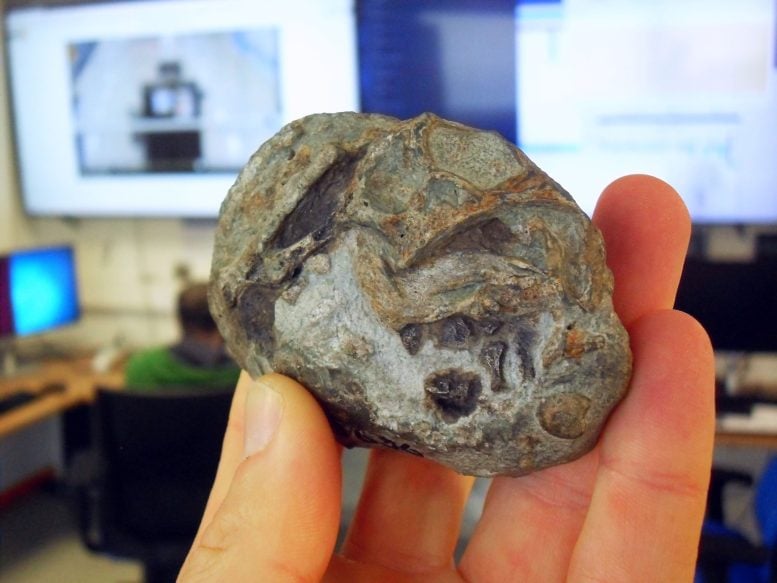
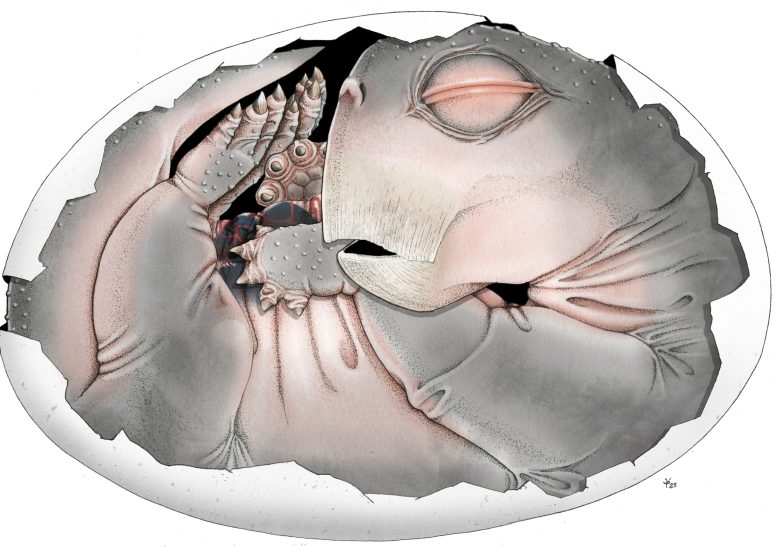
“This fossil was discovered during a field excursion I led in 2008, nearly 17 years ago. My preparator and exceptional fossil finder, John Nyaphuli, identified a small nodule that at first revealed only tiny flecks of bone. As he carefully prepared the specimen, it became clear that it was a perfectly curled-up Lystrosaurus hatchling. I suspected even then that it had died within the egg, but at the time, we simply didn’t have the technology to confirm it,” says Professor Botha.
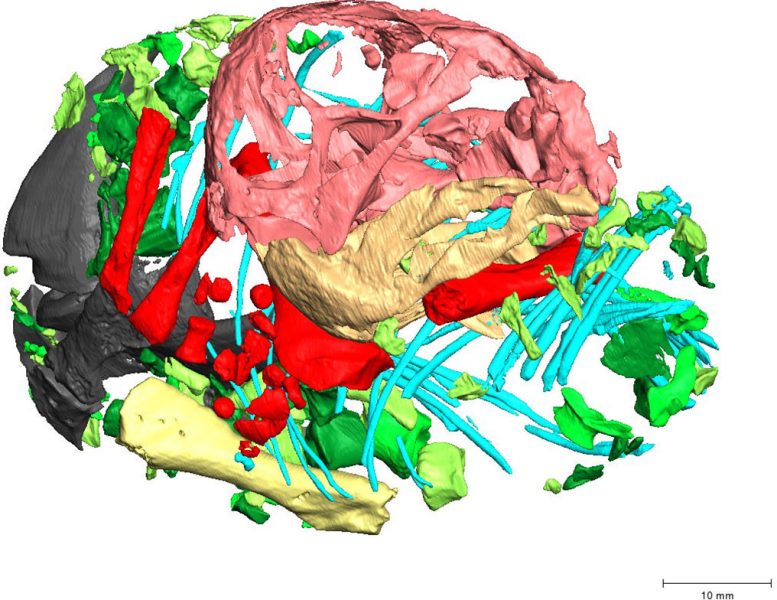
Using advanced synchrotron X-ray CT scanning at the ESRF, researchers were finally able to examine the fossil in detail. Dr. Fernandez described the process as exciting: “Understanding reproduction in mammal ancestors has been a long-lasting enigma, and this fossil provides a key piece to this puzzle. It was essential that we scanned the fossil just right to capture the level of detail needed to resolve such tiny, delicate bones.”
The scans revealed a key developmental feature. “When I saw the incomplete mandibular symphysis, I was genuinely excited,” says Professor Benoit. “The mandible, the lower jaw, is made up of two halves that must fuse before the animal can feed. The fact that this fusion had not yet occurred shows that the individual would have been incapable of feeding itself.”
Large Eggs, Precocial Young, and Fast-Reproduction Survival Strategy
The study indicates that Lystrosaurus produced relatively large eggs compared to its body size. In modern species, larger eggs contain more yolk, which provides enough nutrition for embryos to develop without needing care after hatching. This suggests Lystrosaurus did not feed its young with milk, unlike modern mammals. Larger eggs also resist drying, which would have been critical in the dry conditions after the extinction.
In this harsh environment, these traits likely improved survival. The research indicates that Lystrosaurus hatchlings were precocial, meaning they were born at a more advanced stage and could move, feed, and avoid predators soon after hatching. They likely reached reproductive maturity quickly.
In simple terms, Lystrosaurus succeeded through rapid growth and early reproduction.
This strategy proved highly effective in a struggling ecosystem. The discovery not only provides the first direct evidence of egg-laying in mammal ancestors but also helps explain why Lystrosaurus became so dominant after the extinction. It highlights how resilience, adaptability, and reproductive strategy played a central role in survival during one of Earth’s most challenging periods.
Scientific Significance and Insights Into Climate Resilience
“This research is important because it provides the first direct evidence that mammal ancestors, such as Lystrosaurus, laid eggs, resolving a long-standing question about the origins of mammalian reproduction. Beyond this fundamental insight, it reveals how reproductive strategies can shape survival in extreme environments: by producing large, yolk-rich eggs and precocial young, Lystrosaurus was able to thrive in the harsh, unpredictable conditions following the end-Permian mass extinction.”
“In a modern context, this work is highly impactful because it offers a deep-time perspective on resilience and adaptability in the face of rapid climate change and ecological crisis. Understanding how past organisms survived global upheaval helps scientists better predict how species today might respond to ongoing environmental stress, making this discovery not just a breakthrough in paleontology but also highly relevant to current biodiversity and climate challenges,” Julien Benoit explains.
Synchrotron Breakthrough and a Historic Paleontology Milestone
“The opportunity to work at the European Synchrotron Radiation Facility alongside beamline scientists was also an unforgettable part of the journey. The cutting-edge data we generated there allowed us to “see” inside the fossil in extraordinary detail, ultimately revealing that the embryo was still at a pre-hatching stage. That moment, when the pieces all came together, was incredibly rewarding.”
“What makes this work especially exciting is that we were able to quite literally follow in John Nyaphuli’s footsteps, returning to a specimen he discovered nearly two decades ago and finally solve the puzzle he uncovered. At the time, all we had was a beautifully curled embryo, but no preserved eggshell to prove it had died within an egg. Using modern imaging techniques, we were able to answer that question definitively,” says Jennifer Botha.
“It is also thrilling because this discovery breaks entirely new ground. For over 150 years of South African paleontology, no fossil had ever been conclusively identified as a therapsid egg. This is the first time we can say, with confidence, that mammal ancestors like Lystrosaurus laid eggs, making it a true milestone in the field.”
Reference: “The first non-mammalian synapsid embryo from the Triassic of South Africa” by Julien Benoit, Vincent Fernandez and Jennifer Botha, 9 April 2026, PLOS ONE.
DOI: 10.1371/journal.pone.0345016
This study was funded by the National Research Foundation’s African Origins Platform, Palaeontological Scientific Trust, and GENUS: DSTI-NRF Centre of Excellence in Palaeosciences.
Never miss a breakthrough: Join the SciTechDaily newsletter.
Follow us on Google and Google News.
3 Comments
What is the shell of an echidna like?
Size of a small grape, soft and leathery. It would be interesting to see one.
A speculative theory: Live births became smaller to avoid predation. so as to become more concealable. Internal production of nutriments supported the maintenance of the smaller (and smaller) young. Success of more concealable young was conserved, and shell-like evolution was the result of a modification of the embreo-protective internal constitution of the live-bearer, moving toward the production of a soft and shell-like protective feature that became able to be expelled and buried. Just a thought.