
Close Menu
    Facebook X (Twitter) Instagram
    SciTechDaily
    • Biology
    • Chemistry
    • Earth
    • Health
    • Physics
    • Science
    • Space
    • Technology
    Facebook X (Twitter) Pinterest YouTube RSS
    SciTechDaily
    Home»Science»Giant Ambush-Predator Worms May Have Colonized the Seafloor Around 20 Million Years Ago
    Science

    Giant Ambush-Predator Worms May Have Colonized the Seafloor Around 20 Million Years Ago

    By Scientific ReportsJanuary 21, 2021No Comments2 Mins Read
    Facebook Twitter Pinterest Telegram LinkedIn WhatsApp Email Reddit
    Share
    Facebook Twitter LinkedIn Pinterest Telegram Email Reddit
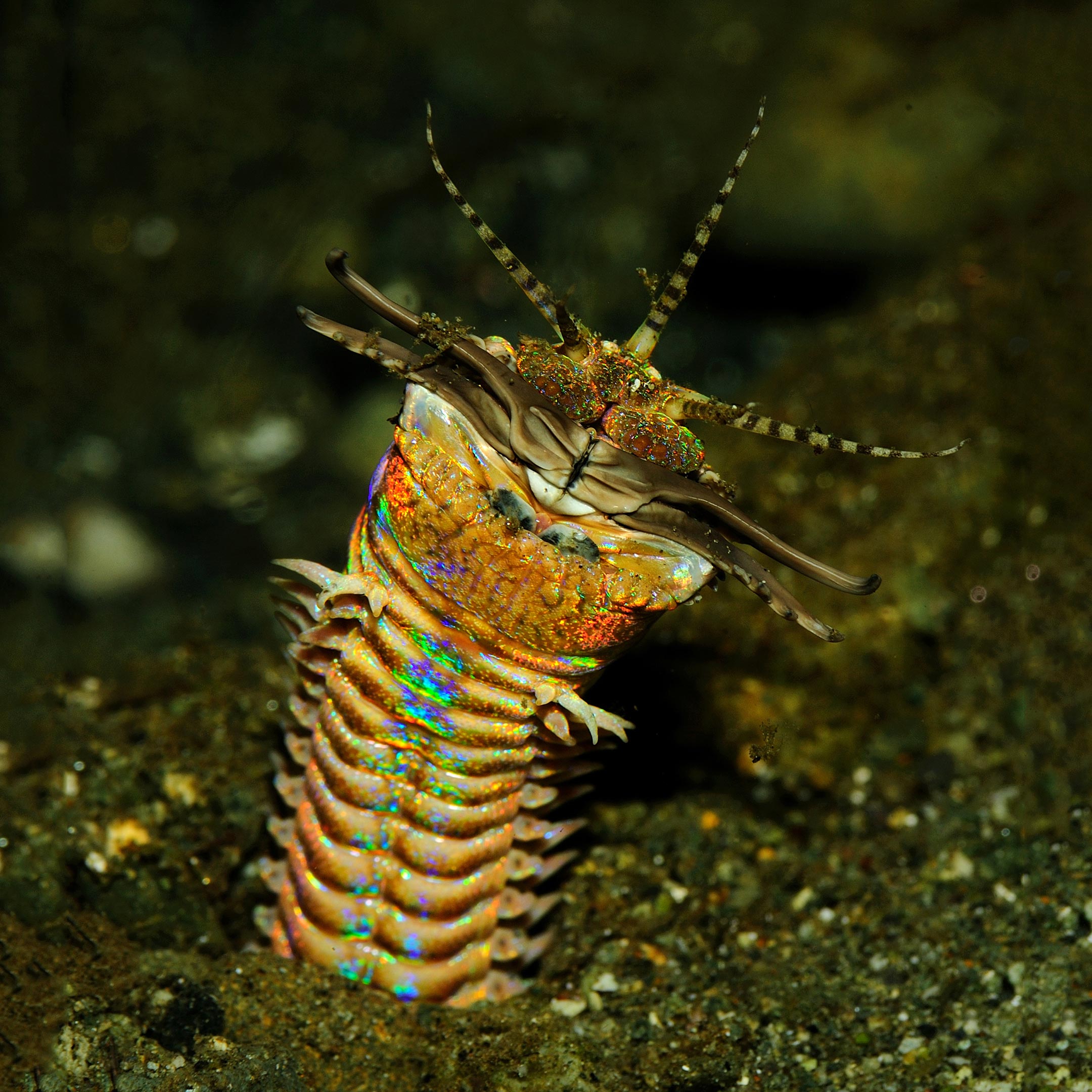
    Bobbit Worm
    Bobbit worm (Eunice aphroditois). Credit: Jenny – Flickr CC BY 2.0

    Fossil Burrows Point to Ancient Seafloor Colonization by Giant Marine Worms

    Giant ambush-predator worms, possible ancestors of the ‘bobbit worm’, may have colonized the seafloor of the Eurasian continent around 20 million years ago. The findings, based on the reconstruction of large, L-shaped burrows from layers of seafloor dating back to the Miocene (23 million to 5.3 million years ago) of northeast Taiwan, are reported in Scientific Reports this week.

    Ludvig Löwemark and colleagues reconstructed a new trace fossil, which they named Pennichnus formosae, using 319 specimens preserved within layers of seafloor formed during the Miocene era across northeast Taiwan. Trace fossils are geological features such as burrows, track marks, and plant root cavities preserved in rocks, which allow for conclusions to be drawn about the behavior of ancient organisms. The trace fossil consists of an L-shaped burrow, roughly 2 meters in length and 2-3 centimeters in diameter.

    Behavior Encoded in Burrows

    The morphology of Pennichnus suggests the burrows were likely inhabited by giant marine worms, such as the bobbit worm (Eunice aphroditois), which are still found today. Bobbit worms hide in long, narrow burrows within the seafloor and propel upwards to grab prey. The authors suggest that the retreat of an ancient worm and its prey into the sediment caused distinct feather-like collapse structures preserved in Pennichnus formosae, which are indicative of disturbance of the sediment surrounding the burrow. Further analysis revealed a high concentration of iron towards the top section of the burrow. The authors suggest this may indicate that the worm re-built its burrow by secreting mucus to strengthen the burrow wall, as bacteria that feed on mucus produced by marine invertebrates are known to create iron-rich environments.

    Although marine worms have existed since the early Palaeozoic, their bodies comprise mainly of soft tissue and are therefore rarely preserved. The trace fossil presented in the study is thought to be the first known fossil of this type produced by a sub-surface ambush predator. It provides a rare glimpse into these creatures’ behavior beneath the seafloor.

    Reference: “The 20-million-year old lair of an ambush-predatory worm preserved in northeast Taiwan” by Yu-Yen Pan, Masakazu Nara, Ludvig Löwemark, Olmo Miguez-Salas, Björn Gunnarson, Yoshiyuki Iizuka, Tzu-Tung Chen and Shahin E. Dashtgard, 21 January 2021, Scientific Reports.
    DOI: 10.1038/s41598-020-79311-0

    Never miss a breakthrough: Join the SciTechDaily newsletter.
    Follow us on Google and Google News.

    Evolution Fossils Marine Biology Paleontology Popular
    Share. Facebook Twitter Pinterest LinkedIn Email Reddit

    Related Articles

    Giant Ancient Shark Discovered in Australia Stuns Scientists

    Textbooks Were Wrong: 249-Million-Year-Old Fossil Discovery Upends Timeline of Evolution

    Mysterious Prehistoric “Sea Dragon” Discovered on English Channel Coast Is Identified As New Species

    Incredible Vision in Ancient “Radiating Teeth” Deep Sea Creatures Drove an Evolutionary Arms Race

    Night of the Living Algae: To Survive Asteroid Impact, Algae Learned to Hunt

    Solved: Mystery That’s Been Puzzling Scientists Since 1852 – Bizarre Giraffe-Necked Reptile Hunted Underwater

    MIT’s New Evidence on Dinosaur Evolution

    “Enigmatic and Strange” – 300-Million-Year-Old Fish Resembles a Sturgeon, but With Key Differences

    Ancient Sea-Worm Mystery Solved by Student After 50 Years in “Wastebasket”

    Leave A Reply Cancel Reply

    • Facebook
    • Twitter
    • Pinterest
    • YouTube

    Don't Miss a Discovery

    Subscribe for the Latest in Science & Tech!

    Trending News

    Breakthrough Bowel Cancer Trial Leaves Patients Cancer-Free for Nearly 3 Years

    Natural Compound Shows Powerful Potential Against Rheumatoid Arthritis

    100,000-Year-Old Neanderthal Fossils in Poland Reveal Unexpected Genetic Connections

    Simple “Gut Reset” May Prevent Weight Gain After Ozempic or Wegovy

    2.8 Days to Disaster: Scientists Warn Low Earth Orbit Could Suddenly Collapse

    Common Food Compound Shows Surprising Power Against Superbugs

    5 Simple Ways To Remember More and Forget Less

    The Atomic Gap That Could Cost the Semiconductor Industry Billions

    Follow SciTechDaily
    • Facebook
    • Twitter
    • YouTube
    • Pinterest
    • Newsletter
    • RSS
    SciTech News
    • Biology News
    • Chemistry News
    • Earth News
    • Health News
    • Physics News
    • Science News
    • Space News
    • Technology News
    Recent Posts
    • ADHD Isn’t Just a Deficit: Study Reveals Powerful Hidden Strengths
    • Scientists Uncover “Astonishing” Hidden Property of Light
    • Scientists Discover Stem Cells That Could Regrow Teeth and Bone
    • Scientists Discover Natural Molecule That Stops Alzheimer’s Protein Clumps From Forming
    • Early Cannabis Use May Stall Key Brain Skills in Teens
    Copyright © 1998 - 2026 SciTechDaily. All Rights Reserved.
    • Science News
    • About
    • Contact
    • Editorial Board
    • Privacy Policy
    • Terms of Use

    Type above and press Enter to search. Press Esc to cancel.