
Close Menu
    Facebook X (Twitter) Instagram
    SciTechDaily
    • Biology
    • Chemistry
    • Earth
    • Health
    • Physics
    • Science
    • Space
    • Technology
    Facebook X (Twitter) Pinterest YouTube RSS
    SciTechDaily
    Home»Space»First Direct Evidence of the Formation Process of Brown Dwarfs
    Space

    First Direct Evidence of the Formation Process of Brown Dwarfs

    By National Radio Astronomy ObservatoryAugust 1, 2015No Comments3 Mins Read
    Facebook Twitter Pinterest Telegram LinkedIn WhatsApp Email Reddit
    Share
    Facebook Twitter LinkedIn Pinterest Telegram Email Reddit
    New Study Shows Brown Dwarfs and Stars Share Formation Process
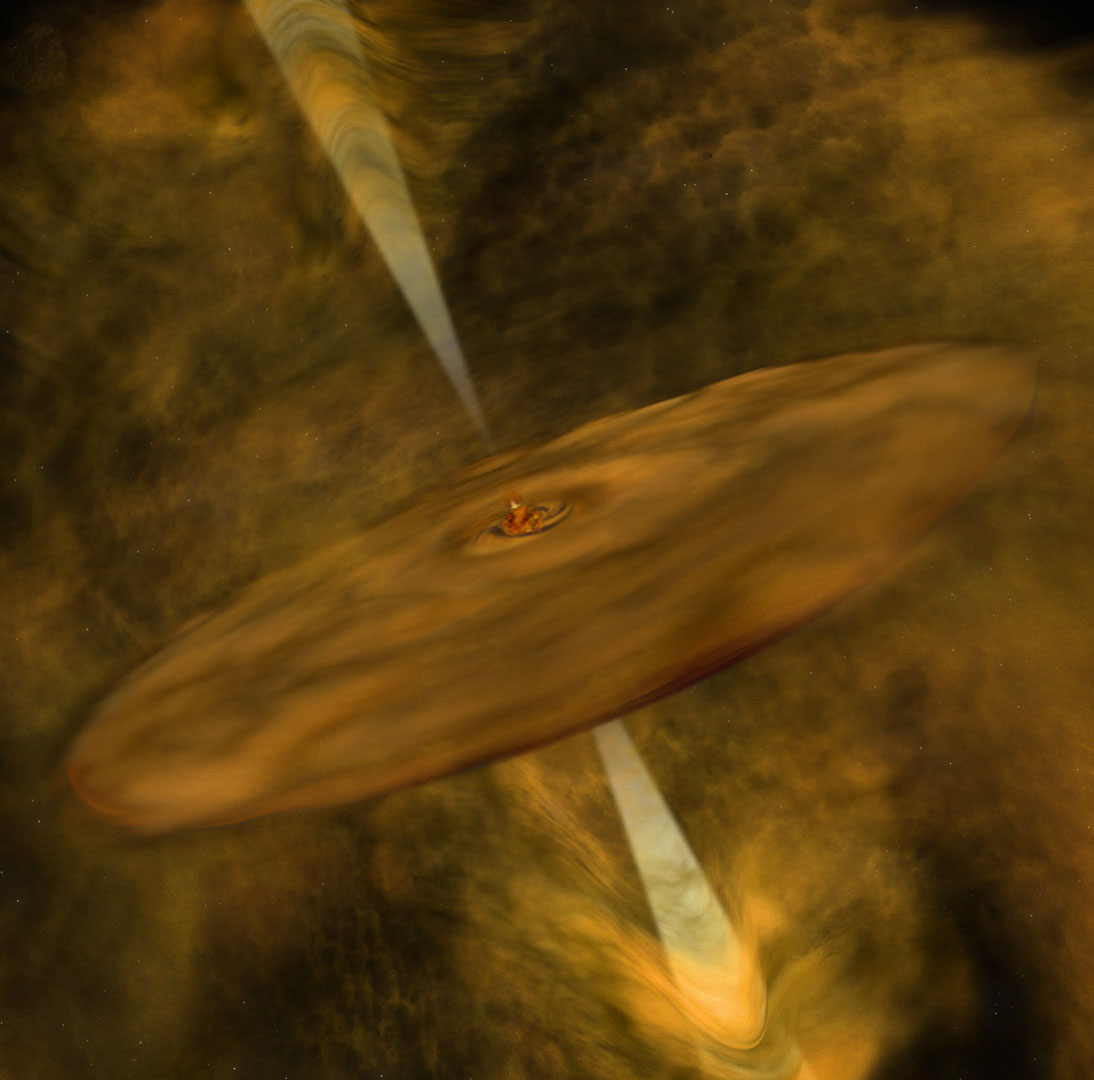
    Artist’s conception of a very young, still-forming brown dwarf, with a disk of material orbiting it, and jets of material ejected outward from the poles of the disk. Credit: Bill Saxton, NRAO/AUI/NSF

    Using the Very Large Array, an international team of astronomers has discovered jets of material ejected by still-forming young brown dwarfs, revealing the first direct evidence that brown dwarfs are produced by a scaled-down version of the same process that produces stars.

    The astronomers studied a sample of still-forming brown dwarfs in a star-forming region some 450 light-years from Earth in the constellation Taurus, and found that four of them have the type of jets emitted by more-massive stars during their formation. The jets were detected by radio observations with the VLA. The scientists also observed the brown dwarfs with the Spitzer and Herschel space telescopes to confirm their status as very young objects.

    “This is the first time that such jets have been found coming from brown dwarfs at such an early stage of their formation, and shows that they form in a way similar to that of stars,” said Oscar Morata, of the Institute of Astronomy and Astrophysics of the Academia Sinica in Taiwan. “These are the lowest-mass objects that seem to form the same way as stars,” he added.

    Brown dwarfs are less massive than stars, but more massive than giant planets such as Jupiter. They have insufficient mass to produce the temperatures and pressures at their cores necessary to trigger the thermonuclear reactions that power “normal” stars. Theorists suggested in the 1960s that such objects should exist, but the first unambiguous discovery of one did not come until 1994.

    A key question has been whether brown dwarfs form like stars or like planets. Stars form when a giant cloud of gas and dust in interstellar space collapses gravitationally, accumulating mass. A disk of orbiting material forms around the young star, and eventually planets form from the material in that disk. In the early stages of star formation, jets of material are propelled outward from the poles of the disk. No such jets mark planet formation, however.

    Previous evidence strongly suggested that brown dwarfs shared the same formation mechanism as their larger siblings, but detecting the telltale jets is an important confirmation. Based on this discovery, “We conclude that the formation of brown dwarfs is a scaled-down version of the process that forms larger stars,” Morata said.

    Morata led an international team of astronomers with members from Asia, Europe, and Latin America. They reported their findings in the Astrophysical Journal.

    Reference: “First Detection of Thermal Radiojets in a Sample of Proto-brown Dwarf Candidates” by Oscar Morata, Aina Palau, Ricardo F. González, Itziar de Gregorio-Monsalvo, Álvaro Ribas, Manuel Perger, Hervé Bouy, David Barrado, Carlos Eiroa, Amelia Bayo, Nuria Huélamo, María Morales-Calderón and Luís F. Rodríguez, 30 June 2015, The Astrophysical Journal.
    DOI: 10.1088/0004-637X/807/1/55

    Never miss a breakthrough: Join the SciTechDaily newsletter.
    Follow us on Google and Google News.

    Astronomy Astrophysics Brown Dwarf Herschel Space Observatory Karl G. Jansky Very Large Array National Radio Astronomy Observatory Spitzer Space Telescope
    Share. Facebook Twitter Pinterest LinkedIn Email Reddit

    Related Articles

    Astronomers Measure Wind Speed on a Brown Dwarf for the First Time

    “Halos” of Cosmic Rays and Magnetic Fields More Common Than Previously Thought

    Young Star Systems May Reveal How Our Own Solar System Came To Be

    Chandra Reveals a New Composite Image of NGC 4258

    Spitzer and WISE Discover Coldest Known Brown Dwarf

    New Research Boosts Binary-Star Formation Theory

    VLA Identifies Discrete Sources of Radio Waves Coming From Distant Galaxies

    Astronomers Discover Some of the Youngest Stars Ever Seen

    Using ALMA and VLA to Unveil Astronomical Mysteries

    Leave A Reply Cancel Reply

    • Facebook
    • Twitter
    • Pinterest
    • YouTube

    Don't Miss a Discovery

    Subscribe for the Latest in Science & Tech!

    Trending News

    Millions Take These IBS Drugs, But a New Study Finds Serious Risks

    Scientists Unlock Hidden Secrets of 2,300-Year-Old Mummies Using Cutting-Edge CT Scanner

    Bread Might Be Making You Gain Weight Even Without Eating More Calories

    Scientists Discover Massive Magma Reservoir Beneath Tuscany

    Europe’s Most Active Volcano Just Got Stranger – Here’s Why Scientists Are Rethinking It

    Alzheimer’s Symptoms May Start Outside the Brain, Study Finds

    Millions Take This Popular Supplement – Scientists Discover a Concerning Link to Heart Failure

    The Universe Is Expanding Too Fast and Scientists Can’t Explain Why

    Follow SciTechDaily
    • Facebook
    • Twitter
    • YouTube
    • Pinterest
    • Newsletter
    • RSS
    SciTech News
    • Biology News
    • Chemistry News
    • Earth News
    • Health News
    • Physics News
    • Science News
    • Space News
    • Technology News
    Recent Posts
    • Scientists Say a Hidden Structure May Exist Inside Earth’s Core
    • Doctors Surprised by the Power of a Simple Drug Against Colon Cancer
    • Why Popular Diabetes Drugs Like Ozempic Don’t Work for Everyone: The “Genetic Glitch”
    • Scientists Create Improved Insulin Cells That Reverse Diabetes in Mice
    • Scientists Stunned After Finding Plant Thought Extinct for 60 Years
    Copyright © 1998 - 2026 SciTechDaily. All Rights Reserved.
    • Science News
    • About
    • Contact
    • Editorial Board
    • Privacy Policy
    • Terms of Use

    Type above and press Enter to search. Press Esc to cancel.