
Close Menu
    Facebook X (Twitter) Instagram
    SciTechDaily
    • Biology
    • Chemistry
    • Earth
    • Health
    • Physics
    • Science
    • Space
    • Technology
    Facebook X (Twitter) Pinterest YouTube RSS
    SciTechDaily
    Home»Biology»A2A Adenosine Receptor May Be a Key to Multiple Sclerosis Treatment
    Biology

    A2A Adenosine Receptor May Be a Key to Multiple Sclerosis Treatment

    By Krishna Ramanujan, Cornell ChronicleJune 8, 2012No Comments3 Mins Read
    Facebook Twitter Pinterest Telegram LinkedIn WhatsApp Email Reddit
    Share
    Facebook Twitter LinkedIn Pinterest Telegram Email Reddit
    A2A Adenosine Receptor Central Nervous System
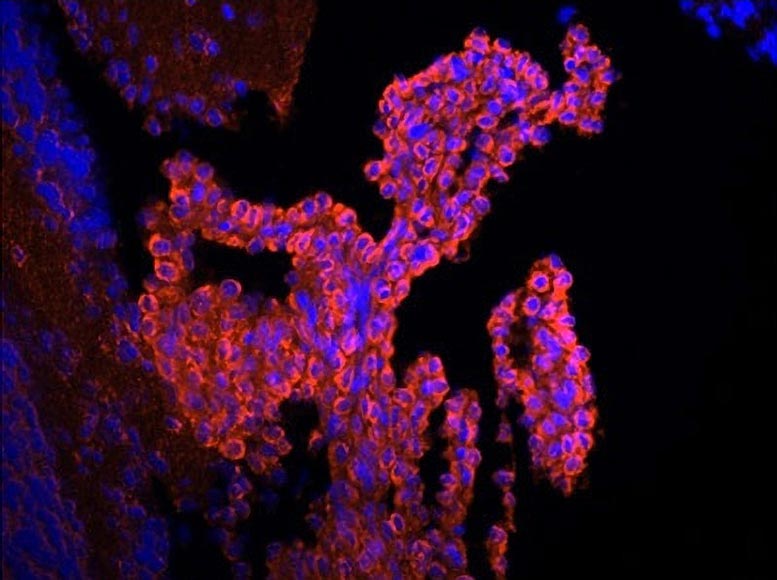
    This image shows the A2A adenosine receptor (in red) abundantly expressed in the central nervous system (CNS). The blue color identifies the nuclei of cells in the CNS. Credit: Bynoe Lab

    A newly published study from researchers at Cornell University shows how the A2A adenosine receptor expressed on blood-brain barrier cells acts as a gateway, allowing immune cells to enter the brain, where they can cause havoc in people with multiple sclerosis.

    A receptor recently discovered to control the movement of immune cells across central nervous system barriers (including the blood-brain barrier) may hold the key to treating multiple sclerosis (MS), a neuroinflammatory disease of the central nervous system.

    In MS, immune cells enter the central nervous system and attack and destroy the myelin sheath surrounding the axons of nerve cells in the brain and spinal cord, resulting in blindness, paralysis, incontinence, and many more symptoms.

    The research, appearing last month online and in print on June 1 in the Journal of Immunology, reveals how the A2A adenosine receptor expressed on blood-brain barrier cells acts as a gateway, allowing immune cells to enter the brain, where they can cause havoc in people with MS.

    The blood-brain barrier is composed of specialized cells that selectively prevent substances from passing from the bloodstream into the brain.

    “We found that expression of this A2A adenosine receptor is important for regulating the entry of cells into the brain; whereby its activation allows immune cell entry and its inhibition blocks entry,” said Margaret Bynoe, associate professor of immunology at Cornell’s College of Veterinary Medicine and senior author of the paper, which was also selected as a featured publication in the “In This Issue” section of the journal, where the top 10 percent of manuscripts are featured. Jeffrey Mills, a postdoctoral associate in Bynoe’s lab, is the paper’s lead author.

    In this study, the researchers used mice where the A2A adenosine receptor was knocked out and then infused those mice with normal immune cells from wild-type mice expressing the A2A adenosine receptor. This produced chimeric mice expressing the A2A receptor on immune cells, but not on blood-brain barrier cells. Without A2A receptor on blood-brain barrier cells, the normal immune cells failed to effectively infiltrate the central nervous system, and thus, these mice were protected and developed less severe symptoms of MS-like disease.

    “The absence of the A2A receptor on blood-brain barrier cells is similar to the effect of pharmacologically blocking the receptor with antagonists [drugs], which also protected mice from MS-like disease,” Bynoe said.

    “The implications of these findings are that, potentially, modulation of this receptor can be beneficial for future treatment of MS,” she added.

    Reference: “A2A Adenosine Receptor Signaling in Lymphocytes and the Central Nervous System Regulates Inflammation during Experimental Autoimmune Encephalomyelitis” by Jeffrey H. Mills, Do-Geun Kim, Antje Krenz, Jiang-Fan Chen and Margaret S. Bynoe, 18 May 2012, Journal of Immunology.
    DOI: 10.4049/jimmunol.1200545

    The study was funded by the National Institutes of Health.

    Never miss a breakthrough: Join the SciTechDaily newsletter.
    Follow us on Google and Google News.

    Cornell University Disease Immune Cells Immunology MS
    Share. Facebook Twitter Pinterest LinkedIn Email Reddit

    Related Articles

    A Step Towards a Possible Alzheimer’s Vaccine, Researchers Eliminate Up to 80% of Senile Plaques in Mice

    Maggots Secretions Suppress Immune Response

    Study Shows that Vorinostat can Dislodge the Dormant HIV Virus in Patients

    Genetic Cause of Glioblastoma Pinpointed

    Increasing Th17 Cells in the Gut May Improve the Control of HIV Growth

    Immune System Inflammation Triggers Macrophages in ALS Patients

    The Tomato Genomics Consortium Sequences the Tomato Genome

    NOD2 Pathway Helps Activate T Cells

    Researchers Identify Genetic Mutation While Studying Cold Urticarial

    Leave A Reply Cancel Reply

    • Facebook
    • Twitter
    • Pinterest
    • YouTube

    Don't Miss a Discovery

    Subscribe for the Latest in Science & Tech!

    Trending News

    Monster Storms on Jupiter Unleash Lightning Beyond Anything on Earth

    Scientists Create “Liquid Gears” That Spin Without Touching

    The Simple Habit That Could Help Prevent Cancer

    Millions Take These IBS Drugs, But a New Study Finds Serious Risks

    Scientists Unlock Hidden Secrets of 2,300-Year-Old Mummies Using Cutting-Edge CT Scanner

    Bread Might Be Making You Gain Weight Even Without Eating More Calories

    Scientists Discover Massive Magma Reservoir Beneath Tuscany

    Europe’s Most Active Volcano Just Got Stranger – Here’s Why Scientists Are Rethinking It

    Follow SciTechDaily
    • Facebook
    • Twitter
    • YouTube
    • Pinterest
    • Newsletter
    • RSS
    SciTech News
    • Biology News
    • Chemistry News
    • Earth News
    • Health News
    • Physics News
    • Science News
    • Space News
    • Technology News
    Recent Posts
    • Scientists Discover a New Meteor Shower From a Mysterious Crumbling Asteroid
    • This Simple Fruit Wash Could Make Produce Safer and Last Days Longer
    • These Tiny Robots 50x Smaller Than a Hair Can Hunt and Move Bacteria
    • Simple Blood Test May Predict Alzheimer’s Years Before Brain Scans Show Signs
    • Scientists Say Adding This Unusual Seafood to Your Diet Could Reverse Signs of Aging
    Copyright © 1998 - 2026 SciTechDaily. All Rights Reserved.
    • Science News
    • About
    • Contact
    • Editorial Board
    • Privacy Policy
    • Terms of Use

    Type above and press Enter to search. Press Esc to cancel.