
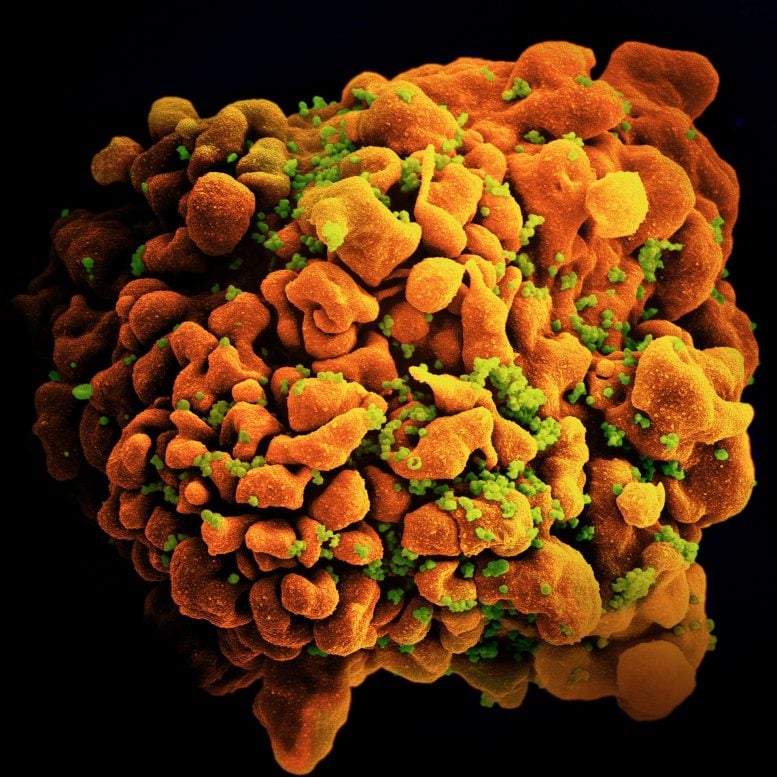
A newly published study from the University of North Carolina found that the drug vorinostat, a deacetylase inhibitor that is used to treat some types of lymphoma, was able to dislodge the dormant HIV virus in patients.
Researchers from the University of North Carolina at Chapel Hill have published pioneering research showing that a drug used to treat certain types of lymphoma was able to dislodge the dormant virus in patients receiving treatment for HIV.
The existence of persistent reservoirs of dormant HIV in the immune system that are not attacked by anti-AIDS drugs is believed to be a major reason why infection reemerges once patients stop taking their medication. The disruption and clearance of these reservoirs is critical to finding a cure for AIDS.
The study was published in the July 25 issue of the leading scientific journal, Nature.

Researchers at UNC, working in collaboration with scientists from the Harvard School of Public Health, National Cancer Institute, Merck, and the University of California at San Diego, undertook a series of experiments designed to evaluate the potential of the drug vorinostat, a deacetylase inhibitor that is used to treat some types of lymphoma, to activate and disrupt the dormant virus.
Initially, laboratory experiments measuring active HIV levels in CD4+ T cells, which are specialized white blood cells that the virus uses to replicate, showed that vorinostat unmasked the hidden virus in these cells. Subsequently, vorinostat was administered to eight HIV-infected men who were medically stable on antiretroviral therapy and the levels of active HIV virus were measured and compared to the levels prior to administration.
Those patients receiving vorinostat showed an average 4.5-fold increase in the levels of HIV RNA in CD4+ T cells, evidence that the virus was being unmasked. This is the first published study to show the potential for deacetylase inhibitors to attack latency within dormant virus pools in a translational clinical study.
“This work provides compelling evidence for a new strategy to directly attack and eradicate latent HIV infection,” said David Margolis, MD, professor of medicine, microbiology and immunology, and epidemiology at the University of North Carolina at Chapel Hill. Targeting latency is the first step on a path that may lead to a cure.
“Long-term, widespread use of antiretrovirals has personal and public health consequences, including side effects, financial costs, and community resistance,” said Margolis, who led the study. “We must seek other ways to end the epidemic, and this research provides new hope for a strategy to eradicate HIV completely from the body.”
Early results of this study were first presented and reported in March 2012 at the Conference on Retroviruses and Opportunistic Infections in Seattle, Washington.
Reference: “Administration of vorinostat disrupts HIV-1 latency in patients on antiretroviral therapy” by N. M. Archin, A. L. Liberty, A. D. Kashuba, S. K. Choudhary, J. D. Kuruc, A. M. Crooks, D. C. Parker, E. M. Anderson, M. F. Kearney, M. C. Strain, D. D. Richman, M. G. Hudgens, R. J. Bosch, J. M. Coffin, J. J. Eron, D. J. Hazuda and D. M. Margolis, 25 July 2012, Nature.
DOI: 10.1038/nature11286
The research conducted is part of a UNC-led consortium, the Collaboratory of AIDS Researchers for Eradication (CARE), funded by the National Institute of Allergy and Infectious Diseases. The consortium is administered by the North Carolina Translational and Clinical Sciences (NC TraCS) Institute at UNC, one of 60 medical research institutions in the US working to improve biomedical research through the NIH Clinical and Translational Science Awards (CTSA) program.
Funding for this research was provided by the National Institutes of Health, Merck & Co., and the James B. Pendleton Charitable Trust.
Never miss a breakthrough: Join the SciTechDaily newsletter.
Follow us on Google and Google News.