
Research Indicates That Certain Neural Cell Circuits Responsible for Color Vision Are Exclusive to Humans
Research in the field of color vision has uncovered new evidence suggesting that humans have the capability to detect a broader spectrum of blue hues compared to monkeys.
According to researchers, “distinct connections found in the human retina may indicate recent evolutionary adaptations for sending enhanced color vision signals from the eye to the brain.” Their findings were published on April 25 in the journal Proceedings of the National Academy of Sciences (PNAS).
Yeon Jin Kim, acting instructor, and Dennis M. Dacey, professor, both in the Department of Biological Structure at the University of Washington School of Medicine in Seattle, led the international, collaborative project.
They were joined by Orin S. Packer of the Dacey lab; Andreas Pollreisz at the Medical University of Vienna, Austria; as well as Paul R. Martin, professor of experimental ophthalmology, and Ulrike Grünert, associate professor of ophthalmology and visual science, both at the University of Sydney, Australia, and the Save Sight Institute.
Comparative Study of Human and Monkey Retinas
The scientists compared connections between color-transmitting nerve cells in the retinas of humans with those in two monkeys, the Old World macaque and the New World common marmoset. The ancestors of modern humans diverged from these two other primate species approximately 25 million years ago.
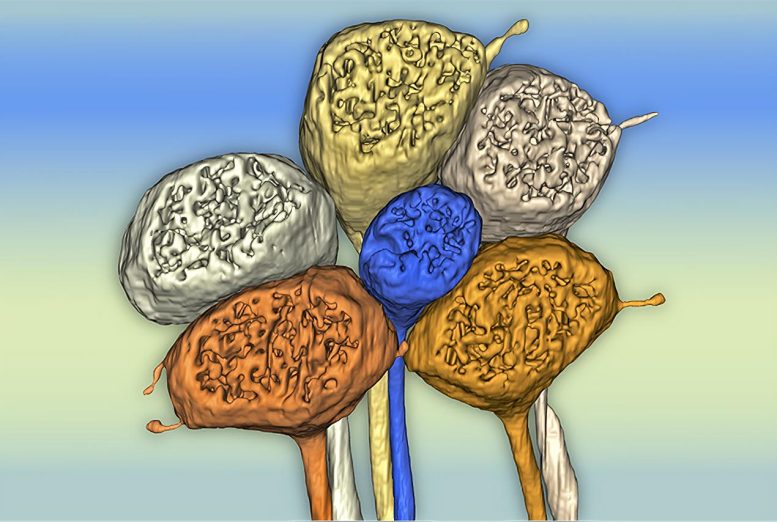
By using a fine-scale microscopic reconstruction method, the researchers wanted to determine if the neural wiring of the areas associated with color vision is conserved across these three species, despite each taking their own independent evolutionary pathways.
The scientists looked at the lightwave-detecting cone cells of the fovea of the retina. This small dimple is densely packed with cone cells. It is the part of the retina responsible for the sharp visual acuity needed to see important details, such as words on a page or what’s ahead while driving, and for color vision.
Cone cells come in three sensitivities: short, medium, and long wavelengths. Information about color comes from neural circuits that process information across different cone types.
Unique Short-Wave Cone Circuit in Humans
The researchers discovered that a certain short-wave or blue-sensitive cone circuit found in humans is absent in marmosets. It is also different from the circuit seen in the macaque monkey. Other features the scientists found in the nerve cell connections in human color vision were not expected, based on earlier nonhuman primate color vision models.
A better understanding of the species-specific, complex neural circuitry that codes for color perception could eventually help explain the origins of the color vision qualities that are distinct to humans.
The researchers also mentioned the possibility that differences among mammals in their visual circuitry could have been at least partially shaped by their behavioral adaptation to ecological niches. Marmosets live in trees whereas humans prefer to dwell on land. The ability to spot ripe fruit among the shifting light of a forest, for example, may have offered a selective advantage for particular color visual circuity. However, the actual effects of environment and behavior on color vision circuitry have not yet been established.
More generally, comparative studies of neural circuits at the level of connections and signaling between nerve cells, the researchers noted, could help answer many other questions. These include elucidating the underlying logic of neural circuit design and providing insight into how evolution has modified the nervous system to help shape perception and behavior.
Reference: “Comparative connectomics reveals noncanonical wiring for color vision in human foveal retina” by Yeon Jin Kim, Orin Packer, Andreas Pollreisz, Paul R. Martin, Ulrike Grünert and Dennis M. Dacey, 25 April 2023, Proceedings of the National Academy of Sciences.
DOI: 10.1073/pnas.2300545120
The study was funded by the National Institutes of Health and the National Eye Institute.
Never miss a breakthrough: Join the SciTechDaily newsletter.
Follow us on Google and Google News.