

Close Menu
    Facebook X (Twitter) Instagram
    SciTechDaily
    • Biology
    • Chemistry
    • Earth
    • Health
    • Physics
    • Science
    • Space
    • Technology
    Facebook X (Twitter) Pinterest YouTube RSS
    SciTechDaily
    Home»Space»ESA’s Euclid Spacecraft Arrives at Port Canaveral Launch Site
    Space

    ESA’s Euclid Spacecraft Arrives at Port Canaveral Launch Site

    By European Space Agency (ESA)May 4, 2023No Comments2 Mins Read
    Facebook Twitter Pinterest Telegram LinkedIn WhatsApp Email Reddit
    Share
    Facebook Twitter LinkedIn Pinterest Telegram Email Reddit
    Euclid Arrives at Port Canaveral
    SA’s Euclid spacecraft arrived at Port Canaveral, Florida, on April 30 before being moved to the Astrotech facility near Cape Canaveral. The satellite is set to launch on a SpaceX Falcon 9 rocket no earlier than July and will travel 1.5 million km to the Sun-Earth Lagrange point L2. Euclid will map billions of galaxies across more than one-third of the sky, helping astronomers study the Universe’s expansion, large-scale distribution of galaxies, and the role of gravity, dark matter, and dark energy, which together make up 95% of the Universe. Credit: Thales Alenia Space / ImagIn

    The European Space Agency’s Euclid spacecraft is set to launch on a SpaceX Falcon 9 rocket in July, mapping billions of galaxies to study the Universe’s expansion, gravity, dark matter, and dark energy.

    ESA’s Euclid spacecraft finished its ocean cruise safe and sound on April 30 at Port Canaveral in Florida. Subsequently, the satellite was moved by road to the Astrotech facility near Cape Canaveral.

    Euclid will launch on a SpaceX Falcon 9 rocket, no earlier than July, before starting its 1.5 million km journey to the Sun-Earth Lagrange point L2. In orbit, Euclid will map billions of galaxies out to 10 billion light years, across more than one-third of the sky.
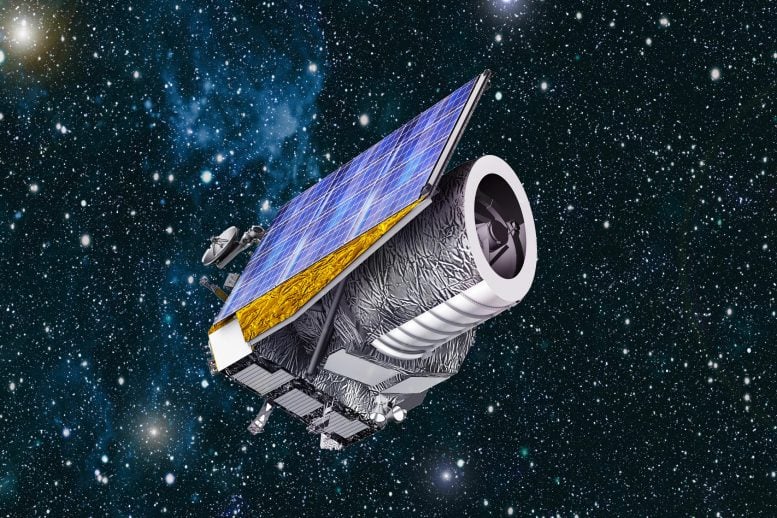
    Euclid Satellite
    This artist’s impression depicts ESA’s Euclid spacecraft. Euclid is a pioneering mission to observe billions of faint galaxies and investigate the origin of the Universe’s accelerating expansion, as well as the mysterious nature of dark energy, dark matter, and gravity. Credit: ESA

    Euclid’s cosmic map will help us understand the Universe’s mysterious components: dark matter and dark energy. Together they appear to make up 95% of the Universe, while the normal matter that we know and are made of (together with stars, planets and all we see) makes up the other 5%.

    Astronomers will use Euclid observations to study the evolution of the expansion of the Universe and the large-scale distribution of galaxies over cosmic history. From this, we can learn more about the role of gravity and the nature of dark matter and dark energy.

    Never miss a breakthrough: Join the SciTechDaily newsletter.
    Follow us on Google and Google News.

    Euclid Mission European Space Agency
    Share. Facebook Twitter Pinterest LinkedIn Email Reddit

    Related Articles

    Dark Universe Explorer: Euclid’s Large Halo Orbit Around Infinitesimal Point

    Unveiling Cosmic Mysteries: Euclid Launches on Epic Voyage To Map the Universe’s Dark Side

    Euclid “Dark Universe” Space Telescope Lifts Off on Quest To Unravel Deepest Cosmic Mysteries

    How To Watch the Euclid “Dark Universe Explorer” Launch Live

    Euclid’s Final Earthly Sighting: Dark Universe Explorer Prepares for Launch

    Euclid Spacecraft Fueled for Launch – New Space Telescope Will Explore the Dark Universe

    Solving Dark Cosmic Mysteries: ESA’s Euclid Mission Into the Unknown [Video]

    Visualizing Dark Matter With the Biggest Astronomy Collaboration Ever

    Module for ESA’s Euclid ‘Dark Universe’ Mission in Development

    Leave A Reply Cancel Reply

    • Facebook
    • Twitter
    • Pinterest
    • YouTube

    Don't Miss a Discovery

    Subscribe for the Latest in Science & Tech!

    Trending News

    Scientists Uncover Promising New Strategy To Stop Parkinson’s in Its Tracks

    Experts Reveal the Surprising Cancer Link Behind a Common Vitamin

    This Strange “Golden Orb” Found 2 Miles Deep Stumped Scientists for Years

    Giant “Last Titan” Dinosaur Discovered in Thailand Was Bigger Than 9 Elephants

    This “Longevity Gene” May Protect the Brain From Aging and Dementia

    Common Cleaning Chemical Could Triple Your Risk of a Dangerous Liver Disease

    Scientists Discover Bizarre 100-Million-Year-Old Insect With Giant Claws

    Scientists Discover “Good” Gut Microbes That Could Protect Against Autism and ADHD

    Follow SciTechDaily
    • Facebook
    • Twitter
    • YouTube
    • Pinterest
    • Newsletter
    • RSS
    SciTech News
    • Biology News
    • Chemistry News
    • Earth News
    • Health News
    • Physics News
    • Science News
    • Space News
    • Technology News
    Recent Posts
    • Light-Matter Particles Could Revolutionize AI Computing
    • Scientists Warn Many Insects May Not Survive a Warming World
    • Hektoria Glacier Collapse Reveals How Fast Antarctica Can Fall Apart
    • Hidden Earthquake Threat: Oregon’s Fault May Be Closer to the Surface Than Scientists Thought
    • Scientists Use Smartwatch Data To Track the Hidden Health Effects of Air Pollution
    Copyright © 1998 - 2026 SciTechDaily. All Rights Reserved.
    • Science News
    • About
    • Contact
    • Editorial Board
    • Privacy Policy
    • Terms of Use

    Type above and press Enter to search. Press Esc to cancel.