
Greenland’s ice is abundant with life, both above and below its surface. Until recently, science was unaware of the existence of certain microscopic organisms living there. Recent findings even suggest that these tiny creatures are responsible for adding color to the ice and accelerating its melting process.
The Greenland glaciers are widely considered as ice deserts, where life is scarce due to the extreme conditions. With the lack of plants and only a limited number of animals, this area sees very few visitors. The massive ice sheets make survival challenging and inhospitable.
However, recent discoveries have challenged this perception. There is a much greater abundance of life on the glaciers than we thought.
Headed by Professor Alexandre Anesio, a group of researchers from the Department of Environmental Science at Aarhus University have discovered that the glaciers are teeming with life. Microbes that have adapted to life on the ice. And not just one or two species. Several thousand different species.
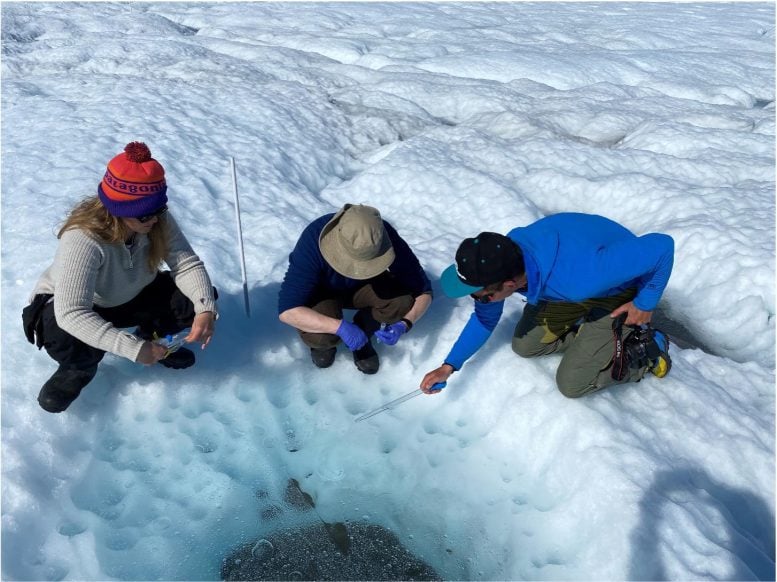
“A small puddle of melt-water on a glacier can easily have 4,000 different species living in it. They live on bacteria, algae, viruses, and microscopic fungi. It’s a whole ecosystem that we never knew existed until recently,” says Alexandre Anesio.
What Do the Microbes Live On?
Over the past 50 years, researchers have repeatedly been surprised by the hardiness of life. Life has been found several kilometers underground – where there is neither sun nor oxygen. Billions of microorganisms “eat” minerals in the bedrock and so can survive.
Researchers have shown that life can even survive in space. In 2007, European researchers placed a colony of more than 3,000 microscopic water bears (tardigrades) outside a satellite and sent them into orbit around the Earth. The orbit lasted 10 days, after which the satellite returned to Earth. No less than 68 percent of the microbes survived the vacuum of space and the lethal radiation.
Therefore, it might not come as a surprise that life also thrives on the glaciers. After all, there is sun, oxygen, and water. Nevertheless, until recently, researchers believed that the ice had too little nourishment to sustain life. But they were wrong.
There is nourishment. Just in incredibly small quantities, explains Alexandre Anesio.
Black Algae
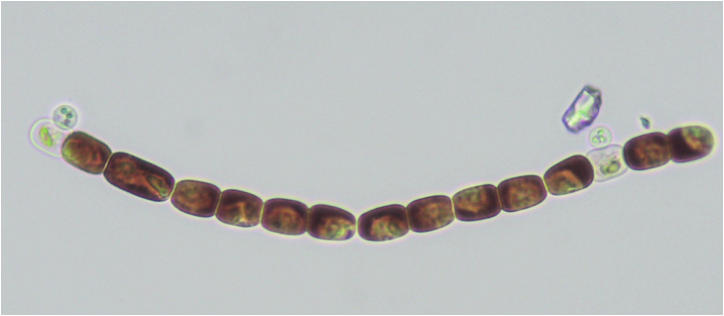
One of the microorganisms on the ice that the researchers spent most time investigating is a small black algae. The algae grows on top of the ice and tinges it black. There is a reason why the black algae is so interesting for the researchers.
“When the ice darkens, it becomes more difficult to reflect sunlight. Instead, heat from the sun’s rays is absorbed by the ice, which starts to melt. The more the ice melts, the warmer the temperature on Earth. The algae, therefore, play an important role in global warming,” says Alexandre Anesio.
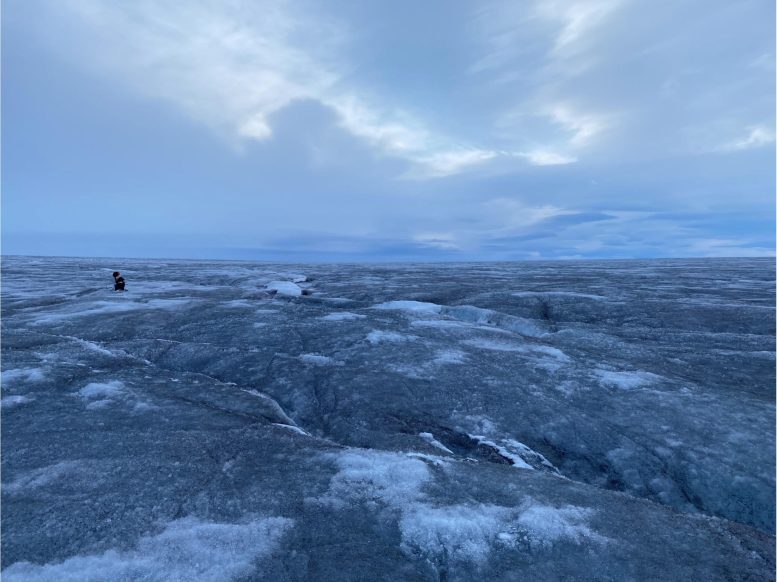
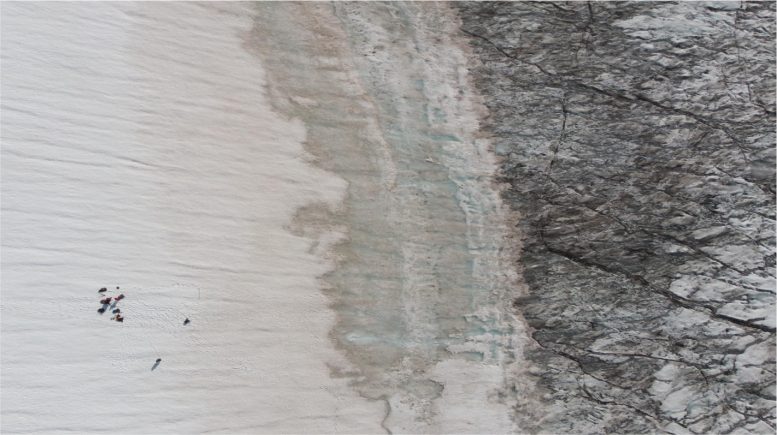
In recent years, larger and larger areas of the ice have become stained by the algae, making the ice melt even faster. Alexandre Anesio has calculated that the algae are increasing the ice melt by about 20 percent.
The algae on the ice also existed before people kicked off global warming through industrialization. However, climate change means spring arrives ever earlier in the Arctic and as a result, the algae have a longer season to grow and spread.
“The algae spread a little more every year. When I travel to Greenland, I now see vast areas where the ice is completely dark because of the algae,” he says.
Looking for an Algaecide
Alexandre Anesio and his colleagues are spending a lot of time on the black algae because they are trying to find out whether the algae growth can be slowed down in some way or another.
The is a balance In most ecosystems – a kind of equilibrium – because the various organisms keep each other in check. So Alexandre Anesio wants to learn more about the relationship between the different microbes.
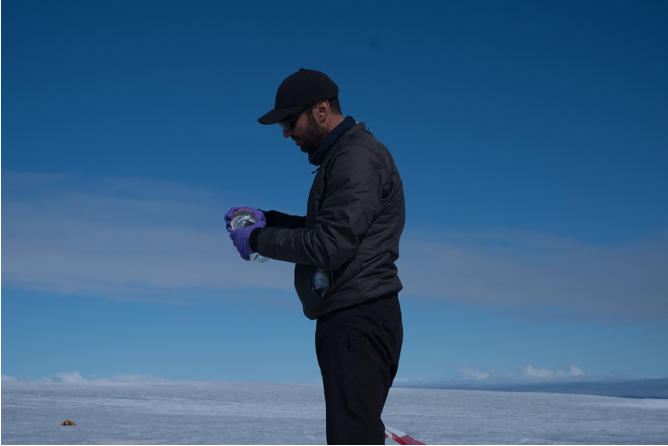
“The various microorganisms on the ice affect each other. Some leave nutrition that others live off. Small viral particles attack and consume bacteria. We believe that some of the fungal spores could eat the black algae. This is what we’re looking for,” he says.
However, he stresses that, even if they do find a way to curb algae growth, this will not solve climate change. Although it could slow it down.
Algae growth is a consequence of our releasing too many greenhouse gases into the atmosphere. And this is where the problem must be solved. We need to focus on slowing down our emissions.
The Same Pigment As in Black Tea
Algae is found virtually everywhere. In the sea, in lakes, on trees and rocks, and even as small spores in the air. Most algae are greenish. Like plants and trees, they are green because of chlorophyll. A molecule that enables them to photosynthesize.
But it’s different for the black algae.
“Because the algae live on the ice, they’re bombarded with sunlight and radiation. To protect themselves, they produce a lot of black pigment. It’s actually the same pigment as in black tea. The pigment forms a protective layer outside the algae and protects the chlorophyll molecules against the dangerous radiation,” says Alexandre Anesio.
When the pigment absorbs the sun’s rays, it generates heat. This heat makes the ice around the algae melt. And this actually benefits the algae. They need both water and micronutrients from the ice to live.
And they can only use the water when it is liquid.
NASA Also Has an Eye on His Research
Alexandre Anesio’s research into life on the ice is important for a better understanding of climate change. However, NASA is also following his research results closely. The results may be crucial in the hunt for life in space.
“NASA has approached us several times because we‘re working with life that lives in one of the most inhospitable places on Earth. If life thrives on and under the ice, there’s a probability that we’ll also find life in the ice on Mars or Jupiter’s and Saturn’s ice moons, for example,” he says.
Before NASA sent their Perseverance rover to Mars, they even invited Alexandre Anesio to a meeting.
“They were afraid that the rover would take with it microbes from Earth. Microbes that may be able to survive on Mars and pollute the samples they were going to take from Mars. So, they wanted to know what conditions life can survive in. What are the boundaries for life?”
Can Give an Indication of What They Should Look For
NASA is so interested in the research of life in the ice because we haven’t found liquid water on any other planets in the solar system. Not yet, anyway. But we’ve found plenty of ice.
However, there is evidence to suggest that there are liquid oceans beneath the frozen surface of Saturn’s moon, Enceladus and Jupiter’s moon, Europa – and one of the necessities of life, as we know it, is liquid water.
Therefore, NASA and other space agencies are very interested in learning more about the type of life that can live on and under the ice. Because organisms that resemble those in Greenland are probably those they’ll be looking for on the ice moons.
“Like us, they’re very interested in how the microorganisms on the ice function. How much nutrition do they need? What type of nutrition? And how does the ecosystem they are part of work? These are questions that we hope to be able to answer in the future,” says Alexandre Anesio.
Reference: “Active and dormant microorganisms on glacier surfaces” by James A. Bradley, Christopher B. Trivedi, Matthias Winkel, Rey Mourot, Stefanie Lutz, Catherine Larose, Christoph Keuschnig, Eva Doting, Laura Halbach, Athanasios Zervas, Alexandre M. Anesio and Liane G. Benning, 30 November 2022, Geobiology.
DOI: 10.1111/gbi.12535
Never miss a breakthrough: Join the SciTechDaily newsletter.
Follow us on Google and Google News.