
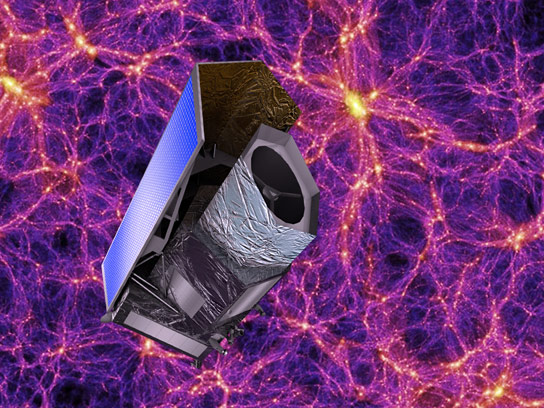
Astrium has begun development on a fully integrated payload module for ESA’s Euclid ‘Dark Universe’ Mission. The module will incorporate a 1.2 m-diameter telescope feeding the mission’s two science instruments, which are being developed by the Euclid Consortium.
The module carrying the telescope and scientific instruments of ESA’s Euclid ‘dark Universe’ mission is now being developed by Astrium in Toulouse, France.
Euclid will be launched in 2020 to explore dark energy and dark matter in order to understand the evolution of the Universe since the Big Bang and, in particular, its present accelerating expansion.
Dark matter is invisible to our normal telescopes but acts through gravity to play a vital role in forming galaxies and slowing the expansion of the Universe.
Dark energy, however, causes a force that is overcoming gravity and accelerating the expansion seen around us today.
Together, these two components are thought to comprise 95% of the mass and energy of the Universe, with ‘normal’ matter, from which stars, planets, and we humans are made, making up the remaining small fraction. Their nature remains a profound mystery.
“Euclid will address the cosmology-themed questions of ESA’s Cosmic Vision 2015–25 program with advanced payload technologies, enabling Europe to become a world leader in this field of research,” says Thomas Passvogel, Head of the Project Department in ESA’s Directorate of Science and Robotic Exploration.
Astrium will deliver a fully integrated payload module incorporating a 1.2 m-diameter telescope feeding the mission’s two science instruments, which are being developed by the Euclid Consortium.
The two state-of-the-art, wide-field instruments – a visible-light camera and a near-infrared camera/spectrometer – will map the 3D distribution of up to two billion galaxies and the associated dark matter and dark energy, spread over more than a third of the whole sky.
By surveying galaxies stretched across ten billion light-years, the mission will plot the evolution of the very fabric of the Universe and the structures within it over three-quarters of its history.
In particular, Euclid will address one of the most important questions in modern cosmology: why is the Universe expanding at an accelerating rate today, rather than slowing down due to the gravitational attraction of all the matter in it?
The discovery of this cosmic acceleration in 1998 was rewarded with the Nobel Prize for Physics in 2011 and yet there is no accepted explanation for it.
By using Euclid to study its effects on the galaxies and clusters of galaxies across the Universe, astronomers hope to come much closer to understanding the true nature and influence of this mysterious dark energy.
“We are excited that Euclid has reached this important milestone, allowing us to progress towards launch in 2020, and bringing us ever closer to uncovering some of the Universe’s darkest secrets,” says Giuseppe Racca, ESA’s Euclid Project Manager.
Never miss a breakthrough: Join the SciTechDaily newsletter.
Follow us on Google and Google News.
2 Comments
Well done! Let us throw some light on Dark Matter by this experiment and show the pseudo-scientists who denounce the concept of Dark Matter itself, even though they are well proved for their existence.
Interesting! Dark matter was explained in a publication at around 1957. The work explained the balance between white and black matter. The expansion of the universe could be du to turbulence caused by the big bang. Fluid turbulence, a complex fluid mechanics problems. It looks like a long time ago from within but who knows at what speed the time elapses from outside this universe. Excuse my english!