
Close Menu
    Facebook X (Twitter) Instagram
    SciTechDaily
    • Biology
    • Chemistry
    • Earth
    • Health
    • Physics
    • Science
    • Space
    • Technology
    Facebook X (Twitter) Pinterest YouTube RSS
    SciTechDaily
    Home»Biology»Immune System Inflammation Triggers Macrophages in ALS Patients
    Biology

    Immune System Inflammation Triggers Macrophages in ALS Patients

    By Rachel Champeau, University of California - Los AngelesJune 6, 2012No Comments3 Mins Read
    Facebook Twitter Pinterest Telegram LinkedIn WhatsApp Email Reddit
    Share
    Facebook Twitter LinkedIn Pinterest Telegram Email Reddit
    ALS macrophages
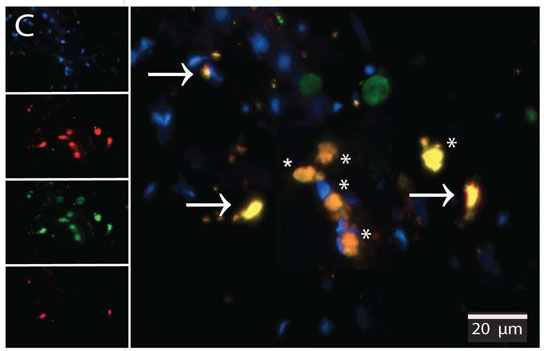
    In the ALS spinal cord, a patient’s own immune cells, called macrophages (green), impact neurons (live neurons are red and marked by an asterisk; and dead neurons are magenta and marked by an arrow). Credit: UCLA

    While working with patients with Lou Gehrig’s disease, researchers at UCLA found that inflammation instigated by the immune system in ALS can trigger macrophages to ingest healthy neurons and that a lipid mediator called resolvin D1 can “turn off” the inflammatory response.

    Findings:
    In an early study, University of California, Los Angeles (UCLA) researchers found that the immune cells of patients with amyotrophic lateral sclerosis (ALS), or Lou Gehrig’s disease, may play a role in damaging the neurons in the spinal cord. ALS is a disease of the nerve cells in the brain and spinal cord that control voluntary muscle movement.

    Specifically, the team found that inflammation instigated by the immune system in ALS can trigger macrophages — cells responsible for gobbling up waste products in the brain and body — to also ingest healthy neurons. During the inflammation process, motor neurons, whether healthy or not, are marked for clean-up by the macrophages.

    In addition, the team found that a lipid mediator called resolvin D1, which is made in the body from the omega-3 fatty acid DHA, was able to “turn off” the inflammatory response that made the macrophages so dangerous to the neurons. Resolvin D1 blocked the inflammatory proteins being produced by the macrophages, curbing the inflammation process that marked the neurons for clean-up. It inhibited key inflammatory proteins like IL-6 with a potency 1,100 times greater than the parent molecule, DHA. DHA has been shown in studies to be neuroprotective in a number of conditions, including stroke and Alzheimer’s disease.

    For the study, the team isolated macrophages from blood samples taken from both ALS patients and controls and spinal cord cells from deceased donors.

    Impact:
    The study findings on resolvin D1 may offer a new approach to attenuating the inflammation in ALS. Currently, there is no effective way of administering resolvins to patients, so clinical research with resolvin D1 is still several years away. The parent molecule, DHA, is available in stores, although it has not been tested in clinical trials for ALS. Studies with DHA are in progress for Alzheimer’s disease, stroke, and brain injury and have been mostly positive.

    Authors:
    Senior author Dr. Milan Fiala, a researcher in the Department of Surgery at the David Geffen School of Medicine at UCLA, and first author Guanghao Liu, a UCLA undergraduate student, are available for interviews.

    Funding:
    The study was privately funded by ALS patients.

    Journal:
    The research appeared in the May 30 edition of the peer‑reviewed American Journal of Neurodegeneration. A copy of the full study is available.

    Images:
    Color images are available showing how a patient’s own immune cells impact neurons, as seen in the spinal cord of an ALS patient.

    Reference: “Neuronal phagocytosis by inflammatory macrophages in ALS spinal cord: inhibition of inflammation by resolvin D1” by Guanghao Liu, Milan Fiala, Mathew T Mizwicki, James Sayre, Larry Magpantay, Avi Siani, Michelle Mahanian, Madhuri Chattopadhyay, Antonio La Cava and Martina Wiedau-Pazos, 15 March 2012, American Journal of Neurodegeneration.
    PMC3560453

    Never miss a breakthrough: Join the SciTechDaily newsletter.
    Follow us on Google and Google News.

    Disease Immune Cells UCLA
    Share. Facebook Twitter Pinterest LinkedIn Email Reddit

    Related Articles

    A2A Adenosine Receptor May Be a Key to Multiple Sclerosis Treatment

    High-Fructose Diet Slows the Brain, Hampering Memory and Learning

    Measuring Motor Neuron Communication May Shed Light on Neurodegenerative Diseases

    Bioengineers Develop Deformability Cytometer to Help Diagnose Disease

    Four Genes May Increase Memory Loss and Risk of Alzheimer’s

    NOD2 Pathway Helps Activate T Cells

    Using RNA Import to Repair Mutations in Human Mitochondria

    Researchers Stop Parkinson’s Disease in Animal Model

    Researchers Identify Genetic Mutation While Studying Cold Urticarial

    Leave A Reply Cancel Reply

    • Facebook
    • Twitter
    • Pinterest
    • YouTube

    Don't Miss a Discovery

    Subscribe for the Latest in Science & Tech!

    Trending News

    The Universe Is Expanding Too Fast and Scientists Can’t Explain Why

    “Like Liquid Metal”: Scientists Create Strange Shape-Shifting Material

    Early Warning Signals of Esophageal Cancer May Be Hiding in Plain Sight

    Common Blood Pressure Drug Shows Surprising Power Against Deadly Antibiotic-Resistant Superbug

    Scientists Uncover Dangerous Connection Between Serotonin and Heart Valve Disease

    Scientists Discover a “Protector” Protein That Could Help Reverse Hair Loss

    Bone-Strengthening Discovery Could Reverse Osteoporosis

    Scientists Uncover Hidden Trigger Behind Stem Cell Aging

    Follow SciTechDaily
    • Facebook
    • Twitter
    • YouTube
    • Pinterest
    • Newsletter
    • RSS
    SciTech News
    • Biology News
    • Chemistry News
    • Earth News
    • Health News
    • Physics News
    • Science News
    • Space News
    • Technology News
    Recent Posts
    • Scientists Overcome Major Quantum Bottleneck, Potentially Transforming Teleportation and Computing
    • Quantum Physics’ Strangest Problem May Hold the Key to Time Itself
    • Scientists Create “Liquid Gears” That Spin Without Touching
    • The Simple Habit That Could Help Prevent Cancer
    • Forgotten Medicinal Plant Shows Promise in Fighting Dangerous Superbugs
    Copyright © 1998 - 2026 SciTechDaily. All Rights Reserved.
    • Science News
    • About
    • Contact
    • Editorial Board
    • Privacy Policy
    • Terms of Use

    Type above and press Enter to search. Press Esc to cancel.