
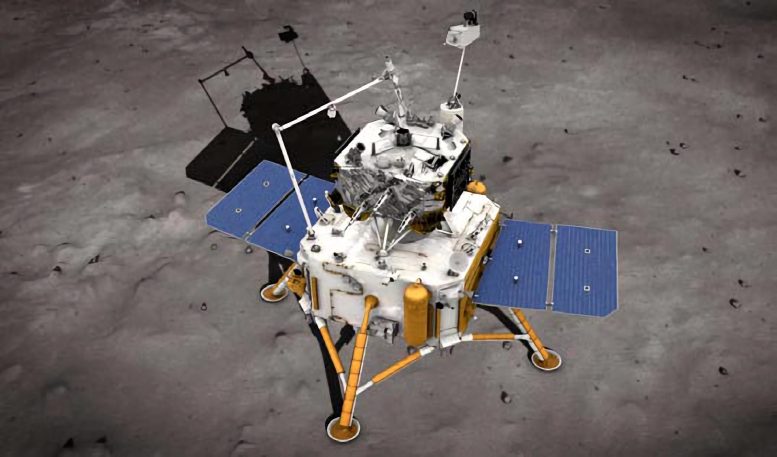
Scientists from the Chinese Academy of Sciences have identified impact glass beads in lunar soils as a new reservoir for water on the Moon.
Due to its potential for in-situ resource utilization by future lunar exploration missions and other space missions, lunar surface water has attracted significant attention.
Now, a research group led by Prof. Sen Hu from the Institute of Geology and Geophysics (IGG) of the Chinese Academy of Sciences (CAS) has found that impact glass beads in Chang’e-5 (CE5) lunar soils contain some water.
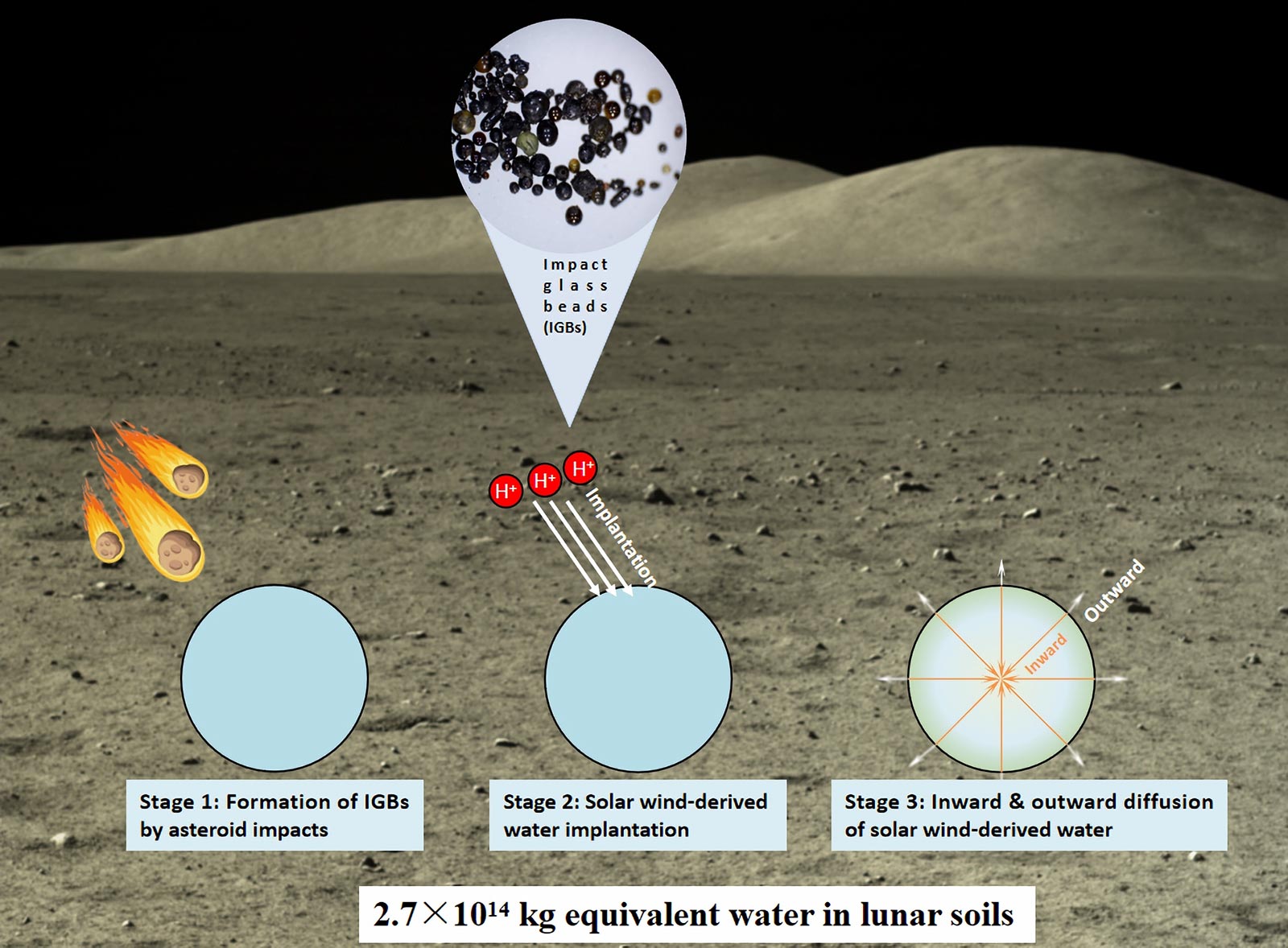
Detailed studies show that these glass beads are likely a new water reservoir on the Moon, recording the dynamic ingress and egress of solar wind-derived water and acting as a buffer for the lunar surface water cycle.
This work will be published today (March 27) in the journal Nature Geoscience.
Many lunar missions have confirmed the presence of structural water or water ice on the Moon. There is little doubt that most of the Moon’s surface harbors water, though the amount is much less than on Earth.
Hydrated Layers and the Lunar Surface Water Cycle
Surface water on the Moon displays diurnal cycles and loss to space, indicating that there should be a hydrated layer or reservoir at depth in lunar soils to sustain the retention, release, and replenishment of water on the surface of the Moon. However, previous studies of water inventory of fine mineral grains in lunar soils, impact-produced agglutinates, volcanic rocks, and pyroclastic glass beads have been unable to explain the retention, release, and replenishment of water on the surface of the Moon (i.e., the lunar surface water cycle). Therefore, there must be a yet-unidentified water reservoir in lunar soils that has the capacity to buffer the lunar surface water cycle.
Doctoral student Huicun He, under the guidance of Prof. Sen Hu, proposed that impact glass beads, a ubiquitous component in lunar soils with an amorphous nature, were a potential candidate for investigation of the unidentified hydrated layer or reservoir in lunar soils.
She systematically characterized the petrography, major element composition, water abundance, and hydrogen isotope composition of the impact glass beads returned by the CE5 mission, aiming to identify and characterize the missing water reservoir on the Moon’s surface.
The CE5 impact glass beads have homogeneous chemical compositions and smooth exposed surfaces. They are characterized by water abundance up to about 2,000 μg.g-1, with extreme deuterium-depleted characteristics. The negative correlation between water abundance and hydrogen isotope composition reflects the fact that water in the CE5 impact glass beads comes from solar winds.
The researchers also analyzed water abundance along six transects in five glass beads, which showed the hydration profiles of solar wind-derived water. Some glass beads were overlapped by a later degassing event. The impact glass beads acted as a sponge for buffering the lunar surface water cycle. The researchers estimate that the amount of water contributed by impact glass beads to lunar soils varies from 3.0 × 10¹¹ kg to 2.7 × 10¹⁴ kg.
“These findings indicate that the impact glasses on the surface of the Moon and other airless bodies in the solar system are capable of storing solar wind-derived water and releasing it into space,” said Prof Hu.
Reference: “A solar wind-derived water reservoir on the Moon hosted by impact glass beads” by Huicun He, Jianglong Ji, Yue Zhang, Sen Hu, Yangting Lin, Hejiu Hui, Jialong Hao, Ruiying Li, Wei Yang, Hengci Tian, Chi Zhang, Mahesh Anand, Romain Tartèse, Lixin Gu, Jinhua Li, Di Zhang, Qian Mao, Lihui Jia, Xiaoguang Li, Yi Chen, Li Zhang, Huaiwei Ni, Shitou Wu, Hao Wang, Qiuli Li, Huaiyu He, Xianhua Li and Fuyuan Wu, 27 March 2023, Nature Geoscience.
DOI: 10.1038/s41561-023-01159-6
The study was a collaboration with Nanjing University, The Open University, The Natural History Museum, The University of Manchester, and the University of Science and Technology of China.
Never miss a breakthrough: Join the SciTechDaily newsletter.
Follow us on Google and Google News.
1 Comment
@Jim. You may have missed this:
“Surface water on the Moon displays diurnal cycles and loss to space, indicating that there should be a hydrated layer or reservoir at depth in lunar soils to sustain the retention, release, and replenishment of water on the surface of the Moon.”
There are, evidently, clouds of water situated in interstellar space. Perhaps the solar system passed through one, and in the event water was captured by the Moon …. and by Earth. Someone given to wild speculation might even suggest it occasioned a planet-wide flood during the Pleistocene.