
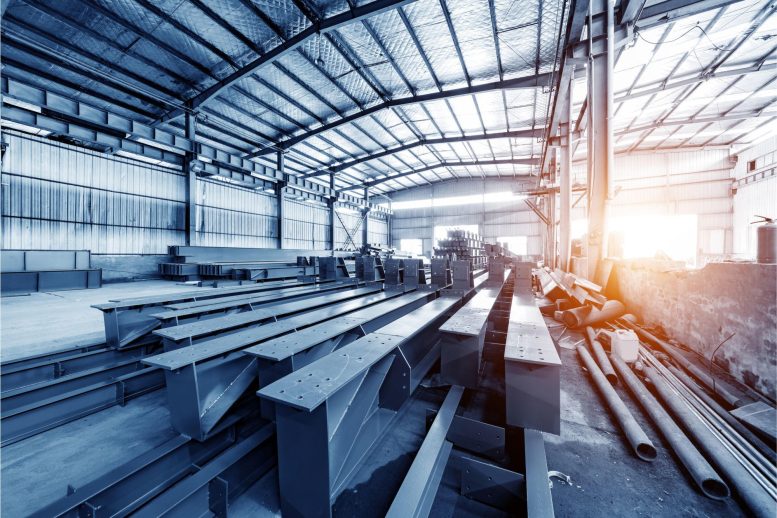
According to a recent study, in order to achieve the goal of zero emissions, we must be ready for a future where the production of steel may be limited.
Steel is a crucial material in our daily lives, playing a significant role in the automobiles we drive, the structures we reside in, and the transportation infrastructure that connects us. However, it also contributes to 7% of the world’s greenhouse gas emissions. In recognition of this, 45 nations made a pledge in 2021 to strive towards nearly zero-emission steel production within the next ten years.
However, the question remains, how is it possible to produce the steel required for society with zero emissions?
A new study focused on the Japanese steel industry shows that if we are truly committed to reaching zero emissions, we must be prepared for a scenario where the amount of steel we can produce is lower. Japan has set a target for a 46% reduction in emissions from steel by 2030, and zero emissions by 2050. So far, the roadmap for achieving this relies heavily on future innovations in technology. Hope is held out for developments in carbon capture and storage (CCS) and hydrogen-based technologies.
In the study, Dr. Takuma Watari, a researcher at the National Institute for Environmental Studies, Japan, currently working with the University of Cambridge, argues that there is no silver bullet. He says that current plans to cut carbon emissions underestimate how difficult it will be to develop CCS and hydrogen technologies and deploy them widely: “These technologies still face serious technical, economic, and social challenges, and have yet to be implemented at scale. And importantly, it is highly uncertain whether there will be sufficient non-emitting electricity to use these technologies.”
We need to confront the possibility that technological innovations might not be ready in time to allow us to maintain current levels of steel production whilst cutting emissions to zero.
Downcycling and Resource Constraints
The research involved mapping the current flows of steel in Japan’s industry and using a model to explore how the industry might change if a strict carbon budget were applied in future. Dr. Watari explains that with current practice, the quantity and quality of steel produced would dramatically decrease under a zero-emission carbon budget.
This is because of a lack of resources and the practice of downcycling, in which scraps of steel containing impurities are used to make new products. It is difficult to remove these impurities, so the new products have different quality and functionality from the original steel.
According to Dr. Watari, “zero-emission steel production is possible by 2050, but in limited quantity and quality compared to current total production. This is due to the limited availability of zero-emission compatible resources and downcycling practices of scrap steel.”
The research indicates that with a carbon budget of zero emissions, the production of steel goods would be dramatically restricted compared to today, reaching about half the current levels at best. In this case, higher-quality steel production (e.g., sheet steel) would be especially hard hit.
The Need for Demand Reduction and Material Efficiency
The implication is clear. It is not enough to rely on a technological silver bullet materializing to transform the supply of steel. We also need to look seriously at strategies to reduce demand by shifting our culture of steel use and improving our material efficiency. We also need to pursue upcycling to produce high-grade steel from scrap steel.
This will require collaboration from those who use steel as well as those who produce it. Steel products could be made more resource efficient if they are designed to last longer or to be lightweight. Once steel products reach the end of their life, upcycling could be achieved through advanced sorting and shredding to remove impurities from scrap steel. As a society, Japan may also have to become less steel-dependent and shift to a model of ‘service use’ rather than ownership of products. Unlike today, when steel is abundant and cheap, a net-zero future will require us to use scarcer, more expensive steel resources with greater efficiency.
Dr. Watari concludes that we do need to invest in technological innovations, but we cannot simply wait for them to appear. Instead, steel users need to prepare for a world where there is less steel available: “We do not deny the need to invest in innovative production technologies. Rather, what we want to highlight is that we should look for far more strategic options, instead of simply relying on silver bullet production technologies. Placing material efficiency and upcycling at the heart of decarbonization plans can reduce the over-reliance on innovative production technologies and prepare for the risk that these technologies may not scale up sufficiently in time.”
Reference: “Limited quantity and quality of steel supply in a zero-emission future” by Takuma Watari, Sho Hata, Kenichi Nakajima and Keisuke Nansai, 5 January 2023, Nature Sustainability.
DOI: 10.1038/s41893-022-01025-0
The study was funded by JSPS KAKENHI, The Environment Research and Technology Development Fund, and the JST-Mirai Program.
Never miss a breakthrough: Join the SciTechDaily newsletter.
Follow us on Google and Google News.
7 Comments
No, we need to live with less climate alarmism.
The “silver bullet” is all the steel just lying around along current and past railroad lines. Repurposing this steel could satisfy the need for ??? long.
Jerry – I hope you live long enough to recognize how your attitude is what has put all of us in the predicament we now face.
Doesn’t transforming to unreliable “renewables” require vast quantities of steel. I don’t understand how destroying the earth will save it. Seems like common sense approach with logical balance isn’t allowed. Many think a simple solution or silver bullet will “fix” the problem, yet we don’t even fully understand the “problem”.
I think such studies and thinking are wrongheaded at best, and counterproductive at worst. China is building two new coal plants a week, for example, and we’re discussing the best way to destroy our economies to bring carbon emissions for steel production to zero? 85% of the world population lives in “developing” countries, which are certainly going to need a lot more of everything in the future to reach “developed” status. They’re going to need steel, and they’re going to produce steel, regardless of the environmental consequences. Have you see the air and water in New Delhi or Shanghai?
Telling them, and ourselves, that net-zero is a future of deprivation and strict discipline, will derail support for renewables. Instead, we should be preaching energy abundance.
We should be focusing on the facts that clean energy processes pollute the air and water far less, renewables are built once then provide energy until the sun burns out, and renewable energy can’t be blockaded or jacked up in price by OPEC or Russian and American wars.
Plus, today in 2023 we don’t have the commercial technology to make steel carbon-neutral. So? Twenty years ago, solar panels produced the most expensive electricity. Today, they produce the cheapest. Humans innovate. That’s how we get rich and fat. Preach that renewables will make us all rich and fat, and we will find a way.
So, we need material economy, instead of human-effort economy we have been using since ever. Steel may be visible on our radar (with 7%, !, of emissions), but the principle holds for everything we produce and use. Things have to be more durable and versatile, we need to curb our boredom with some method other than shopping, and we must keep all the good people, now doing all the senseless jobs creating and selling crap, alive and happy.
It is truly fascinating to watch a large percentage of the country going from understanding what a phenominal benefit to life on earth for all species CO2 is, to blaming it for EVERYTHING we can possibly blame it for.
Idiots are literally blaming even the behavior of humans on it.
Here is a simple question: would black Jesus Obama move ocean front for 11 million dollars, if it was going to be underwater like he lied everyone else would be?
The amswer is simple—no. Would he allow himself to get rich off CC? Obviously yes.