
The discovery of steel tools in Iberia’s Final Bronze Age reveals sophisticated metallurgy long before Roman influence.
An international and interdisciplinary team, led by Dr. Ralph Araque Gonzalez, an archaeologist from the Faculty of Humanities in Freiburg, has confirmed that steel tools were in use in Europe nearly 2900 years ago. Through geochemical analyses, the team determined that stone stelae found on the Iberian peninsula from the Final Bronze Age contain intricate engravings that could only have been created using tempered steel.
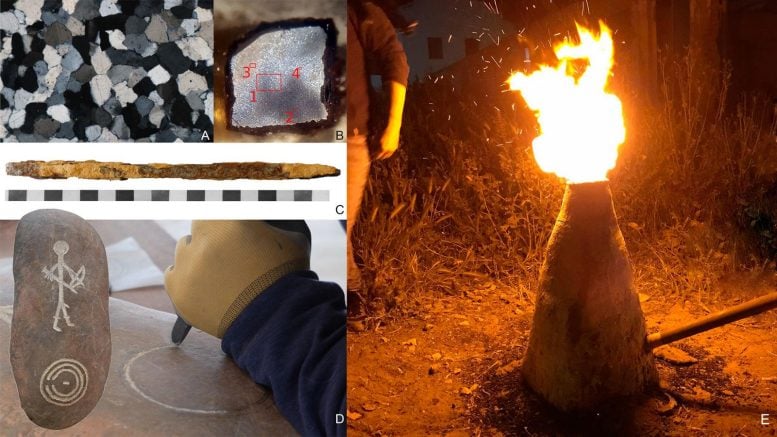
This finding was further supported by metallographic analysis of an iron chisel from the same time period and region (Rocha do Vigio, Portugal, ca. 900 BCE), which revealed that it had the required carbon content to be classified as proper steel.
The result was also confirmed experimentally by undertaking trials with chisels made of various materials: only the chisel made of tempered steel was suitably capable of engraving the stone. Until recently it was assumed that it was not possible to produce suitable quality steel in the Early Iron Age and certainly not in the Final Bronze Age, and that it only came to be widespread in Europe under the Roman Empire.
“The chisel from Rocha do Vigio and the context where it was found show that iron metallurgy including the production and tempering of steel were probably indigenous developments of decentralized small communities in Iberia, and not due to the influence of later colonization processes. This also has consequences for the archaeological assessment of iron metallurgy and quartzite sculptures in other regions of the world,” explains Araque Gonzalez.
The study ‘Stone-working and the earliest steel in Iberia: Scientific analyses and experimental replications of final bronze age stelae and tools’ has been published in the Journal of Archaeological Science.
Iberian Pillars of Siliceous Quartz Sandstone Could Only Be Worked With Tempered Steel
The archaeological record of Late Bronze Age Iberia (c. 1300-800 BCE) is fragmentary in many parts of the Iberian Peninsula: sparse remains of settlement and nearly no detectable burials are complemented by traces of metal hoarding and remains of mining activities. Taking this into account, the western Iberian stelae with their depictions of anthropomorphic figures, animals, and selected objects are of unique importance for the investigation of this era.
Until now, studies of the actual rocks from which these stelae were made to gain insights into the use of materials and tools have been the exception. Araque Gonzalez and his colleagues analyzed the geological composition of the stelae in depth. This led them to discover that a significant number of stelae were not as had been assumed made of quartzite, but silicate quartz sandstone. “Just like quartzite, this is an extremely hard rock that cannot be worked with bronze or stone tools, but only with tempered steel,” says Araque Gonzalez.
Chisel Discovery and Archaeological Experiment Confirm the Use of Steel
Analysis of an iron chisel found in Rocha do Vigio showed that Iberian stonemasons from the Final Bronze Age had the necessary tools. The researchers discovered that it consisted of heterogeneous yet astonishingly carbon-rich steel. To confirm their findings, the researchers also carried out an experiment involving a professional stonemason, a blacksmith, and a bronze caster, and attempted to work the rock that the pillars were made of using chisels of different materials.
The stonemason could not work the stone with either the stone or the bronze chisels, or even using an iron chisel with an untempered point. “The people of the Final Bronze Age in Iberia were capable of tempering steel. Otherwise, they would not have been able to work the pillars,” concludes Araque Gonzalez as a result of the experiment.
Reference: “Stone-working and the earliest steel in Iberia: Scientific analyses and experimental replications of final bronze age stelae and tools” by Ralph Araque Gonzalez, Bastian Asmus, Pedro Baptista, Rui Mataloto, Pablo Paniego Díaz, Vera Rammelkammer, Alexander Richter and Giuseppe Vintrici, 10 February 2023, Journal of Archaeological Science.
DOI: 10.1016/j.jas.2023.105742
The study was funded by the German Research Foundation.
Never miss a breakthrough: Join the SciTechDaily newsletter.
Follow us on Google and Google News.
1 Comment
It’s a beautiful thought — that connection to a blacksmith millennia ago, tinkering with material ratios and adding strange new liquified elements traded from mines in mysterious distant places. More like an alchemist than a metallurgist, he would spend days tending to the intense fires, mixing precious things carved from the earth, testing what cools to see if it would help ensure the tribe’s survival, and then fiercely guarding the secret of how the magical tool was produced. I’d love to hear Neil Oliver describe this story.
That said, the ancient egyptians also made intricate carvings in quartzite, as well as using enormous carved blocks of it in the pyramids in the way of potential thieves. Supposedly they did this inefficiently with copper tools and fine-grit abrasives. I like the practical experimentation, but the ancients had more time on their hands.