
Close Menu
    Facebook X (Twitter) Instagram
    SciTechDaily
    • Biology
    • Chemistry
    • Earth
    • Health
    • Physics
    • Science
    • Space
    • Technology
    Facebook X (Twitter) Pinterest YouTube RSS
    SciTechDaily
    Home»Space»Hubble Space Telescope Is Back Online – Partially
    Space

    Hubble Space Telescope Is Back Online – Partially

    By Nancy Atkinson, Universe TodayNovember 12, 2021No Comments3 Mins Read
    Facebook Twitter Pinterest Telegram LinkedIn WhatsApp Email Reddit
    Share
    Facebook Twitter LinkedIn Pinterest Telegram Email Reddit
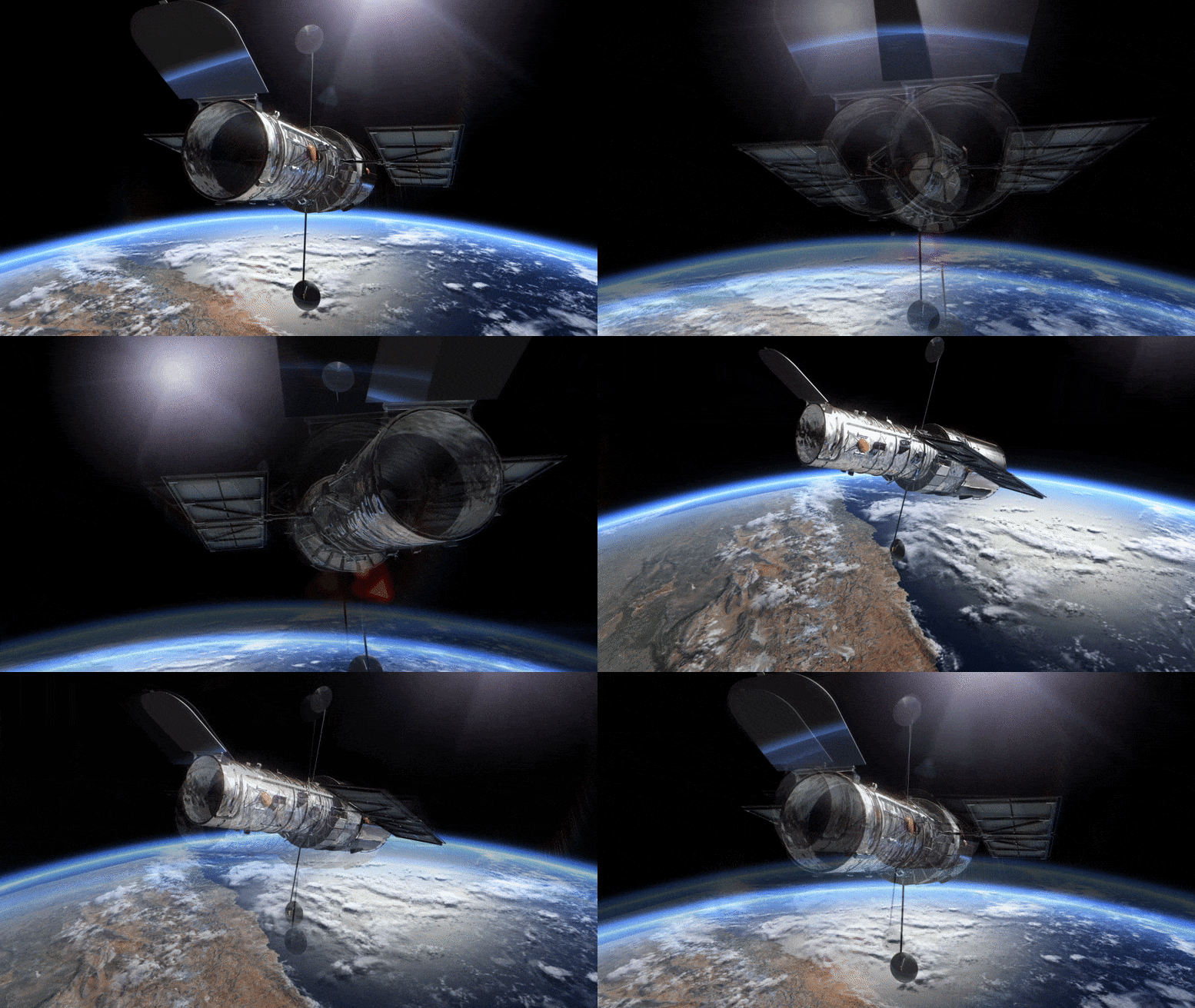
    Hubble Space Telescope Over Earth
    3D animation showing the Hubble Space Telescope over the Earth. Credit: ESA/Hubble (M. Kornmesser & L. L. Christensen)

    The Hubble Space Telescope has been in ‘safe mode’ since October 23, with all of the science instruments offline and unavailable for observations. However, engineers have now been able to bring one instrument, the Advanced Camera for Surveys (ACS), back online, and have restarted its science observations. NASA said engineers are still investigating the issue as the other four instruments remain offline.

    The underlying cause appears to be a “synchronization error” which means the instruments could not sync up to collect data properly. An earlier update from NASA said the root cause appeared to be a timing problem in the command flow. But the Hubble team has remained confident throughout this latest glitch that the instruments are all still in good health, and the recovery of the ACS is bolstering for their continued work on the issue.

    Safe mode is designed to keep the telescope stable and allow it to remain powered via its solar panels while the engineering team works through the technical issues.

    Hubble has gone through a series of technical problems recently. In June of this year, a malfunctioning main computer required operators to switch to a backup copy, causing five weeks of downtime. In March 2021, an issue with a software update took the spacecraft offline for a few days. This may be par for the course for the aging observatory.

    Astronaut Mike Good Hubble Space Telescope
    Astronaut Mike Good works on repairing the Space Telescope Imaging Spectrograph during the final Hubble servicing mission in May 2009. Periodic upgrades have kept the telescope equipped with state-of-the-art instruments, which have given astronomers increasingly better views of the cosmos. Credit: NASA

    Hubble has been in space since 1990 and has revolutionized our understanding of the cosmos. With the five servicing missions by Space Shuttle astronauts to repair and replace systems on the telescope — including all five of the main instruments – the observatory has basically been completely upgraded since it launched. But the last servicing mission was in 2009, and Hubble’s age is becoming apparent.

    NASA said that over the past week, the mission team has continued investigating the root cause of the synchronization issues and has seen no additional problems. The team will continue looking into possible short-term solutions this week and develop estimates for implementation. Once this occurs, the team will discuss returning the other instruments to operational status and resuming their science observations.

    Adapted from an article originally published on Universe Today.

    Never miss a breakthrough: Join the SciTechDaily newsletter.
    Follow us on Google and Google News.

    Astronomy Hubble Space Telescope NASA
    Share. Facebook Twitter Pinterest LinkedIn Email Reddit

    Related Articles

    Hubble Reveals a Star Disk Three Times Hotter Than the Sun’s Surface

    A Star’s Unexpected Heatwave: FU Orionis Challenges Astrophysics Models

    NASA’s Hubble Reveals How the LMC Defied Galactic Destruction

    Legendary Star’s Smooth Disk Mystifies Astronomers, Challenges Planet Formation Theories

    Cosmic Horror Unveiled: NASA Reveals “Blood-Soaked Eyes” Staring From Deep Space [Video]

    Spanning 248 Billion Miles: Stunning Hubble Timelapse Captures a Star’s Violent Eruptions

    Jupiter’s Great Red Spot Enigma: Unexplained Oscillations Baffle Astronomers

    Unlocking Uranus: NASA’s Dual Observations Pave the Way to Discovering New Worlds

    Astronomers Baffled by Black Hole Jets Igniting Star Explosions

    Leave A Reply Cancel Reply

    • Facebook
    • Twitter
    • Pinterest
    • YouTube

    Don't Miss a Discovery

    Subscribe for the Latest in Science & Tech!

    Trending News

    5 Simple Ways To Remember More and Forget Less

    The Atomic Gap That Could Cost the Semiconductor Industry Billions

    Researchers Finally Solve 50-Year-Old Blood Group Mystery

    Scientists Discover “Molecular Switch” That Fuels Alzheimer’s Brain Inflammation

    Trees Emit Tiny Lightning Flashes During Storms and Scientists Finally Prove It

    Pomegranate Compound Could Help Protect Against Heart Disease

    Your Blood Test Might Already Show Alzheimer’s Risk

    Scientists Were Wrong About This Strange “Rule-Breaking” Particle

    Follow SciTechDaily
    • Facebook
    • Twitter
    • YouTube
    • Pinterest
    • Newsletter
    • RSS
    SciTech News
    • Biology News
    • Chemistry News
    • Earth News
    • Health News
    • Physics News
    • Science News
    • Space News
    • Technology News
    Recent Posts
    • Scientists Make Breakthrough in Turning Plastic Trash Into Clean Fuel Using Sunlight
    • Scientists Complete Largest 3D Map of the Universe to Probe Dark Energy
    • Hidden Parasite Found in Popular Portuguese Lake Raises Health Concerns
    • This Simple Trick Can Boost Your Workout Endurance by 20%
    • This Popular Supplement May Interfere With Cancer Treatment, Scientists Warn
    Copyright © 1998 - 2026 SciTechDaily. All Rights Reserved.
    • Science News
    • About
    • Contact
    • Editorial Board
    • Privacy Policy
    • Terms of Use

    Type above and press Enter to search. Press Esc to cancel.