
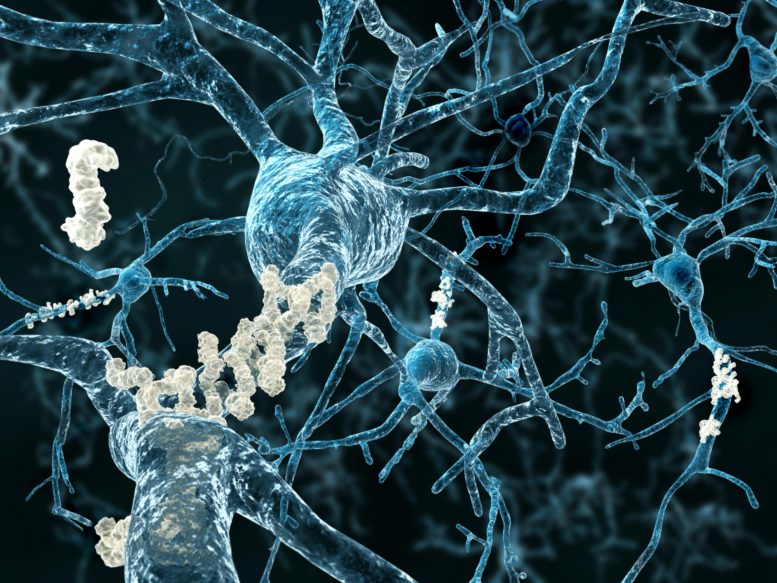
Researchers at the Université Laval have shown that the molecule MPL (monophosphoryl lipid A) can eliminate up to 80% of the senile plaques associated with Alzheimer’s disease when injected into mice. The researchers believe that it could be administered to Alzheimer’s patients to slow the progression of the disease and to stimulate their natural immunity.
A team of researchers from Université Laval, CHU de Québec, and pharmaceutical firm GlaxoSmithKline (GSK) has discovered a way to stimulate the brain’s natural defense mechanisms in people with Alzheimer’s disease. This major breakthrough, details of which are presented in an early online edition of the Proceedings of the National Academy of Sciences (PNAS), opens the door to the development of a treatment for Alzheimer’s disease and a vaccine to prevent the illness.
One of the main characteristics of Alzheimer’s disease is the production in the brain of a toxic molecule known as amyloid beta. Microglial cells, the nervous system’s defenders, are unable to eliminate this substance, which forms deposits called senile plaques.
The team led by Dr. Serge Rivest, professor at Université Laval’s Faculty of Medicine and researcher at the CHU de Québec research center, identified a molecule that stimulates the activity of the brain’s immune cells. The molecule, known as MPL (monophosphoryl lipid A), has been used extensively as a vaccine adjuvant by GSK for many years, and its safety is well established.
In mice with Alzheimer’s symptoms, weekly injections of MPL over a twelve-week period eliminated up to 80% of senile plaques. In addition, tests measuring the mice’s ability to learn new tasks showed significant improvement in cognitive function over the same period.
The researchers see two potential uses for MPL. It could be administered by intramuscular injection to people with Alzheimer’s disease to slow the progression of the illness. It could also be incorporated into a vaccine designed to stimulate the production of antibodies against amyloid beta. “The vaccine could be given to people who already have the disease to stimulate their natural immunity,” said Serge Rivest. “It could also be administered as a preventive measure to people with risk factors for Alzheimer’s disease.”
“When our team started working on Alzheimer’s disease a decade ago, our goal was to develop better treatment for Alzheimer’s patients,” explained Professor Rivest. “With the discovery announced today, I think we’re close to our objective.”
Reference: “Toll-like receptor 4 stimulation with the detoxified ligand monophosphoryl lipid A improves Alzheimer’s disease-related pathology” by Jean-Philippe Michaud, Maxime Hallé, Antoine Lampron, Peter Thériault, Paul Préfontaine, Mohammed Filali, Pascale Tribout-Jover, Anne-Marie Lanteigne, Rachel Jodoin, Christopher Cluff, Vincent Brichard, Rémi Palmantier, Anthony Pilorget, Daniel Larocque and Serge Rivest, 15 January 2013, Proceedings of the National Academy of Sciences.
DOI: 10.1073/pnas.1215165110
In addition to Rivest, the study’s co-authors are Jean-Philippe Michaud, Antoine Lampron, Peter Thériault, Paul Préfontaine, Mohammed Filali, and nine researchers from GlaxoSmithKline.
Never miss a breakthrough: Join the SciTechDaily newsletter.
Follow us on Google and Google News.
2 Comments
It is a worthy discovery indeed if it fructifies, to eliminate Alzheimer’s disease which is prevalent in the aging population. Thank You.
@Madanagopal.V.C: Indeed!