
Close Menu
    Facebook X (Twitter) Instagram
    SciTechDaily
    • Biology
    • Chemistry
    • Earth
    • Health
    • Physics
    • Science
    • Space
    • Technology
    Facebook X (Twitter) Pinterest YouTube RSS
    SciTechDaily
    Home»Biology»Maggots Secretions Suppress Immune Response
    Biology

    Maggots Secretions Suppress Immune Response

    By SciTechDailyDecember 10, 2012No Comments2 Mins Read
    Facebook Twitter Pinterest Telegram LinkedIn WhatsApp Email Reddit
    Share
    Facebook Twitter LinkedIn Pinterest Telegram Email Reddit
    maggots-heal-wounds
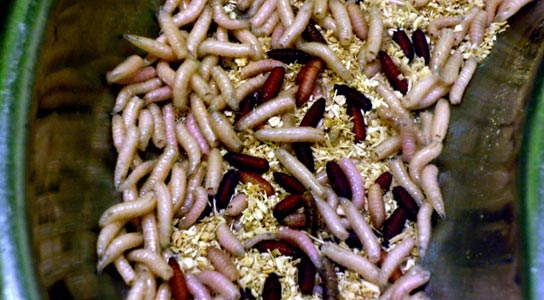
    Maggots’ excretions soothe inflamed wounds, speeding healing. Credit: Cory Doctorow

    Researchers have figured out how fly larvae works as a healing balm that’s been used by battlefield surgeons for centuries to close wounds.

    The scientists published their findings in the journal Wound Repair and Regeneration. Maggots suppress the immune system. They consume dead tissue, leaving healthy tissue practically unscathed. Physicians have been using larvae to clean wounds for a long time. The use of penicillin in the 1940s made clinical maggots less useful, but in the 1990s, when antibiotic-resistant bacteria arose, it created a new demand for alternative treatments. In 2004, the FDA approved maggot therapy as a prescription treatment.

    Until now, no one had scientifically tested the idea that maggots curb inflammation. A team in the Netherlands siphoned samples of maggot secretions from disinfected maggots in the lab. Then, they were added to blood samples from four healthy adults. The levels of complement proteins were measured. These are involved in the body’s inflammatory response.

    Every blood sample treated with maggot secretions showed lower levels of complement proteins than control samples. It was up to 99.9% in the best cases. The researchers also found the broken-down remnants of two complement proteins, C3 and C4, in the secretion-treated samples, suggesting that the secretions had ripped the proteins apart.

    When the researchers tested blood samples from postoperative patients, they discovered that maggot secretions reduced the levels of complement proteins by 19% to 55%. The team tested the maggot secretions again after a day, a week and a month to test their shelf life. They also boiled some. The secretions were more effective after boiling, and lost no potency even after a month.

    If the secretions didn’t suppress the immune system, the larvae would probably be attacked by the body. The team is now working on isolating the complement-inhibiting compounds.

    Reference: “Maggot excretions affect the human complement system” by Gwendolyn Cazander MD, PhD; Marco W. J. Schreurs PhD; Lennaert Renwarin; Corry Dorresteijn; Dörte Hamann PhD and Gerrolt. N. Jukema MD, PhD, 30 October 2012, Wound Repair and Regeneration.
    DOI: 10.1111/j.1524-475X.2012.00850.x

    Never miss a breakthrough: Join the SciTechDaily newsletter.
    Follow us on Google and Google News.

    Disease Healing Immunobiology Immunology Maggots Medicine Regeneration
    Share. Facebook Twitter Pinterest LinkedIn Email Reddit

    Related Articles

    TH17 Cells Convert From Pro-Inflammatory to Anti-Inflammatory

    Max Planck Researchers Discover New Weapon of the Immune System

    Researchers Uncover Mode of Action of New Multiple Sclerosis Drug

    “Personalized” Tumor Vaccine Works on Hard-to-Treat Leukemia

    Nanoparticle Immunogen Design Targets HIV and Other Fast-Mutating Viruses

    Nanogels Provide a New Way to Attack Lupus

    Study Provides Evidence That Viruses Can Have Immune Systems

    A Step Towards a Possible Alzheimer’s Vaccine, Researchers Eliminate Up to 80% of Senile Plaques in Mice

    Study Shows that Vorinostat can Dislodge the Dormant HIV Virus in Patients

    Leave A Reply Cancel Reply

    • Facebook
    • Twitter
    • Pinterest
    • YouTube

    Don't Miss a Discovery

    Subscribe for the Latest in Science & Tech!

    Trending News

    Scientists Uncover Potential Brain Risks of Popular Fish Oil Supplements

    Scientists Discover a Surprising Way To Make Bread Healthier and More Nutritious

    After 60 Years, Scientists Uncover Unexpected Brain Effects of Popular Diabetes Drug Metformin

    New Research Uncovers Hidden Side Effects of Popular Weight-Loss Drugs

    Scientists Rethink Extreme Warming After Surprising Ocean Discovery

    Landmark Study Links Never Marrying to Significantly Higher Cancer Risk

    Researchers Discover Unknown Beetle Species Just Steps From Their Lab

    Largest-Ever Study Finds Medicinal Cannabis Ineffective for Anxiety, Depression, PTSD

    Follow SciTechDaily
    • Facebook
    • Twitter
    • YouTube
    • Pinterest
    • Newsletter
    • RSS
    SciTech News
    • Biology News
    • Chemistry News
    • Earth News
    • Health News
    • Physics News
    • Science News
    • Space News
    • Technology News
    Recent Posts
    • Students Build Dark Matter Detector and Set New Experimental Limits
    • Scientists Discover Caffeine Can Repair Key Memory Circuits After Sleep Loss
    • Strange 65-Foot Dinosaur Discovered in Argentina
    • Researchers Uncover Source of Strange Deformation in Earth’s Largest Continental Rift
    • Scientists Solve Mystery of Where the Colorado River Vanished Millions of Years Ago
    Copyright © 1998 - 2026 SciTechDaily. All Rights Reserved.
    • Science News
    • About
    • Contact
    • Editorial Board
    • Privacy Policy
    • Terms of Use

    Type above and press Enter to search. Press Esc to cancel.