
Close Menu
    Facebook X (Twitter) Instagram
    SciTechDaily
    • Biology
    • Chemistry
    • Earth
    • Health
    • Physics
    • Science
    • Space
    • Technology
    Facebook X (Twitter) Pinterest YouTube RSS
    SciTechDaily
    Home»Earth»River Formation Due to Interplay Between Incision and Soil Creep
    Earth

    River Formation Due to Interplay Between Incision and Soil Creep

    By SciTechDailyDecember 10, 2012No Comments3 Mins Read
    Facebook Twitter Pinterest Telegram LinkedIn WhatsApp Email Reddit
    Share
    Facebook Twitter LinkedIn Pinterest Telegram Email Reddit
    river-formation-perron
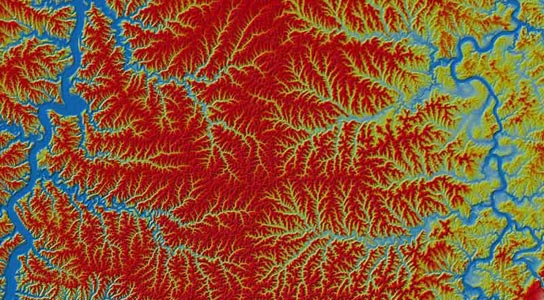
    Branching river networks in the Allegheny Plateau in Pennsylvania and West Virginia. Credit: Taylor Perron/MIT

    The precise conditions that cause rivers to form branches have long been a mystery, until now. A new study pinpoints two opposing physical forces that work together to produce the intricate patterns of rivers. This could help scientists understand rivers at all scales, even on other worlds.

    The scientists published their findings in the journal Nature. When rain hits a tilted surface, it tends to flow toward the existing depressions. The flow of water erodes the rock, widening and deepening the depressions. This process is called incision, and it could be characterized as competitive and even cannibalistic. As the individual rills grow from incision, they capture smaller neighbors, forming tributaries. Instead of spreading indefinitely, a process called soil creep smooths over the land, filling in the cracks with a slow, yet steady drift of soil.

    Researchers have known for more than a century that these processes shape rivers, but they hadn’t been able to quantify their relative importance or figure out how they work together to create river basins that are finely branched in some landscapes and not in others.

    The scientists guessed that a certain ratio between rates of incision and soil creep acted like a tipping point for the creation of river branches. Below this value, they expected no tributaries to form. Above it, rivers would begin to capture smaller rivers and form a network of tributaries.

    They compared California’s Salinas Valley with the Allegheny Plateau in southwest Pennsylvania, each with a 25 km2 region that contains thousands of river basins. The rivers in California are four times as branched as the ones in Pennsylvania. Neither region is strongly influenced by the faults and folds of a tectonic boundary. This allowed the team to compare Incision and soil creep without too much interference from other variables.

    Once the river networks were mapped, the team created a mathematical model that included the equations for soil creep and incision in river channels surrounded by raised mountain ridges. The model was manipulated to see if it could produce the same branching patterns. This helped them identify a tipping point, which is a dimensionless value between 250 and 300, where incision overrides soil creep. When the models went beyond the tipping point in accelerated geological time, the valleys bloomed as they cannibalized their neighbors. Below the critical value, the river will shrink back to the size of its neighbors and ultimately lose its tributaries.

    The researchers believe this kind of analysis could be applied to the rivers of methane on Titan, Saturn’s moon.

    Reference: “The root of branching river networks” by J. Taylor Perron, Paul W. Richardson, Ken L. Ferrier and Mathieu Lapôtre, 5 December 2012, Nature.
    DOI: 10.1038/nature11672

    Never miss a breakthrough: Join the SciTechDaily newsletter.
    Follow us on Google and Google News.

    Earth Science
    Share. Facebook Twitter Pinterest LinkedIn Email Reddit

    Related Articles

    Earthquake Doublets Reveal Changing Speed of the Earth’s Inner Core

    Nitrogen Deposits Increased 60% from the 1980s – 2000s in China

    5-Mile Wide Buried Asteroid Crater Discovered in Canada

    Grand Canyon Thought to Be 65 Million Years Older Than Previous Estimates

    Unusual Indian Ocean Earthquakes May Signal Tectonic Breakup

    Impact of Plants on Cloud Formation and the Atmosphere

    Nitrogen Pollution Is Altering Sensitive Ecosystems

    Tropical Oceans Role in Climate Change

    Defects in Mantle Rocks Slow Down the Passage of Seismic Waves

    Leave A Reply Cancel Reply

    • Facebook
    • Twitter
    • Pinterest
    • YouTube

    Don't Miss a Discovery

    Subscribe for the Latest in Science & Tech!

    Trending News

    Tea or Coffee? Your Daily Choice Could Affect Osteoporosis Risk

    Vitamin C May Fight Cancer in a Surprising Way

    Hidden Earthquake Threat: Oregon’s Fault May Be Closer to the Surface Than Scientists Thought

    Scientists Discover Hidden Sleep Switch That Boosts Brainpower, Builds Muscle, and Burns Fat

    Ancient Mega-Floods Once Ripped Across Mars and Left This Giant Scar

    Scientists Discover Cheap, Natural Remedy for High Blood Pressure

    Earth’s Upper Atmosphere Is Cooling Fast and Scientists Finally Know Why

    32,000 Olympic Pools of Magma Nearly Erupted Beneath Atlantic Island

    Follow SciTechDaily
    • Facebook
    • Twitter
    • YouTube
    • Pinterest
    • Newsletter
    • RSS
    SciTech News
    • Biology News
    • Chemistry News
    • Earth News
    • Health News
    • Physics News
    • Science News
    • Space News
    • Technology News
    Recent Posts
    • Ancient Roman Gold Mines Discovered in Spain’s Pyrenees
    • Ancient DNA Reveals How Farming Spread and Nearly Broke a Civilization
    • 146,000-Year-Old Discovery Rewrites the Story of Human Creativity
    • The Type of Alcohol You Drink Could Affect How Long You Live
    • 19-Year Study Reveals the Surprising Truth About Sitting and Dementia
    Copyright © 1998 - 2026 SciTechDaily. All Rights Reserved.
    • Science News
    • About
    • Contact
    • Editorial Board
    • Privacy Policy
    • Terms of Use

    Type above and press Enter to search. Press Esc to cancel.