
Acknowledgment: Cambridge Astronomical Survey Unit
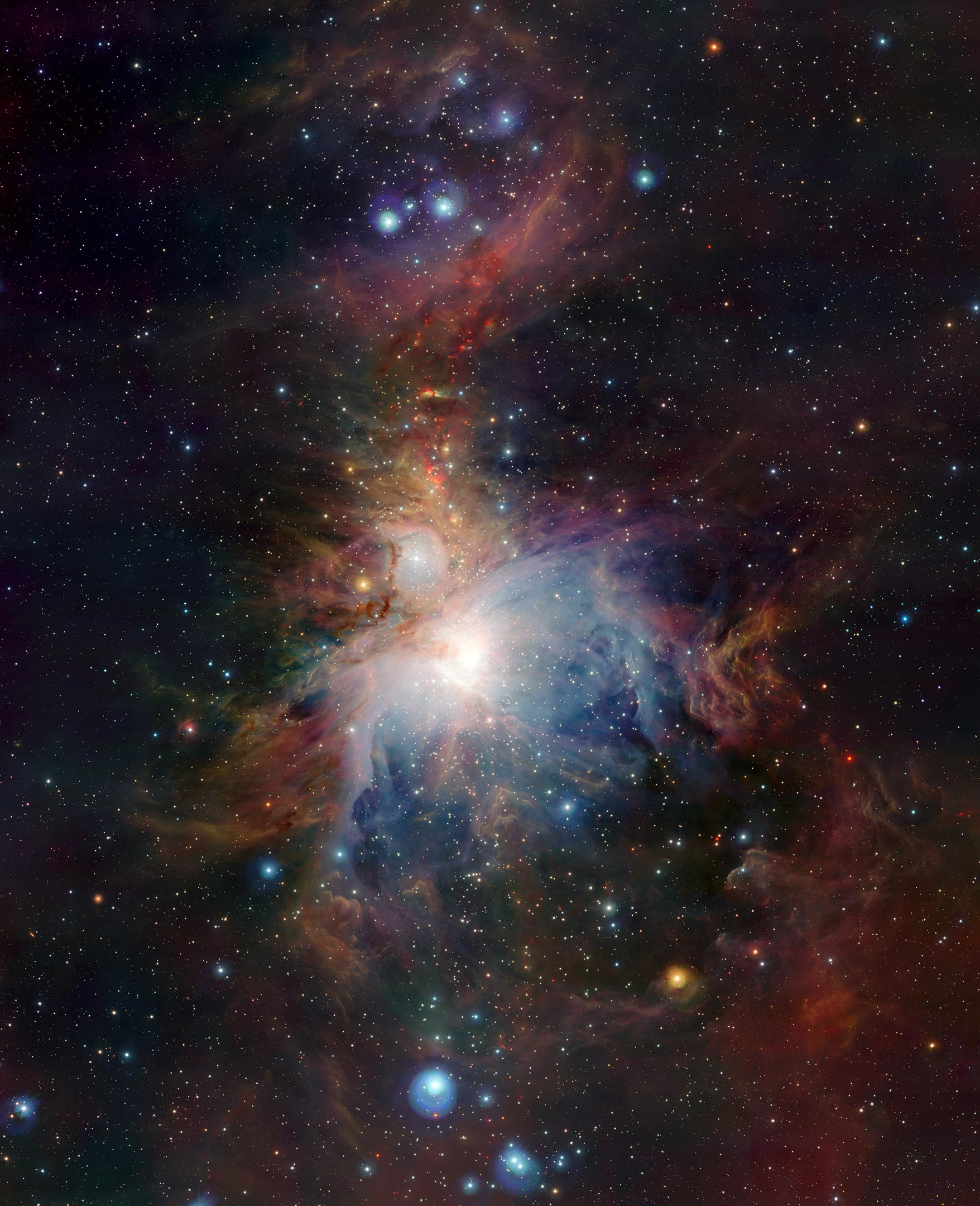
Taken by ESO’s VISTA survey telescope, this popular image shows a wide-field view of the Orion Nebula (Messier 42), which resides about 1,350 light-years from Earth.
The Orion Nebula reveals many of its hidden secrets in a dramatic image taken by ESO’s VISTA survey telescope. The telescope’s huge field of view can show the full splendor of the whole nebula and VISTA’s infrared vision also allows it to peer deeply into dusty regions that are normally hidden and expose the curious behavior of the very active young stars buried there.
VISTA — the Visible and Infrared Survey Telescope for Astronomy — is the latest addition to ESO’s Paranal Observatory. It is the largest survey telescope in the world and is dedicated to mapping the sky at infrared wavelengths. The large (4.1-meter or 13.5-foot) mirror, wide field of view and very sensitive detectors make VISTA a unique instrument. This dramatic new image of the Orion Nebula illustrates VISTA’s remarkable powers.
The Orion Nebula is a vast stellar nursery lying about 1,350 light-years from Earth. Although the nebula is spectacular when seen through an ordinary telescope, what can be seen using visible light is only a small part of a cloud of gas in which stars are forming. Most of the action is deeply embedded in dust clouds and to see what is really happening astronomers need to use telescopes with detectors sensitive to the longer wavelength radiation that can penetrate the dust. VISTA has imaged the Orion Nebula at wavelengths about twice as long as can be detected by the human eye.
A 3D panning (artist’s impression) on the Orion Nebula. Credit: ESO/M. Kornmesser
As in the many visible light pictures of this object, the new wide field VISTA image shows the familiar bat-like form of the nebula in the center of the picture as well as the fascinating surrounding area. At the very heart of this region lie the four bright stars forming the Trapezium, a group of very hot young stars pumping out fierce ultraviolet radiation that is clearing the surrounding region and making the gas glow. However, observing in the infrared allows VISTA to reveal many other young stars in this central region that cannot be seen in visible light.
In this zoom sequence we start with the familiar view of the bright constellation of Orion (The Hunter) to the right and the brilliant star Sirius to the lower-left. We then zoom in on the region of the hunter’s sword to reveal the Orion Nebula, also known as Messier 42, a vast stellar nursery about 1350 light-years from the Earth. As we close in further we shift to the view from the VISTA survey telescope, observing in the infrared part of the spectrum. The new telescope’s huge field of view allows it to image the whole nebula and its surroundings in a single picture and its infrared vision also means that it can peer deep into the normally hidden dusty regions and reveal the curious antics of the very active young stars buried there. Credit: ESO/J. Emerson/VISTA and R. Gendler. Music: John Dyson (from the album “Moonwind”). Acknowledgment: Cambridge Astronomical Survey Unit
Looking to the region above the center of the picture, curious red features appear that are completely invisible except in the infrared. Many of these are very young stars that are still growing and are seen through the dusty clouds from which they form. These youthful stars eject streams of gas with typical speeds of 700,000 km/hour (435,000 mi/hour) and many of the red features highlight the places where these gas streams collide with the surrounding gas, causing emission from excited molecules and atoms in the gas. There are also a few faint, red features below the Orion Nebula in the image, showing that stars form there too, but with much less vigor. These strange features are of great interest to astronomers studying the birth and youth of stars.
This image shows the power of the VISTA telescope to image wide areas of the sky quickly and deeply in the near-infrared part of the spectrum. The telescope is just starting to survey the sky and astronomers are anticipating a rich harvest of science from this unique ESO facility
Never miss a breakthrough: Join the SciTechDaily newsletter.
Follow us on Google and Google News.