
Close Menu
    Facebook X (Twitter) Instagram
    SciTechDaily
    • Biology
    • Chemistry
    • Earth
    • Health
    • Physics
    • Science
    • Space
    • Technology
    Facebook X (Twitter) Pinterest YouTube RSS
    SciTechDaily
    Home»Space»Unprecedented Detail: The Running Chicken Nebula Captured in 1.5-Billion-Pixel Masterpiece
    Space

    Unprecedented Detail: The Running Chicken Nebula Captured in 1.5-Billion-Pixel Masterpiece

    By European Southern Observatory (ESO)December 25, 20231 Comment5 Mins Read
    Facebook Twitter Pinterest Telegram LinkedIn WhatsApp Email Reddit
    Share
    Facebook Twitter LinkedIn Pinterest Telegram Email Reddit
    Running Chicken Nebula
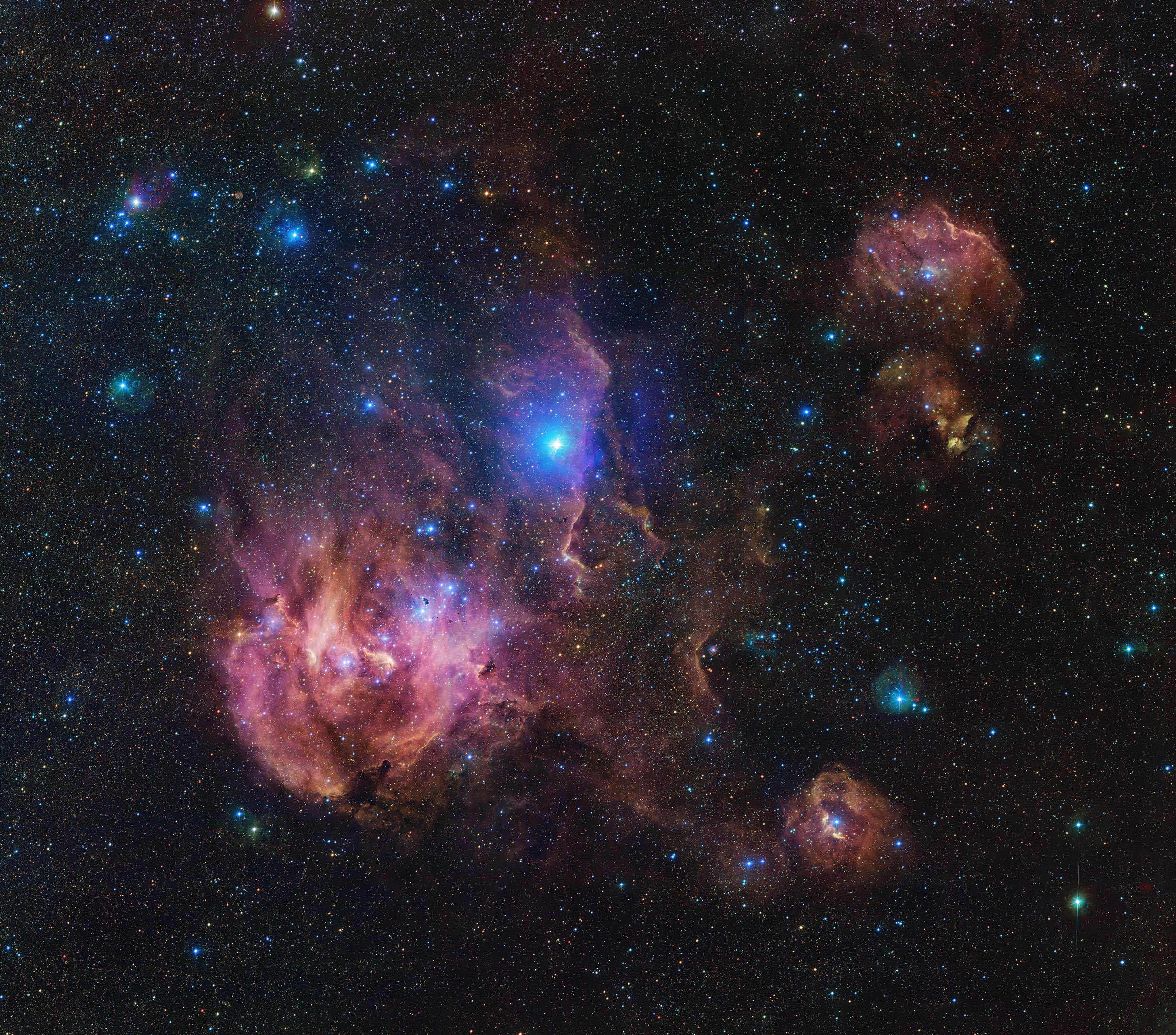
    The Running Chicken Nebula comprises several clouds, all of which we can see in this vast image from the VLT Survey Telescope (VST), hosted at ESO’s Paranal site. This 1.5-billion-pixel image spans an area in the sky of about 25 full Moons. The clouds shown in wispy pink plumes are full of gas and dust, illuminated by the young and hot stars within them. Credit: ESO/VPHAS+ team. Acknowledgment: CASU

    The ESO unveils a detailed image of the Running Chicken Nebula, located 6500 light-years away in the Centaurus constellation. This 1.5-billion-pixel image, captured by the VST, highlights young stars and regions like IC 2948 and IC 2944, offering a cosmic feast for the eyes.

    While many holiday traditions involve feasts of turkey, soba noodles, latkes, or Pan de Pascua, this year, the European Southern Observatory (ESO) is bringing you a holiday chicken. The so-called Running Chicken Nebula, home to young stars in the making, is revealed in spectacular detail in this 1.5-billion-pixel image captured by the VLT Survey Telescope (VST), hosted at ESO’s Paranal site in Chile.

    This vast stellar nursery is located in the constellation Centaurus (the Centaur), at about 6500 light-years from Earth. Young stars within this nebula emit intense radiation that makes the surrounding hydrogen gas glow in shades of pink.

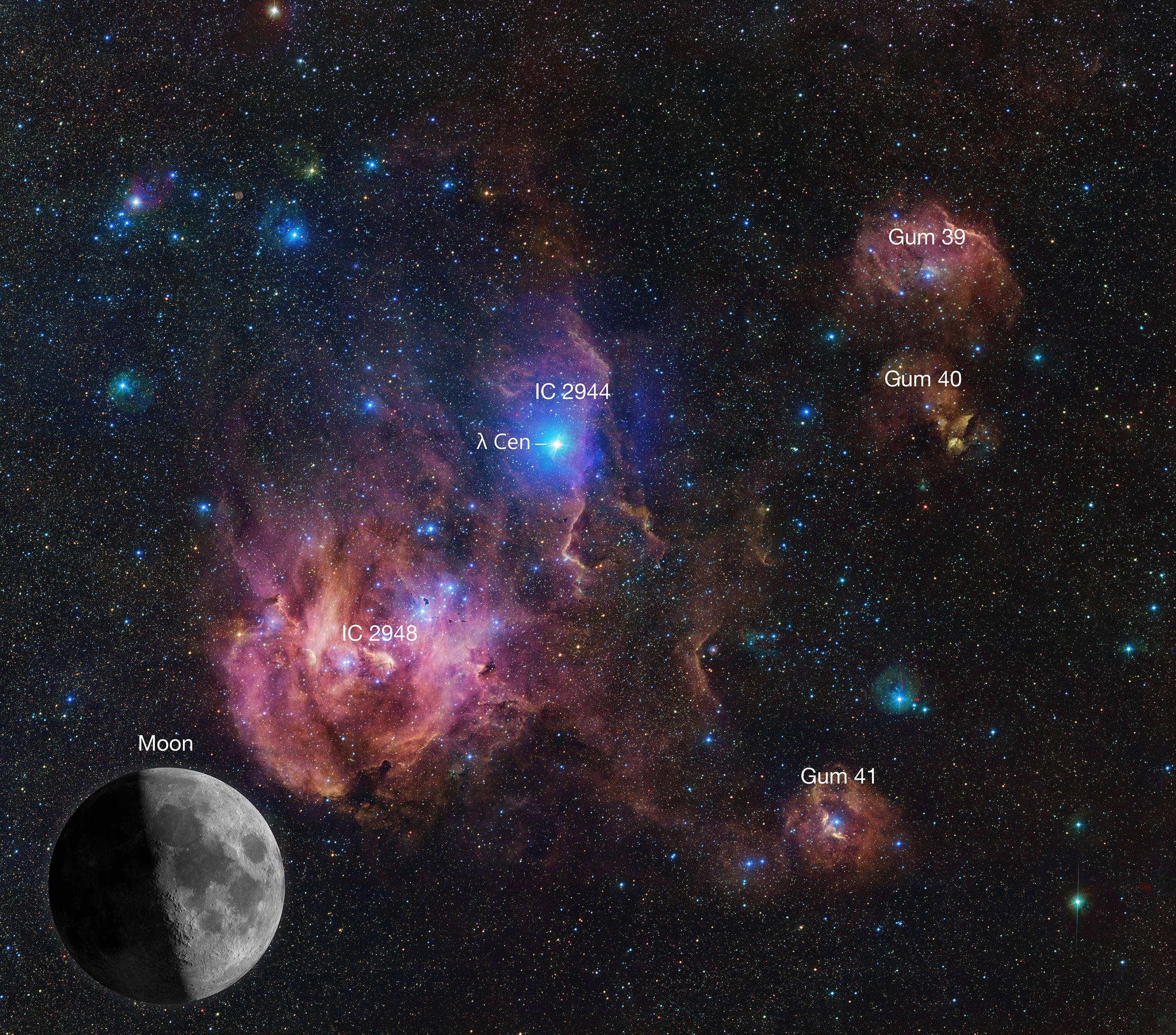
    The Running Chicken Nebula actually comprises several regions, all of which we can see in this vast image that spans an area in the sky of about 25 full Moons.[1] The brightest region within the nebula is called IC 2948, where some people see the chicken’s head and others its rear end. The wispy pastel contours are ethereal plumes of gas and dust. Towards the center of the image, marked by the bright, vertical, almost pillar-like, structure, is IC 2944. The brightest twinkle in this particular region is Lambda Centauri, a star visible to the naked eye that is much closer to us than the nebula itself.
    Running Chicken Nebula Annotated
    The Running Chicken Nebula comprises several clouds, the most prominent of which are labeled in this vast image from the VLT Survey Telescope (VST), hosted at ESO’s Paranal site. The bright star labeled Lambda Centauri is actually much closer to us than the nebula itself, and can be seen with the naked eye. The clouds shown in wispy pink plumes are full of gas and dust, illuminated by the young and hot stars within them. Overall, this image spans an area in the sky of about 25 full Moons, one of which is shown to scale for reference. Credit: ESO/VPHAS+ team. Acknowledgment: CASU

    There are, however, many young stars within IC 2948 and IC 2944 themselves — and while they might be bright, they’re most certainly not merry. As they spit out vast amounts of radiation, they carve up their environment much like, well, a chicken. Some regions of the nebula, known as Bok globules, can withstand the fierce bombardment from the ultraviolet radiation pervading this region. If you zoom in to the image, you might see them: small, dark, and dense pockets of dust and gas dotted across the nebula.

    Other regions pictured here include, to the upper right, Gum 39 and 40, and to the lower right, Gum 41. Aside from nebulae, there are countless orange, white, and blue stars, like fireworks in the sky. Overall in this image, there are more wonders than can be described — zoom in and pan across, and you’ll have a feast for the eyes.


    This 3D animation of the Running Chicken Nebula imagines what it might feel like to fly close to these swirling clouds of gas and dust. This video is based on a real image from the VLT Survey Telescope, hosted at ESO’s Paranal site; however, the 3D location of the stars shown here is only indicative. Credit: ESO/VPHAS+ team. Acknowledgment: CASU

    This image is a large mosaic comprising hundreds of separate frames carefully stitched together. The individual images were taken through filters that let through light of different colors, which were then combined into the final result presented here. The observations were conducted with the wide-field camera OmegaCAM on the VST, a telescope owned by the National Institute for Astrophysics in Italy (INAF) and hosted by ESO at its Paranal site in Chile’s Atacama Desert that is ideally suited for mapping the southern sky in visible light. The data that went into making this mosaic were taken as part of the VST Photometric Hα Survey of the Southern Galactic Plane and Bulge (VPHAS+), a project aimed at better understanding the life cycle of stars.
    Running Chicken Nebula Centaurus Constellation Sky Chart
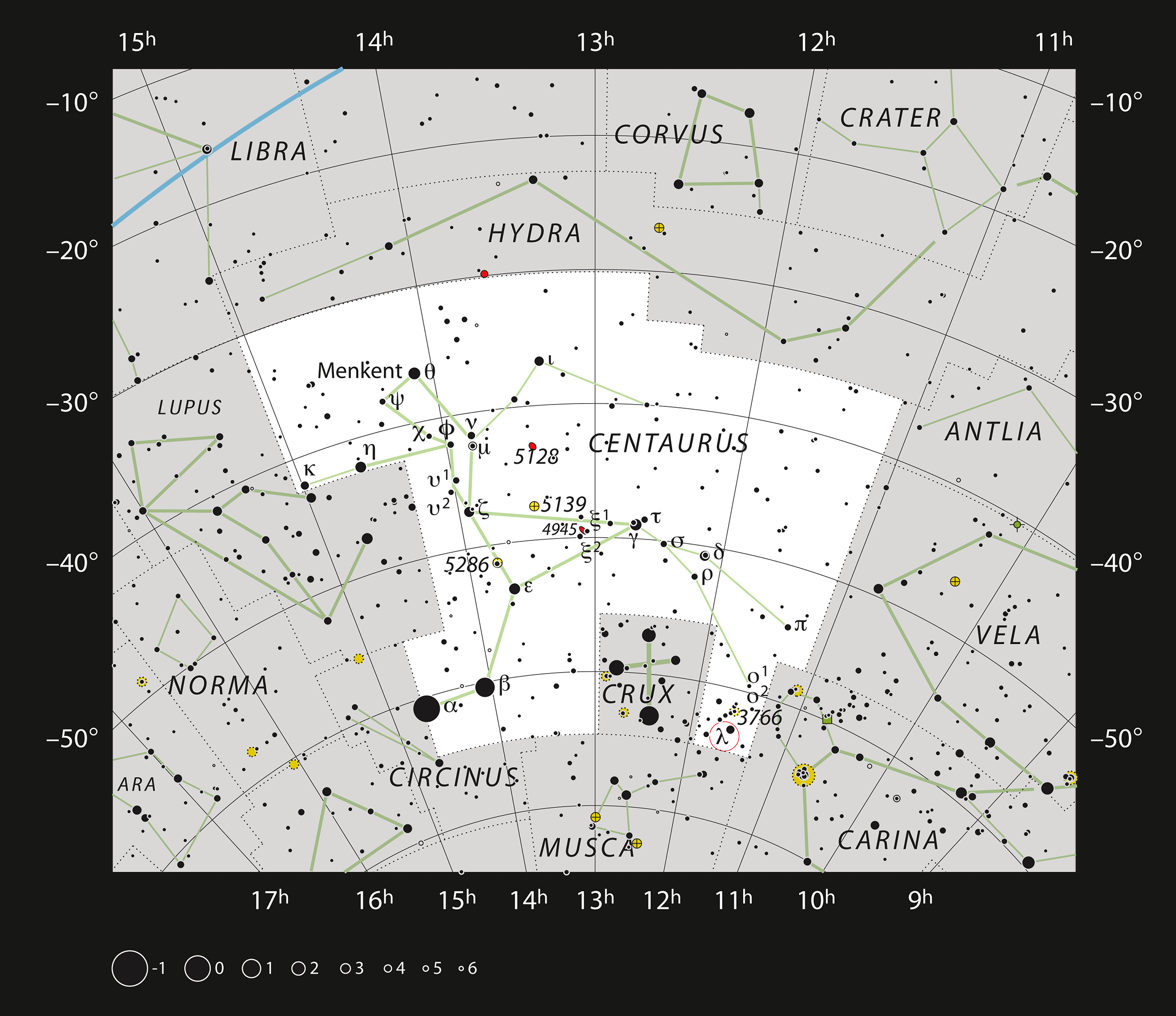
    This chart shows the location of the Running Chicken Nebula (IC2944) in the large southern constellation of Centaurus (The Centaur). This map shows most of the stars visible to the unaided eye under good conditions and the location of the nebula itself is marked with a red circle. Although the star cluster IC 2948, associated with this nebula, is easily seen in a small telescope, the nebula is very faint and was only discovered photographically early in the 20th century. Credit: ESO, IAU and Sky & Telescope

    Notes

    1. This image, edge to edge, is 270 light-years wide. It would take an average chicken almost 21 billion years to run across it. That’s much longer than our Universe has been around for.

    Access the full-size 3.9 GB image here.

    Never miss a breakthrough: Join the SciTechDaily newsletter.
    Follow us on Google and Google News.

    Astronomy Astrophysics European Southern Observatory Nebula Popular
    Share. Facebook Twitter Pinterest LinkedIn Email Reddit

    Related Articles

    “We Found Something Never Seen Before” – Mysterious Shock Wave Around Dead Star Surprises Astronomers

    “Doesn’t Make Any Sense” – Star Pair That Shouldn’t Exist Shocks Astronomers

    “Meteorological Beast in Our Solar System” – Powerful Stratospheric Winds Measured on Jupiter for the First Time

    Astronomers Have Discovered the Most Distant Source of Radio Emission Ever Known – 13 Billion Light-Years Away

    Distant Colliding Galaxy Dying Out As It Loses the Ability to Form Stars – Ejecting 10,000 Suns-Worth of Gas a Year

    Puzzling Six-Exoplanet System Discovered With Resonant Rhythmic Movement

    Death by Spaghettification: Telescopes Record Last Moments of Star Devoured by a Black Hole

    Galaxies Trapped in the Web of a Supermassive Black Hole – Cosmic “Spider’s Web” of Gas Extends Over 300 Times the Size of the Milky Way

    Planetary Nebula Fleming 1 Likely Has Two White Dwarfs Circling Each Other at Its Center

    1 Comment

    1. Jojo on December 25, 2023 7:47 pm

      Why is the universe so big and humans so puny?

      Reply
    Leave A Reply Cancel Reply

    • Facebook
    • Twitter
    • Pinterest
    • YouTube

    Don't Miss a Discovery

    Subscribe for the Latest in Science & Tech!

    Trending News

    Scientists Discover Game-Changing New Way To Treat High Cholesterol

    This Small Change to Your Exercise Routine Could Be the Secret to Living Longer

    Scientists Discover 430,000-Year-Old Wooden Tools, Rewriting Human History

    AI Could Detect Early Signs of Alzheimer’s in Under a Minute – Far Before Traditional Tests

    What if Dark Matter Has Two Forms? Bold New Hypothesis Could Explain a Cosmic Mystery

    This Metal Melts in Your Hand – and Scientists Just Discovered Something Strange

    Beef vs. Chicken: Surprising Results From New Prediabetes Study

    Alzheimer’s Breakthrough: Scientists Discover Key Protein May Prevent Toxic Protein Clumps in the Brain

    Follow SciTechDaily
    • Facebook
    • Twitter
    • YouTube
    • Pinterest
    • Newsletter
    • RSS
    SciTech News
    • Biology News
    • Chemistry News
    • Earth News
    • Health News
    • Physics News
    • Science News
    • Space News
    • Technology News
    Recent Posts
    • Researchers Discover Unknown Beetle Species Just Steps From Their Lab
    • Jellyfish Caught Feasting on Exploding Sea Worms for the First Time
    • Ancient “Spaghetti” in Dogs’ Hearts Reveals Heartworm’s Shocking Origins
    • Milk Nanoparticles Could Revolutionize Treatment for Deadly Bile Duct Cancer
    • Largest-Ever Study Finds Medicinal Cannabis Ineffective for Anxiety, Depression, PTSD
    Copyright © 1998 - 2026 SciTechDaily. All Rights Reserved.
    • Science News
    • About
    • Contact
    • Editorial Board
    • Privacy Policy
    • Terms of Use

    Type above and press Enter to search. Press Esc to cancel.