
Witnessing a Galaxy’s Death in Action
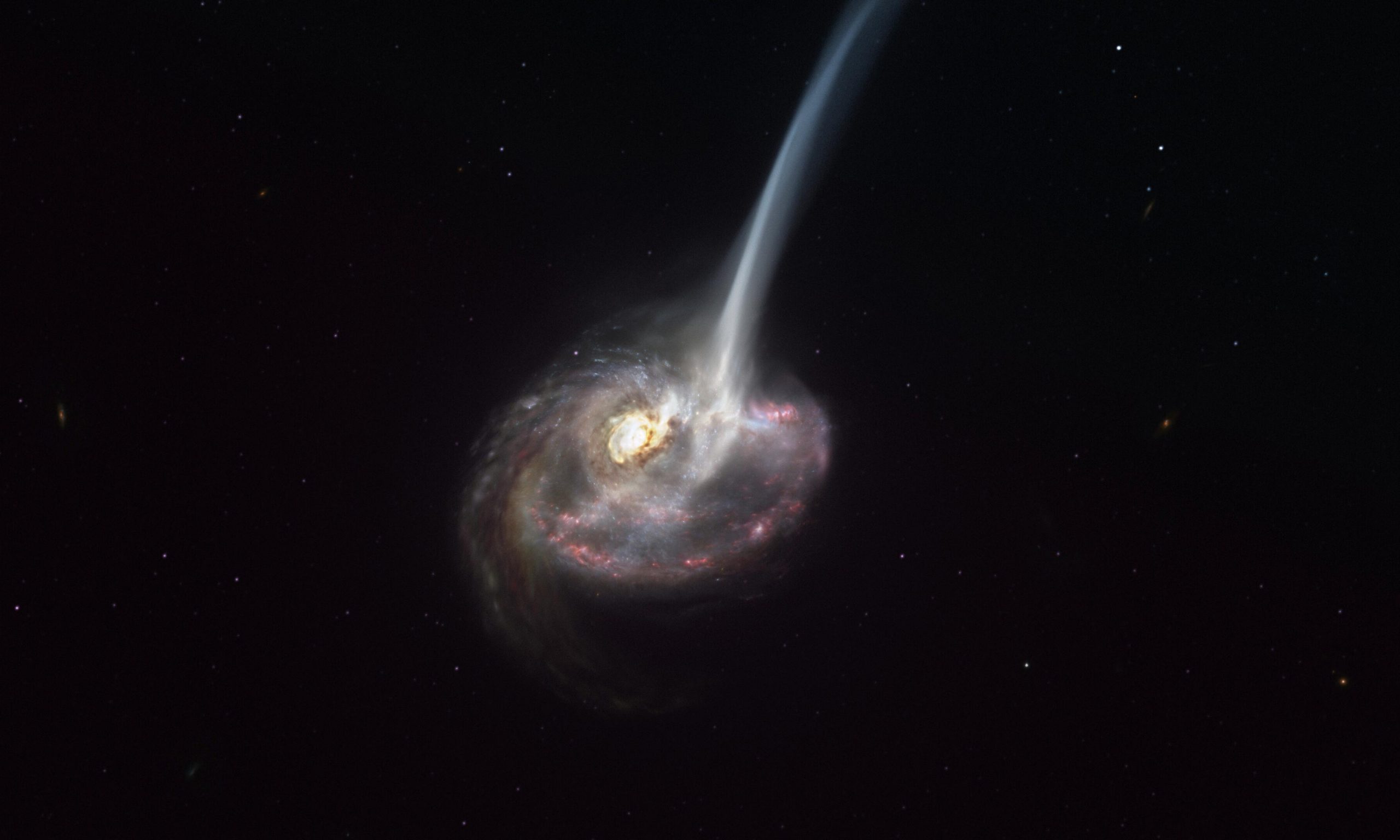
Galaxies begin to “die” when they stop forming stars, but until now astronomers had never clearly glimpsed the start of this process in a far-away galaxy. Using the Atacama Large Millimeter/submillimeter Array (ALMA), in which the European Southern Observatory (ESO) is a partner, astronomers have seen a galaxy ejecting nearly half of its star-forming gas. This ejection is happening at a startling rate, equivalent to 10,000 Suns-worth of gas a year — the galaxy is rapidly losing its fuel to make new stars. The team believes that this spectacular event was triggered by a collision with another galaxy, which could lead astronomers to rethink how galaxies stop bringing new stars to life.
“This is the first time we have observed a typical massive star-forming galaxy in the distant Universe about to ‘die’ because of a massive cold gas ejection,” says Annagrazia Puglisi, lead researcher on the new study, from the Durham University, UK, and the Saclay Nuclear Research Centre (CEA-Saclay), France. The galaxy, ID2299, is distant enough that its light takes some 9 billion years to reach us; we see it when the Universe was just 4.5 billion years old.
The gas ejection is happening at a rate equivalent to 10,000 Suns per year, and is removing an astonishing 46% of the total cold gas from ID2299. Because the galaxy is also forming stars very rapidly, hundreds of times faster than our Milky Way, the remaining gas will be quickly consumed, shutting down ID2299 in just a few tens of million years.
A Galactic Merger Sparks the Outflow
The event responsible for the spectacular gas loss, the team believes, is a collision between two galaxies, which eventually merged to form ID2299. The elusive clue that pointed the scientists towards this scenario was the association of the ejected gas with a “tidal tail”. Tidal tails are elongated streams of stars and gas extending into interstellar space that result when two galaxies merge, and they are usually too faint to see in distant galaxies. However, the team managed to observe the relatively bright feature just as it was launching into space, and were able to identify it as a tidal tail.
Most astronomers believe that winds caused by star formation and the activity of black holes at the centers of massive galaxies are responsible for launching star-forming material into space, thus ending galaxies’ ability to make new stars. However, the new study published today in Nature Astronomy suggests that galactic mergers can also be responsible for ejecting star-forming fuel into space.
Revisiting Old Assumptions
“Our study suggests that gas ejections can be produced by mergers and that winds and tidal tails can appear very similar,” says study co-author Emanuele Daddi of CEA-Saclay. Because of this, some of the teams that previously identified winds from distant galaxies could in fact have been observing tidal tails ejecting gas from them. “This might lead us to revise our understanding of how galaxies ‘die’,” Daddi adds.
Puglisi agrees about the significance of the team’s finding, saying: “I was thrilled to discover such an exceptional galaxy! I was eager to learn more about this weird object because I was convinced that there was some important lesson to be learned about how distant galaxies evolve.”
This surprising discovery was made by chance, while the team were inspecting a survey of galaxies made with ALMA, designed to study the properties of cold gas in more than 100 far-away galaxies. ID2299 had been observed by ALMA for only a few minutes, but the powerful observatory, located in northern Chile, allowed the team to collect enough data to detect the galaxy and its ejection tail.
“ALMA has shed new light on the mechanisms that can halt the formation of stars in distant galaxies. Witnessing such a massive disruption event adds an important piece to the complex puzzle of galaxy evolution,” says Chiara Circosta, a researcher at the University College London, UK, who also contributed to the research.
In the future, the team could use ALMA to make higher-resolution and deeper observations of this galaxy, enabling them to better understand the dynamics of the ejected gas. Observations with the future ESO’s Extremely Large Telescope could allow the team to explore the connections between the stars and gas in ID2299, shedding new light on how galaxies evolve.
Read Galaxy Mergers Could Limit Star Formation for more on this research.
Reference: “A titanic interstellar medium ejection from a massive starburst galaxy at redshift 1.4” by Annagrazia Puglisi, Emanuele Daddi, Marcella Brusa, Frederic Bournaud, Jeremy Fensch, Daizhong Liu, Ivan Delvecchio, Antonello Calabrò, Chiara Circosta, Francesco Valentino, Michele Perna, Shuowen Jin, Andrea Enia, Chiara Mancini and Giulia Rodighiero, 11 January 2021, Nature Astronomy.
DOI 10.1038/s41550-020-01268-x
The team is composed of A. Puglisi (Centre for Extragalactic Astronomy, Durham University, UK and CEA, IRFU, DAp, AIM, Université Paris-Saclay, Université Paris Diderot, Sorbonne Paris Cité, CNRS, France [CEA]), E. Daddi (CEA), M. Brusa (Dipartimento di Fisica e Astronomia, Università di Bologna, Italy and INAF-Osservatorio Astronomico di Bologna, Italy), F. Bournaud (CEA), J. Fensch (Univ. Lyon, ENS de Lyon, Univ. Lyon 1, CNRS, Centre de Recherche Astrophysique de Lyon, France), D. Liu (Max Planck Institute for Astronomy, Germany), I. Delvecchio (CEA), A. Calabrò (INAF-Osservatorio Astronomico di Roma, Italy), C. Circosta (Department of Physics & Astronomy, University College London, UK), F. Valentino (Cosmic Dawn Center at the Niels Bohr Institute, University of Copenhagen and DTU-Space, Technical University of Denmark, Denmark), M. Perna (Centro de Astrobiología (CAB, CSIC–INTA), Departamento de Astrofísica, Spain and INAF-Osservatorio Astrofisico di Arcetri, Italy), S. Jin (Instituto de Astrofísica de Canarias and Universidad de La Laguna, Dpto. Astrofísica, Spain), A. Enia (Dipartimento di Fisica e Astronomia, Università di Padova, Italy [Padova]), C. Mancini (Padova) and G. Rodighiero (Padova and INAF-Osservatorio Astronomico di Padova, Italy).
Never miss a breakthrough: Join the SciTechDaily newsletter.
Follow us on Google and Google News.