
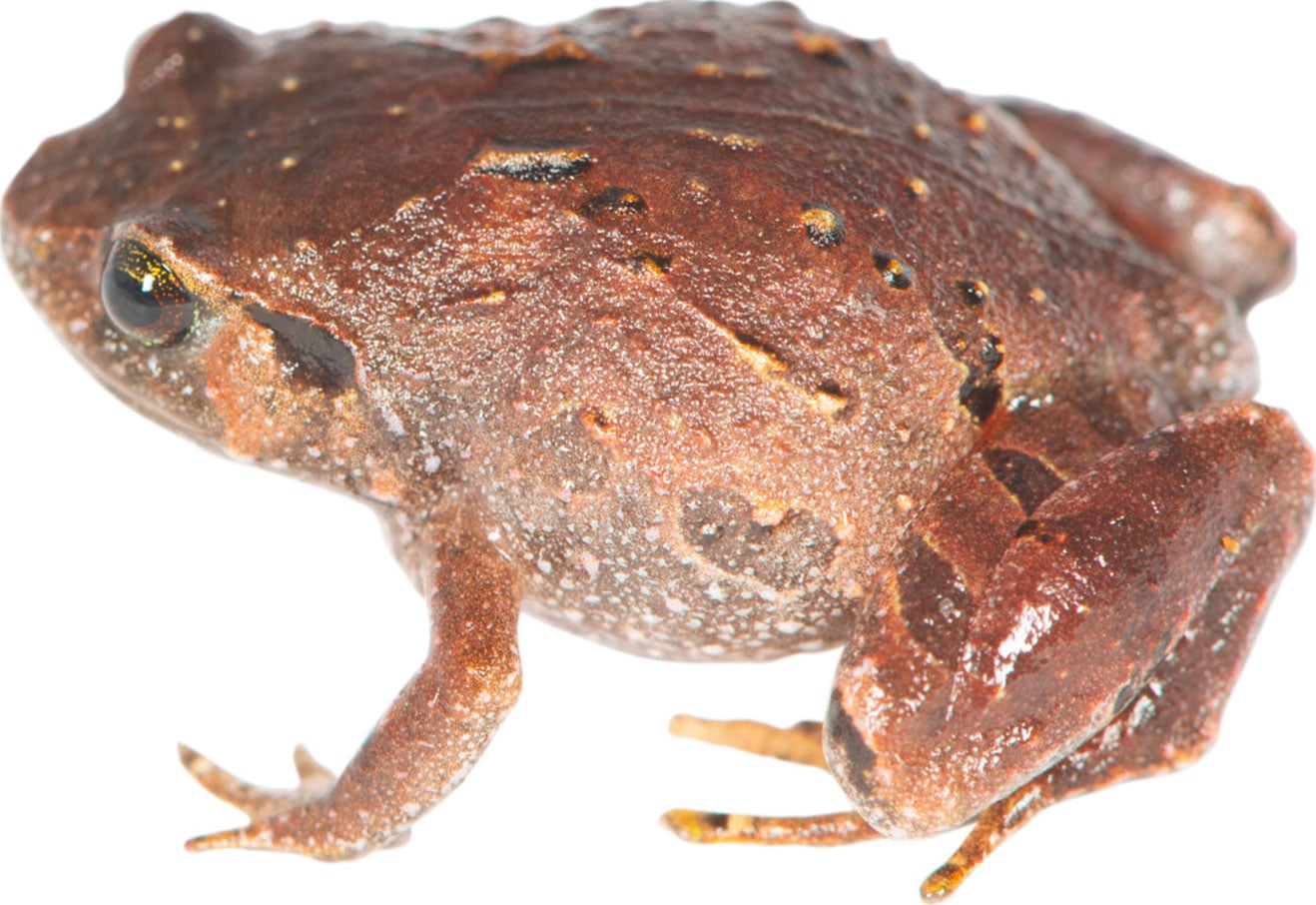
Seven newly identified diamond frogs reveal hidden diversity that is already influencing conservation planning in Madagascar.
Beneath the leaf litter of Madagascar’s forests, diamond frogs can remain hidden for most of their lives. An international research group has now described seven new species of these elusive amphibians (Rhombophryne), showing that the group contains even more diversity than scientists had recognized.
Correctly identifying species and determining where they live are essential steps in documenting biodiversity and protecting threatened wildlife. By combining field discoveries, museum specimens, and advanced DNA analysis, the researchers uncovered overlooked species and resolved a taxonomic problem that had persisted for decades. The clarified names and distributions provide a stronger basis for conservation work in Madagascar’s rapidly disappearing forests.
“Diamond frogs have been hiding their diversity beneath our feet,” said Dr. Mark D. Scherz, Curator of Herpetology at the Natural History Museum Denmark and lead author of the study.
“Many species spend most of their lives beneath the leaf litter, and even when they emerge, they can look deceptively similar,” he added.
Hidden lifestyles concealed major differences
Diamond frogs are among the most unusual amphibians native to Madagascar. Some have exceptionally rounded bodies similar to the rain frogs of mainland Africa and spend much of their time beneath the forest floor. Others have long legs suited to mossy habitats or sturdy bodies adapted to life on the ground.
Most appear brown when first seen, but several species carry vivid orange patches or contrasting white or black markings on their thighs and lower backs. These hidden colors may help startle potential predators.
Because the frogs are difficult to find and often look alike, they remain among Madagascar’s least studied vertebrates.
Museum DNA resolved decades of uncertainty
The investigation began more than 12 years ago, when repeated expeditions produced frogs that researchers recognized as undescribed species. Naming them was not straightforward because older scientific names could not be confidently connected to the genetic lineages found in living populations.
“When I started this project twelve years ago, we already knew there were several species waiting to be described, and almost every expedition to Madagascar revealed another one. Some were relatively straightforward to describe, but others were complicated by uncertainty surrounding older species names. Untangling that puzzle took years,” Scherz said.
The decisive evidence came from museomics, which involves recovering and sequencing DNA from historical museum specimens. Researchers compared genetic information from these preserved frogs with newly collected material, then added evidence from external anatomy, skeletal structure, and frog calls.
This combined approach allowed them to connect historical species names with the correct evolutionary lineages and settle long-running questions about the group’s classification.
Historical specimens, including examples used to establish the original species descriptions, were particularly important for confirming several identities.
“Museum collections are far more than archives of the past – they are essential scientific resources for understanding biodiversity today,” said Dr. Alice Petzold of the University of Potsdam, who led the museomics work.
“By sequencing historical specimens, including the original type specimens, we were able to answer questions that have persisted for generations,” she added.
New species are shaping forest protection
The project brought together scientists and institutions in Madagascar and Europe, illustrating how species research can directly support conservation. Many diamond frogs live in forests that are becoming increasingly fragmented through deforestation, but basic information about numerous species remains scarce.
“For many species, we still know almost nothing about their breeding biology, population sizes or ecological requirements. Without that knowledge, it becomes much more difficult to assess their conservation status and protect them effectively,” said co-author Dr. Andolalao Rakotoarison of the Institut d’Enseignement Supérieur de Soavinandriana Itasy, Madagascar.
The results are already contributing to conservation decisions. At a protected area planning workshop held in March 2026 through Madagascar’s Biodiversity 30×30 Program, several of the newly named frogs, including Rhombophryne quentini, informed proposals to strengthen and enlarge protected areas.
The seven additions raise the number of recognized Rhombophryne species to 27. Even so, the researchers conclude that more unnamed species almost certainly remain in Madagascar and have yet to receive formal scientific descriptions.
Although the work resolves several long-standing questions, Dr. Mark D. Scherz views it as a starting point for further discovery.
“Every newly described species represents millions of years of unique evolutionary history. The more we learn about Madagascar’s remarkable amphibians, the clearer it becomes that there is still an enormous amount left to discover,” he said.
Reference: “A wealth of riches: A comprehensive revision of diamond frogs, genus Rhombophryne Boettger, 1880 (Microhylidae: Cophylinae), with the description of seven new species” by Mark D. Scherz, Frank Glaw, Alice Petzold, Franco Andreone, Jörn Köhler, Achille P. Raselimanana, Carl Hutter, Francesco Belluardo, Andolalao Rakotoarison, Michael Hofreiter, Miguel Vences and Angelica Crottini, 22 July 2026, Vertebrate Zoology.
DOI: 10.3897/vz.76.e172567
Never miss a breakthrough: Join the SciTechDaily newsletter.
Follow us on Google and Google News.