
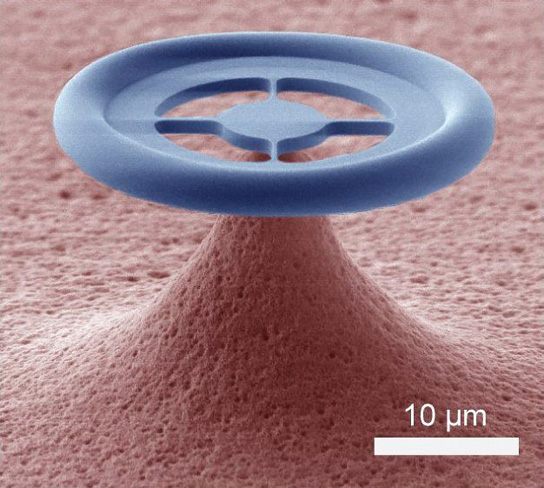
By using a laser to illuminate an object, physicists in the EPFL’s Laboratory of Photonics and Quantum Measurement have shown that it is possible to control the motion of an object, large enough to be seen with the naked eye, at the level where quantum mechanics dominates. Radiation pressure damping by laser light cools the motion down while the interaction between light and the movement of the oscillator form an intimate connection.
Researchers supported by the Swiss National Science Foundation (SNSF) have demonstrated a microscopic system in which light can be converted into a mechanical oscillation and back. This interaction is so strong that it becomes possible to control the motion of the oscillator at the level where quantum mechanics governs its behavior.
Since the early 20th century, it is known that the movement of objects is ultimately governed by the laws of quantum mechanics, which predict some intriguing phenomena: An object could simultaneously be in two places at the same time, and it should always be moving a little, even at a temperature of absolute zero – the oscillator is then said to be in its quantum ground state. Yet we never experience such behavior in the things we see around us and interact with in daily life.
Quantum strangeness
Indeed, quantum effects can only be observed on very well isolated systems, where the coupling to the surrounding environment is extremely weak. For large objects, the unavoidable coupling quickly washes out the quantum properties, in a process known as decoherence. Until recently, scientists were only able to observe quantum mechanical traits in the motion of tiny systems, such as single atoms or molecules. Now, a team of physicists in the EPFL’s Laboratory of Photonics and Quantum Measurement directed by Tobias Kippenberg has shown that it is possible to control the motion of an object, sufficiently large to be seen with the naked eye, at the level where quantum mechanics dominates. They achieve this by illuminating the object with laser light. The results are published in this week’s edition of Nature magazine*.
A ring of light
The structure is a carefully crafted glass donut on a microchip, with a diameter of 30 micrometers (about one-half of a hair’s diameter) which can vibrate at a well-defined frequency. At the same time, it acts as a racetrack for light, which can circle around the circumference of the donut. In turning the bend, the light exerts a little force on the glass surface, an effect called ‘radiation pressure’. Although this force is very small, in these structures it can become appreciable since light circles around the structure up to a million times before being lost. The radiation pressure force can make the ring move, causing it to vibrate like a finger running along the rim of a wineglass. But it can in fact also dampen the vibrations, and thus cool down the oscillatory motion.
Cold, colder, …
Cooling is crucial to reaching the regime of quantum mechanical motion, as this is normally overshadowed by random thermal fluctuations. For this reason, the structure is brought to a temperature of less than one degree above absolute zero. Radiation pressure damping by laser light launched into the donut then cools the motion down by an extra factor of 100. The oscillator is cooled so much that it spends a large fraction of the time in its quantum ground state. But even more importantly: The interaction between light and the movement of the oscillator can be made so strong that the two form an intimate connection. A small excitation in the form of a light pulse can fully transform into a small vibration and back again. For the first time, this transformation between light and motion is made to occur within a time that is short enough such that the quantum properties of the original light pulse are not lost in the process through decoherence. By outpacing decoherence, the current results provide a powerful way to control the quantum properties of the oscillator motion, and see the peculiar predictions of quantum mechanics at play in human-made objects.
Never miss a breakthrough: Join the SciTechDaily newsletter.
Follow us on Google and Google News.
3 Comments
Again, Tetryonics comes to the rescue…
Given the range and applied scope of Quantum Physics in today’s Technological World there remains a driving desire to rationalize our numerous disparate scientific theories into one coherent discipline that can be applied equally to the Quantum and Cosmological scales of our Universe.
Such a theory would need to preserve the currently observed outcomes and present established theories in a new light, offering additional testable predictions of its own, and ideally do so in a manner that is simpler than that of the established quantum theories and hypotheses.
Many Foundational properties of Quantum Mechanics remain unaddressed by scientific theory and in the following pages an overview of the key quantum properties challenging our current scientific advancement will be highlighted, including a number of assumptions that currently impede the development of a fully realized, coherent solution to all of our current scientific questions.
In addition to revolutionizing our understanding of Quantum geometries and interactions, Tetryonic Theory facilitates the development of a whole new field of Physical maths based on equilateral triangles in lieu of the spherical geometries historically employed.
It effortlessly merges the tested features of Classical mechanics with the statistical probabilities of quantum mechanics and scales up to the cosmological scales of General Relativity.
no
I’m glad that this article (fascinating overall) contains a detail often overlooked in science articles written for the general population. It describes the glass ring as being “30 micrometers, or half the width of a human hair”. Extrapolate this to conclude that a human hair has a width of 60 microns (micrometers).
We all have an intuitive sense of a human hair (and we know that the width may vary by quite a degree).
I’ve read articles which described something as “one one thousandth” the width of a human hair (for which I have no sense of scale for) unless I can translate that into something more sensible (60 nanometers), which is about “molecular size” to an average civilian.