
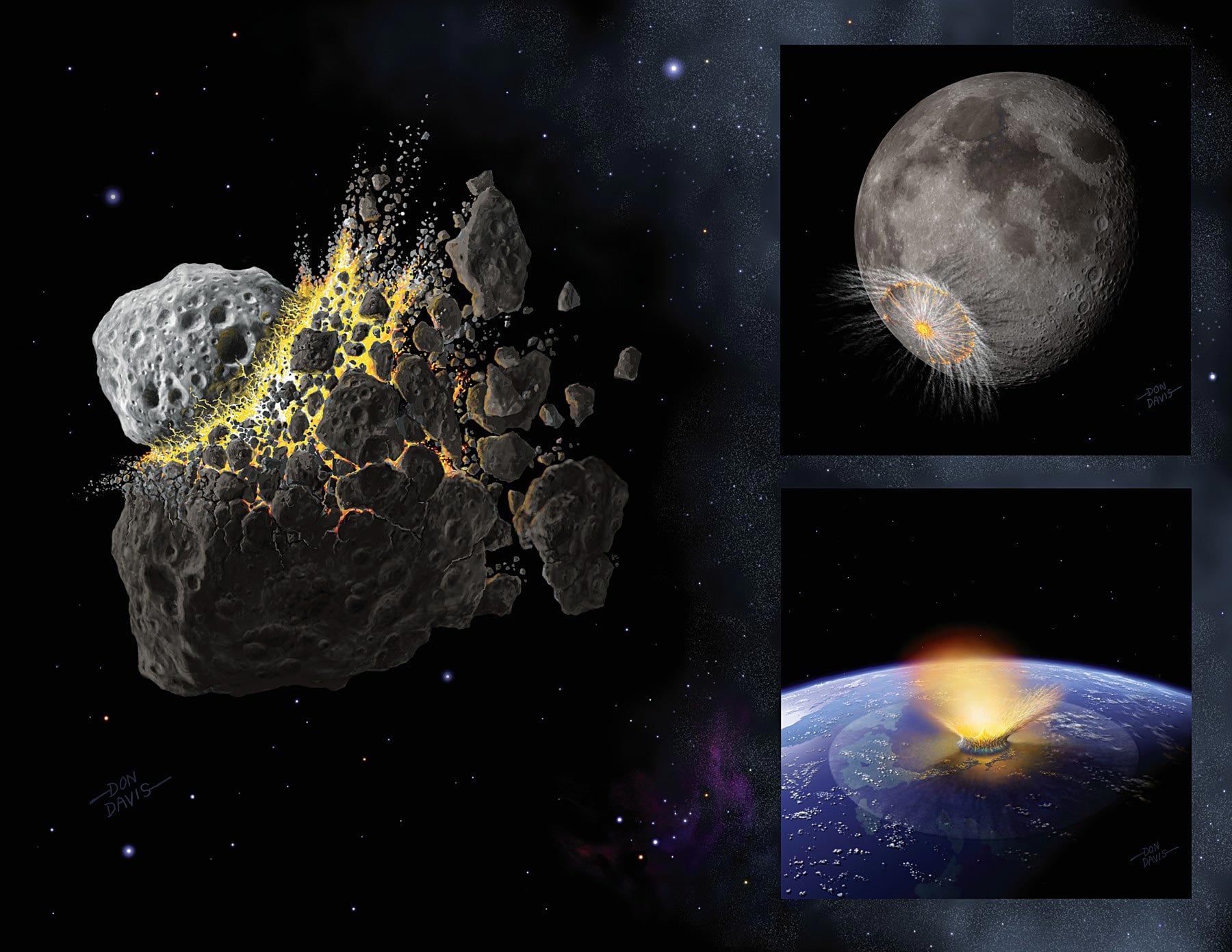
A shattered asteroid may have unleashed a long-lasting cosmic barrage that left scars across the inner solar system and possibly changed Earth’s history.
A violent asteroid collision may have sent a wave of debris sweeping through the inner solar system about 800 million years ago, potentially affecting Earth, the Moon, and Mars.
A new study led by the Southwest Research Institute connects that ancient bombardment to the breakup of the Eulalia parent body, a large object in the main asteroid belt between Mars and Jupiter. According to the researchers, the collision may have produced an enormous supply of fragments that later crossed the paths of the rocky planets.
The event could help explain a mysterious increase in large impacts recorded on the Moon from the same period. It may also have had broader geological and biological consequences on Earth, although direct evidence from such an ancient era is difficult to preserve.
How Ancient Impacts May Have Shaped Life
“The role impacts have played in shaping the origin and evolution of life in our solar system is poorly understood,” said Dr. William Bottke, an executive director in SwRI’s Solar System Science and Exploration Division in Boulder, Colorado. He also directs the Center for Lunar Origin and Evolution (CLOE), SwRI’s team in NASA’s Solar System Exploration Research Virtual Institute, and is lead author of a paper describing this research. “The heavily cratered surface of the Moon serves as a reminder of the large impacts in Earth’s past, but so far, only the Chicxulub impact event 66 million years ago has been strongly linked to a specific effect on life, namely the mass extinction of the dinosaurs.”
Chicxulub is the most famous example of an impact altering life on Earth. That asteroid struck near what is now Mexico and triggered environmental changes associated with the disappearance of the nonavian dinosaurs.
Researchers suspect that other impact episodes may also have influenced the planet’s climate, geology, and living organisms. Proving those connections becomes much harder as scientists look further back in time.
Why Earth’s Oldest Craters Are So Hard to Find
Earth does not preserve its surface as neatly as the Moon. Plate tectonics continually moves and recycles sections of the crust, volcanoes create new terrain, and erosion gradually removes older formations.
Because of this constant renewal, geological evidence of impacts older than 650 million years is especially difficult to identify. Many ancient craters have likely been buried, distorted, or destroyed.
The Moon offers a much more stable record. With no plate tectonics, flowing water, or thick atmosphere to erase its features, its surface retains scars from impacts that occurred billions of years ago.
“These rare events, triggered by large, well-positioned collisions in the main asteroid belt, bombard all inner solar system worlds,” Bottke said. “So, evidence preserved on the Moon’s static surface can be used to infer what happened on Earth and Mars in ancient times.”
Clues From Apollo Impact Glass
Previous research has suggested that the Moon experienced a noticeable rise in large impacts around 800 million years ago. The evidence comes partly from estimated crater ages and from impact glass collected during the Apollo missions.
Impact glass forms when the energy of a collision melts rock almost instantly. The molten material then cools and hardens, preserving a time stamp that scientists can use to estimate when an impact occurred.
The unresolved question was where the objects responsible for this apparent spike came from.
“Our cosmic forensics team used collisional and dynamical models to link these to the formation of the Eulalia asteroid family, when a primitive carbonaceous chondrite-like object collided with another object,” Bottke said. “The location of the parent asteroid was key — it broke up on the brink of the gravitational 3:1 mean motion resonance with Jupiter.”
Carbonaceous chondrites are primitive, carbon-rich space rocks that contain material left over from the solar system’s formation. An asteroid family is a collection of fragments that share similar orbits because they originated in the breakup of a larger parent body.
Jupiter’s Gravitational Escape Route
The Eulalia parent body appears to have broken apart near an especially important orbital region known as the J3:1 resonance.
In this configuration, an asteroid circles the Sun three times during each orbit completed by Jupiter. Repeated gravitational tugs from the giant planet can destabilize an asteroid’s path and eventually push it out of the main belt.
This makes the J3:1 resonance a kind of gravitational escape route. Once objects enter it, their orbits can shift into regions that cross the paths of Earth, Mars, and other planets. Many near-Earth asteroids are believed to have traveled through this same part of the asteroid belt.
The researchers’ simulations indicate that roughly half of the Eulalia fragments entered the resonance almost immediately. This would have sent a large amount of rocky debris into the inner solar system and sharply increased the number of impacts on the Moon and the terrestrial planets.
A Bombardment Lasting Millions of Years
The initial rush of fragments may not have been the end of the event. Over the following 100-150 million years, the models suggest that another 25% of the debris gradually moved into the J3:1 resonance.
That slower migration was driven by the Yarkovsky effect, a subtle force caused by heat. An asteroid absorbs sunlight and later releases that energy as infrared radiation. The tiny push produced by this uneven heat emission can gradually alter the object’s orbit over very long periods.
Although the force is extremely weak, it can move small asteroids far enough to place them inside a powerful resonance with Jupiter. From there, they may be redirected toward the inner solar system.
The results show that the breakup of the Eulalia parent body could plausibly explain the increase in lunar craters dating to about 800 million years ago. The same event may also have exposed Earth and Mars to a prolonged barrage.
Estimates suggest that for every large object that struck the Moon, Earth was hit by roughly twenty objects of a similar or greater size. Earth presents a much larger target and has stronger gravity, making collisions more likely.
Possible Effects on Earth and Mars
The timing of the proposed bombardment is particularly intriguing. Its peak appears to overlap with a period of widespread cooling on Earth and significant changes in the biosphere, the global collection of living organisms and ecosystems.
That overlap does not prove that the impacts caused those changes. However, it raises the possibility that repeated collisions may have influenced the atmosphere, climate, oceans, or biological evolution.
“Given that the peak of this barrage coincides with a period of widespread cooling and major shifts in our biosphere, it is tempting to suggest that the former produced the latter,” Bottke said. “On Mars, these impacts would have triggered substantial episodes of seismic shaking and can be linked in time with a surge in volcanic activity. Together, this showcases how certain catastrophic collisions in the main belt could have had far-reaching consequences for the history of the terrestrial planets.”
On Mars, major impacts would have generated intense seismic waves similar to extremely powerful earthquakes. Researchers also found that the timing may coincide with increased volcanic activity, suggesting that the bombardment could have affected the planet far beneath its surface.
Taken together, the findings offer a broader view of how one collision in the asteroid belt may have influenced several worlds. A shattered asteroid near a gravitational gateway could have sent debris across the inner solar system, leaving lasting marks on the Moon and possibly altering the geological and biological histories of Earth and Mars.
Reference: “An 800 Myr-old Impact Shower on the Terrestrial Planets from the Breakup of the Eulalia Parent Body” by William F. Bottke, David Vokrouhlický, Melissa Dykhuis and Nicolle Zellner, 15 July 2026, The Planetary Science Journal.
DOI: 10.3847/PSJ/ae74cc
Never miss a breakthrough: Join the SciTechDaily newsletter.
Follow us on Google and Google News.