
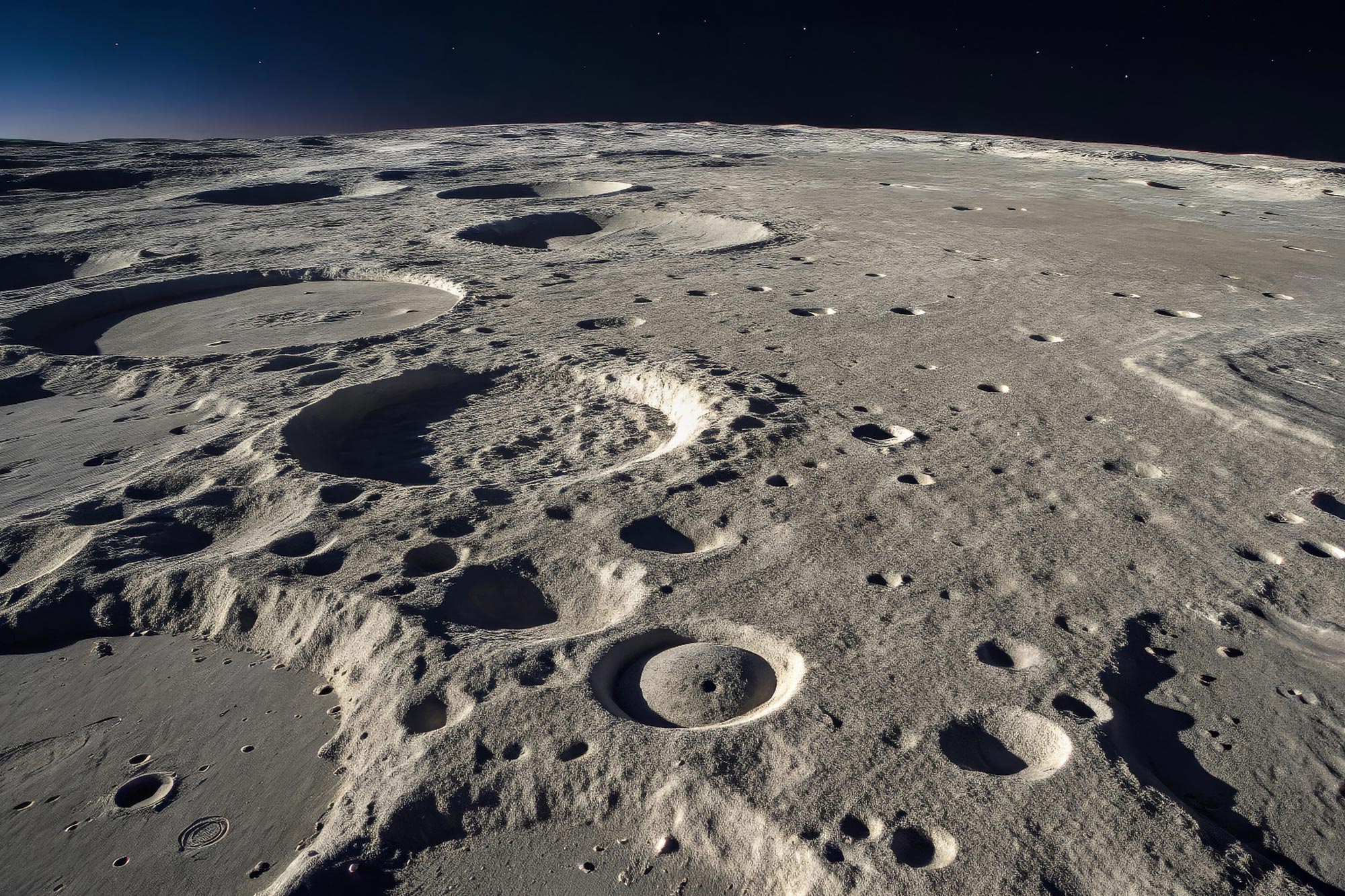
The Moon’s far side is overturning a long-held theory, revealing that the early Solar System’s asteroid assault may have faded slowly instead of exploding in one catastrophic burst.
For decades, scientists have debated whether the early Solar System endured one sudden, catastrophic wave of asteroid strikes or a much longer period of gradually fading violence. Rocks collected from the Moon’s far side are now strengthening the case for the second possibility.
Rather than pointing to one brief, catastrophic storm of impacts, the ancient rocks suggest the bombardment gradually weakened over billions of years as the Solar System slowly cleared away debris left behind after the planets formed.
That difference could reshape scientists’ understanding of the earliest chapters of planetary history. Powerful collisions altered surfaces, atmospheres, and possibly even oceans. On Earth, they may have influenced when the crust stabilized, when environments became habitable, and how conditions suitable for life developed.
Most traces of those events have vanished from our planet. Erosion wears away craters, volcanic eruptions bury ancient landscapes, and plate tectonics continually destroy and rebuild the crust. The Moon has no comparable geological recycling system, leaving its rocks and heavily cratered surface as a rare archive of the Solar System’s violent beginnings.
The Moon’s Ancient Geological Archive
Research co-author Dr. Fred Jourdan, from Curtin University’s School of Earth and Planetary Sciences and John de Laeter Centre, said lunar material preserves evidence of events that occurred soon after the planets took shape.
“The Moon is like a time capsule—it has preserved a record of events that have been erased from Earth by erosion, plate tectonics, and other geological processes,” Dr. Jourdan said.
Until recently, nearly every lunar sample available for detailed laboratory analysis came from the side of the Moon that always faces Earth. Material from the far side provides access to a region with a very different geological history, allowing researchers to test whether conclusions drawn from the near side represent the entire Moon.
Far-Side Samples Rewrite Lunar History
“Samples collected from the Moon’s far side are particularly significant because they allow us to compare two very different parts of the Moon for the first time. Until now, almost everything we knew came from the side facing Earth.”
“By analyzing these ancient rocks, we can better understand when major asteroid impacts occurred and how the early Solar System evolved. The far side preserves a cleaner record of those earliest impacts because it was much less affected by later geological events than the side facing Earth.
“These samples are helping us rewrite parts of the Moon’s history and suggest the early Solar System experienced a long decline in asteroid impacts rather than a single catastrophic bombardment.”
The researchers studied tiny rock fragments containing evidence of impacts that occurred between about 4.33 billion and 1.13 billion years ago. Together, the samples allowed the team to reconstruct more than three billion years of lunar collisions and track how the bombardment changed over time.
Challenging the Late Heavy Bombardment
The results contribute to a major debate over the so-called late heavy bombardment, a proposed period when the inner Solar System may have experienced a sudden surge in impacts roughly four billion years ago. Instead of supporting a narrow spike in collisions, the far-side rocks point to a longer and more gradual decline.
That extended timeline could also transform how scientists interpret the early Earth. Because the Earth and Moon occupy the same region of the Solar System, both would have encountered many of the same populations of asteroids and other rocky objects.
What the Moon Reveals About Earth
“The Moon and Earth share a common history, but the evidence of early impacts has largely disappeared from our planet,” Dr. Jourdan said.
“Because the Earth and Moon formed together, every major impact recorded on the Moon tells us something about the conditions experienced by the young Earth.
“Studying lunar rocks allows us to look back billions of years and better understand the events that shaped the environments of both worlds and helps us understand the role asteroid impacts played in planetary evolution and the conditions that may have influenced the emergence of life on Earth.
“The findings come amid a new era of lunar exploration and science, with China’s Chang’e-6 mission being the first to return samples from the Moon’s far side.”
Reference: “The bombardment history on the lunar farside revealed by 40Ar/39Ar geochronology of Chang’e-6 impact melt rocks” by Wan-Feng Zhang, Le Zhang, Mang Lin, Fred Jourdan, Jun-Jie Wang, Yan-Qiang Zhang, Jing-You Chen, De-Wen Zheng, Peng-Li He, Fei Su, Huai-Yu He, Hua-Ning Qiu, Xiu-Juan Bai, Xiao-Ping Xia, Ming Xiao, Ying-De Jiang, Jun-Jie Li, Jia Zhang, Lie-Kun Yang, Fang-Fang Huang, Bo Wei, Jiang-Ze Wang, Qin Zhou, Yong-Hua Cao, Ze-Xian Cui, Qing Yang, Lin-Li Chen and Yi-Gang Xu, 23 July 2026, Science Advances.
DOI: 10.1126/sciadv.aee8718
Never miss a breakthrough: Join the SciTechDaily newsletter.
Follow us on Google and Google News.