

Lunar Glass Shows Moon Asteroid Impacts Mirrored on Earth
Scientists have found asteroid impacts on the Moon millions of years ago coincided precisely with some of the largest meteorite impacts on Earth, such as the one that wiped out the dinosaurs.
Additionally, the new research study also discovered that major impact events on Earth were not stand-alone events, but were accompanied by a series of smaller impacts. These findings shed new light on asteroid dynamics in the inner solar system, including the probability of potentially devastating Earth-bound asteroids.
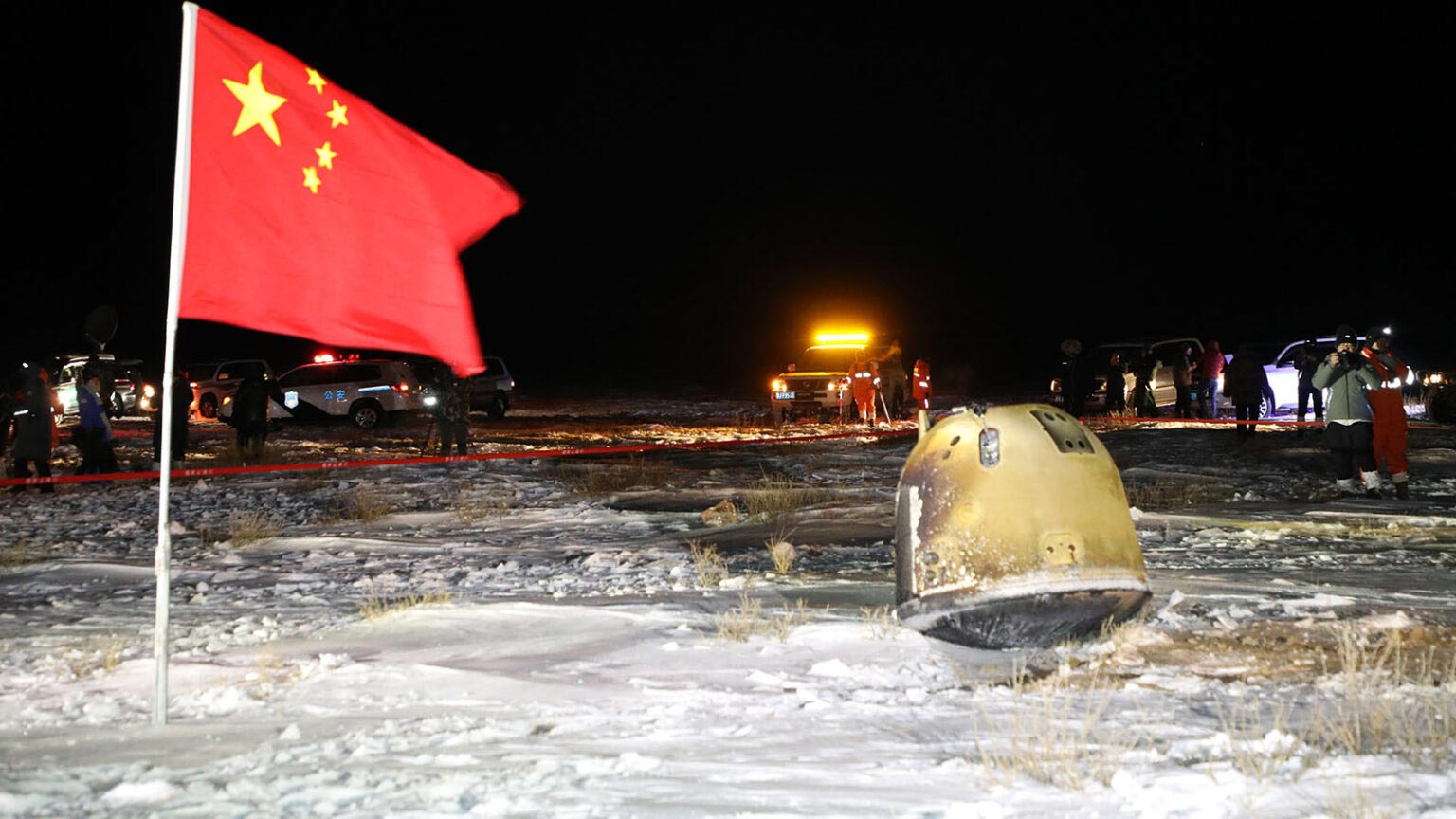
Led by Curtin University, the international research team studied microscopic glass beads aged up to two billion years old that were discovered in lunar soil that was brought back to Earth in December 2020 as part of the Chinese National Space Agency’s Chang’e-5 Lunar mission. Because the heat and pressure of meteorite impacts created the glass beads, their age distribution should mimic the impacts, revealing a timeline of bombardments.
Mirroring Earth’s Impact Events
According to lead author Professor Alexander Nemchin, from Curtin University’s Space Science and Technology Centre (SSTC) in the School of Earth and Planetary Sciences, the findings suggest that the timing and frequency of asteroid impacts on the Moon may have been mirrored on Earth, telling us more about the history of the evolution of our own planet.
“We combined a wide range of microscopic analytical techniques, numerical modeling, and geological surveys to determine how these microscopic glass beads from the Moon were formed and when,” Professor Nemchin said.
“We found that some of the age groups of the lunar glass beads coincide precisely with the ages of some of the largest terrestrial impact crater events, including the Chicxulub impact crater responsible for the dinosaur extinction event.
“The study also found that large impact events on Earth such as the Chicxulub crater 66 million years ago could have been accompanied by a number of smaller impacts. If this is correct, it suggests that the age-frequency distributions of impacts on the Moon might provide valuable information about the impacts on the Earth or inner solar system.”
Future comparative studies could give further insight into the geological history of the Moon, said co-author Associate Professor Katarina Miljkovic, also from Curtin’s SSTC.
“The next step would be to compare the data gleaned from these Chang’e-5 samples with other lunar soils and crater ages to be able to uncover other significant Moon-wide impact events which might in turn reveal new evidence about what impacts may have affected life on Earth,” Associate Professor Miljkovic said.
Reference: “Constraining the formation and transport of lunar impact glasses using the ages and chemical compositions of Chang’e-5 glass beads” by Tao Long, Yuqi Qian, Marc D. Norman, Katarina Miljkovic, Carolyn Crow, James W. Head, Xiaochao Che, Romain Tartèse, Nicolle Zellner, Xuefeng Yu, Shiwen Xie, Martin Whitehouse, Katherine H. Joy, Clive R. Neal, Joshua F. Snape, Guisheng Zhou, Shoujie Liu, Chun Yang, Zhiqing Yang, Chen Wang, Long Xiao, Dunyi Liu and Alexander Nemchin, 28 September 2022, Science Advances.
DOI: 10.1126/sciadv.abq2542
The international collaboration was supported by the Australian Research Council and involved researchers from Australia, China, the USA, the UK, and Sweden including co-authors Dr. Marc Norman from the Australian National University, Dr. Tao Long from the Beijing SHRIMP Center at the Chinese Academy of Geological Sciences and PhD student Yuqi Qian from the China University of Geosciences.
Never miss a breakthrough: Join the SciTechDaily newsletter.
Follow us on Google and Google News.
7 Comments
You people are idiots. Did you have a big bag of stupid before you wrote this rubbish. How about you learn how to do some critical thinking.
Every crater on the Moon is a circle. So… if it is from an impact, the projectile would have had to strike the Moon at 90°.
Anything not 90° would leave an elongated scar.
Also: The side of the Moon, that is always facing the Earth has only circular craters. How could a projectile strike that face at 90° if the Earth is in the way? Did the projectile swing around the Earth, then straighten up before the impact. Ffs
What? Think about this one… what forms a perfect sphere?
Its never going to be an impact.
Anything???
A bubble. Bubbles form perfect spheres. Droplets form perfect spheres (in the right conditions.
Ffs, stop promoting the stupidest theories about impact crater’s
Also Curtin university should know better.
The World’s largest impact crater.
Discovered 23 April 2013 by Steven Russell Jeffs.
The effect of gravity would resolve your point of puzzlement.
Another Idiot.
Gravity is not the answer to everything and every situation.
Every time something is observed and ‘they’ can’t provide a reasonable explanation, out trots Gravity.
Apologies for the Idiot comment, I get frustrated when ppl (fall back to and) quote stupid theories. Cheers Steve.
Steven,
Are all impact craters on Earth circular? It was my (perhaps incorrect) thinking that they were. Yet, no way can I believe they hit coming straight down. Your response will be interesting.
Apologies Joe, I posted a reply to you, but, didn’t know I could tag your name. Hopefully the reply is in your feed somewhere. Cheers Steve.
This kind of numbers science is always bulls***. It is all a big guess, and when cornered the eggheads always back down and admit it was shilling for grants. Even eggheads want a nice car.
Reply to Joe: Every geological feature in the world was formed in a single collision event. Everything. All the ‘impact crater scars’ observed around the globe are from ejecta debris falling back to Earth, and, all are observed to be ‘laying’ in the same direction, as expected with the direction of the Earth’s spin. That being said, there is 1 (and only 1,that I have been able to find) that is pointing in the opposite direction. The site is in outback N.S.W near Cobar, a true slide to a stop, superman style impact scar, measuring 9km wide and 18kms long and (as I said) the only object pointing in the opposite direction. Which would mean: it collided with Earth after every geological feature had been made. Get on Google Earth and see for yourself. Cheers Steve.