
Close Menu
    Facebook X (Twitter) Instagram
    SciTechDaily
    • Biology
    • Chemistry
    • Earth
    • Health
    • Physics
    • Science
    • Space
    • Technology
    Facebook X (Twitter) Pinterest YouTube RSS
    SciTechDaily
    Home»Space»Webb Telescope Uncovers Evidence of Hydration on Asteroid Psyche
    Space

    Webb Telescope Uncovers Evidence of Hydration on Asteroid Psyche

    By Southwest Research InstituteAugust 15, 2024No Comments5 Mins Read
    Facebook Twitter Pinterest Telegram LinkedIn WhatsApp Email Reddit
    Share
    Facebook Twitter LinkedIn Pinterest Telegram Email Reddit
    Psyche Impact James Webb Space Telescope
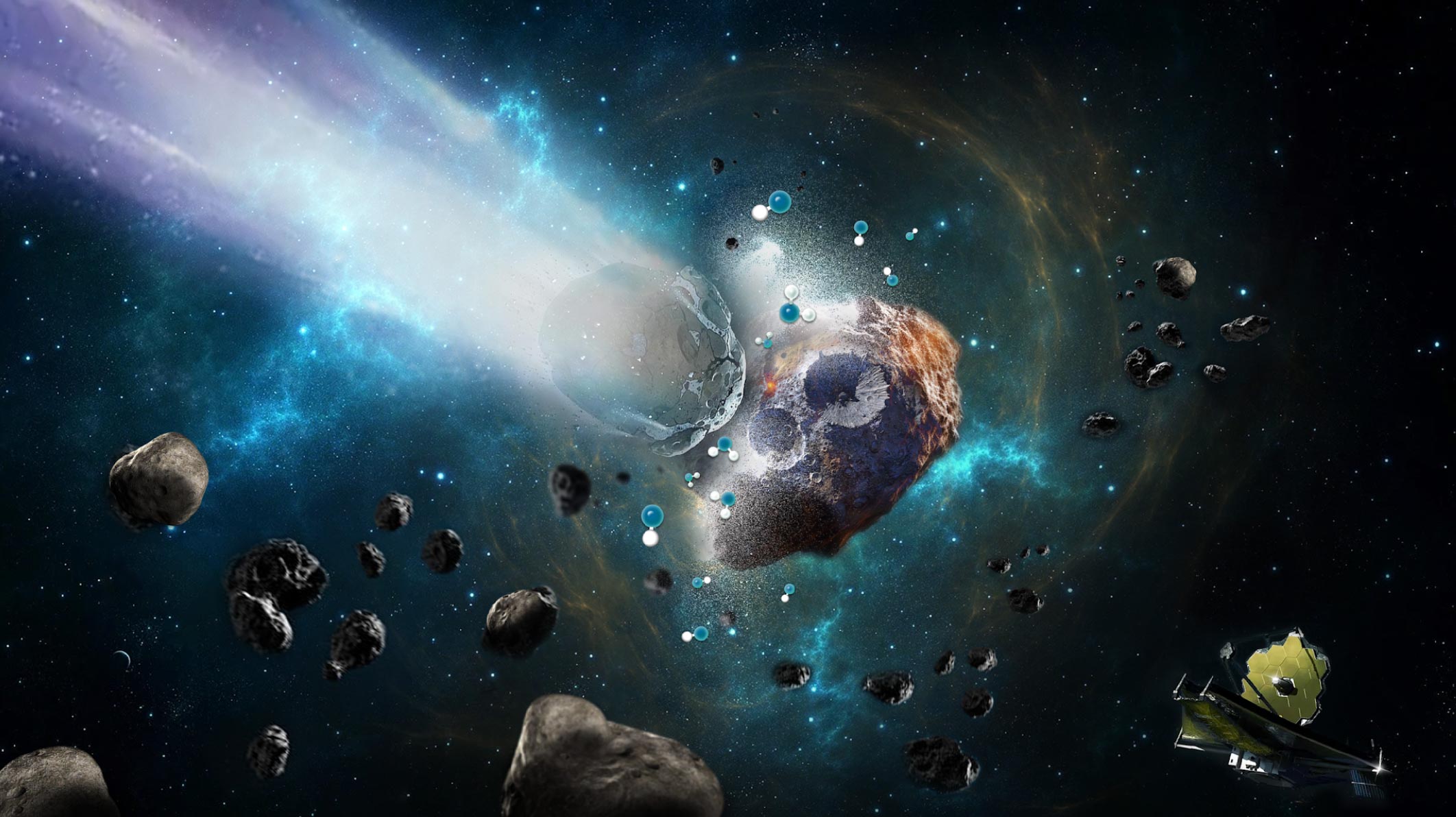
    An SwRI-led team used NASA’s Webb telescope, shown in the bottom right corner of this illustration, to confirm the presence of hydrated minerals on the surface of Psyche, a massive and heavily metallic body in the main asteroid belt. These findings suggest a complex history for this interesting asteroid, which many scientists think could be the remnant core of a protoplanet, including impacts with hydrated asteroids. Credit: Southwest Research Institute

    NASA’s Webb telescope has identified hydroxyl molecules on Psyche, a metallic asteroid, hinting at a more intricate history.

    Psyche’s origin could challenge existing models, indicating it might have formed beyond the solar system’s “snow line.” This discovery will refine our understanding of asteroid compositions and water distribution in the solar system.

    Discovery of Hydroxyl Molecules on Psyche

    Using data from NASA’s James Webb Space Telescope, a Southwest Research Institute-led team has confirmed hydroxyl molecules on the surface of the metallic asteroid Psyche. The presence of hydrated minerals suggests a complex history for Psyche, important context for the NASA spacecraft en route to this interesting asteroid orbiting the Sun between Mars and Jupiter.
    Asteroid Psyche (Illustration)
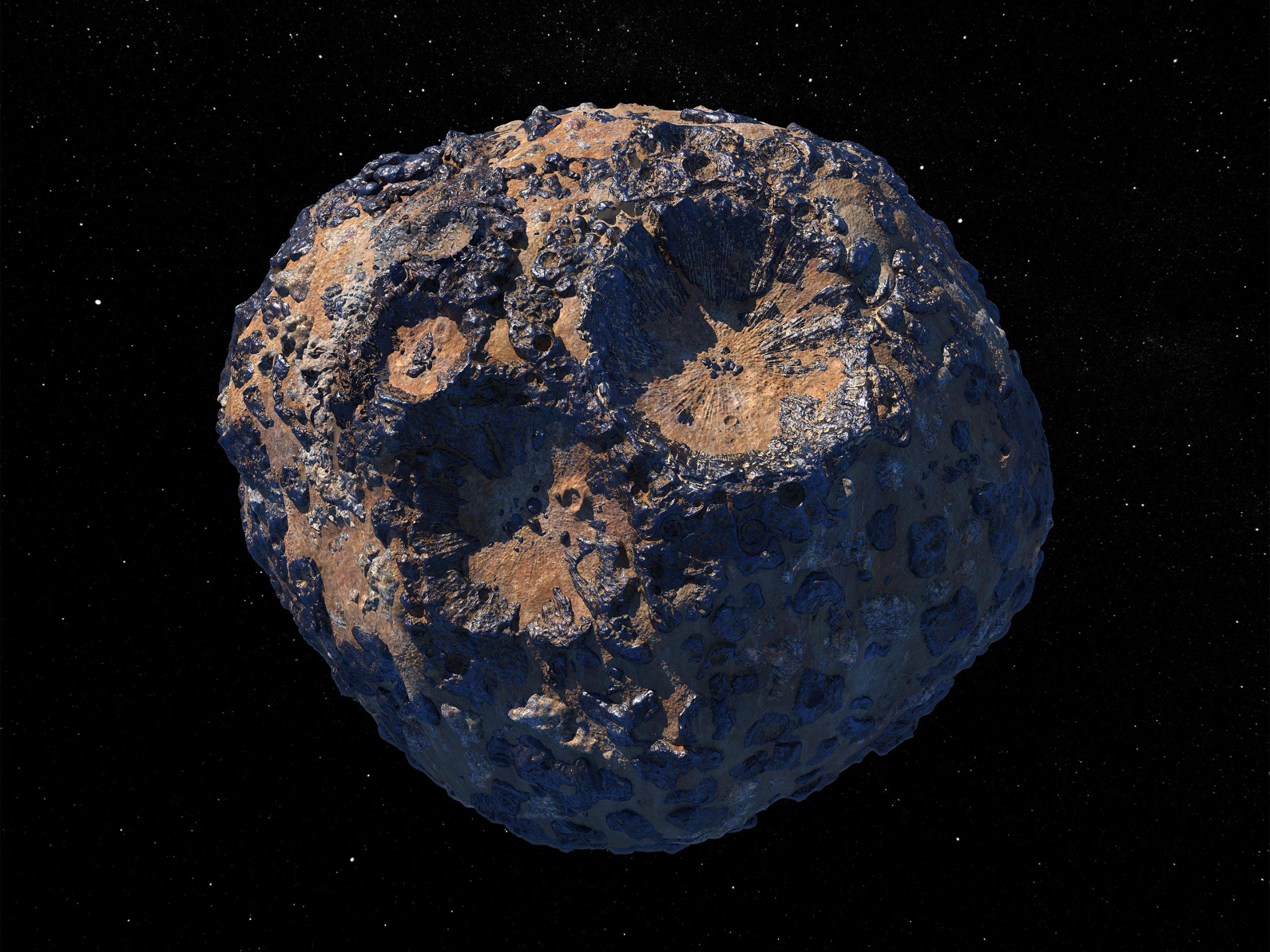
    This illustration depicts the 140-mile-wide (226-kilometer-wide) asteroid Psyche, the target of NASA’s mission of the same name. Based on data obtained from Earth, scientists believe the asteroid is a mixture of metal and rock. Credit: NASA/JPL-Caltech/ASU

    Psyche: A Massive Asteroid With a Mysterious Past

    At about 140 miles in diameter, Psyche is one of the most massive objects in the main asteroid belt. Previous observations indicate that Psyche is a dense, largely metallic object that could be a leftover core from a planet that experienced a catastrophic collision. On October 13, 2023, NASA launched the Psyche spacecraft, which is traveling 2.2 billion miles to arrive at the asteroid in August 2029.

    “Using telescopes at different wavelengths of infrared light, the SwRI-led research will provide different but complementary information to what the Psyche spacecraft is designed to study,” said SwRI’s Dr. Tracy Becker, second author of a new American Astronomical Society’s Planetary Science Journal paper discussing these findings.

    Implications for Solar System Evolution

    “Our understanding of solar system evolution is closely tied to interpretations of asteroid composition, particularly the M-class asteroids that contain higher concentrations of metal,” said Center for Astrophysics | Harvard & Smithsonian’s Dr. Stephanie Jarmak, the paper’s lead author, who conducted much of this research while at SwRI. “These asteroids were initially thought to be the exposed cores of differentiated planetesimals, a hypothesis based on their spectral similarity to iron meteorites.”

    SpaceX Falcon Heavy Rocket Launches With Psyche Spacecraft Onboard
    NASA’s Psyche spacecraft, atop a SpaceX Falcon Heavy rocket, lifts off from Kennedy Space Center’s historic Launch Complex 39A in Florida on October 13, 2023. The Psyche mission will study a metal-rich asteroid with the same name, located in the main asteroid belt between Mars and Jupiter. This is NASA’s first mission to study an asteroid that has more metal than rock or ice. Credit: SpaceX

    Hydrated Minerals and Psyche’s Complex History

    The Webb data point to hydroxyl and perhaps water on Psyche’s surface. The hydrated minerals could result from external sources, including impactors. If the hydration is native or endogenous, then Psyche may have a different evolutionary history than current models suggest.

    “Asteroids are leftovers from the planetary formation process, so their compositions vary depending on where they formed in the solar nebula,” said SwRI’s Dr. Anicia Arredondo, another co-author. “Hydration that is endogenous could suggest that Psyche is not the remnant core of a protoplanet. Instead, it could suggest that Psyche originated beyond the ‘snow line,’ the minimum distance from the Sun where protoplanetary disc temperatures are low enough for volatile compounds to condense into solids, before migrating to the outer main belt.”

    However, the paper found the variability in the strength of the hydration features across the observations implies a heterogeneous distribution of hydrated minerals. This variability suggests a complex surface history that could be explained by impacts from carbonaceous chondrite asteroids thought to be very hydrated.

    Broad Implications for Water Distribution in the Solar System

    Understanding the location of asteroids and their compositions tells us how materials in the solar nebula were distributed and have evolved since formation. How water is distributed in our solar system will provide insight into the distribution of water in other solar systems and, because water is necessary for all life on Earth, will drive where to look for potential life, both in our solar system and beyond.

    Reference: “Estimate of Water and Hydroxyl Abundance on Asteroid (16) Psyche from JWST Data” by Stephanie G. Jarmak, Tracy M. Becker, Charles E. Woodward, Casey I. Honniball, Andrew S. Rivkin, Margaret M. McAdam, Zoe A. Landsman, Saverio Cambioni, Thomas G. Müller, Driss Takir, Kurt D. Retherford, Anicia Arredondo and Linda T. Elkins-Tanton, 23 August 2024, The Planetary Science Journal.
    DOI: 10.3847/PSJ/ad66b9

    NASA’s Webb telescope, developed in partnership with the European and Canadian space agencies, is part of the Space Telescope Science Institute, operated by the Association of Universities for Research in Astronomy. The Psyche mission is led by Arizona State University. NASA’s Jet Propulsion Laboratory is responsible for mission management, operations, and navigation.

    Never miss a breakthrough: Join the SciTechDaily newsletter.
    Follow us on Google and Google News.

    Asteroid Astronomy James Webb Space Telescope Popular Solar System Southwest Research Institute
    Share. Facebook Twitter Pinterest LinkedIn Email Reddit

    Related Articles

    For the First Time: Water Molecules Have Been Discovered on an Asteroid’s Surface

    Webb and SOFIA Telescopes Provide Deep Insight Into Asteroid Psyche’s Metallic Mystique

    Scientists Detect 6000-Mile-Long Plume of Water Escaping From Saturn’s Moon

    James Webb Space Telescope Detects Asteroid the Size of Rome’s Colosseum

    Study Provides Darkest-Ever View of Primordial Interstellar Ices

    Webb and Hubble Space Telescopes Capture Detailed Views of DART Asteroid Impact

    Webb Space Telescope: Uncovering Hidden Parts of Our Solar System

    NASA’s James Webb Space Telescope to Examine Objects in the Solar System Graveyard

    First Ultraviolet Observations Offer More Complete View of Massive Asteroid Psyche

    Leave A Reply Cancel Reply

    • Facebook
    • Twitter
    • Pinterest
    • YouTube

    Don't Miss a Discovery

    Subscribe for the Latest in Science & Tech!

    Trending News

    AI Could Detect Early Signs of Alzheimer’s in Under a Minute – Far Before Traditional Tests

    What if Dark Matter Has Two Forms? Bold New Hypothesis Could Explain a Cosmic Mystery

    This Metal Melts in Your Hand – and Scientists Just Discovered Something Strange

    Beef vs. Chicken: Surprising Results From New Prediabetes Study

    Alzheimer’s Breakthrough: Scientists Discover Key Protein May Prevent Toxic Protein Clumps in the Brain

    Quantum Reality Gets Stranger: Physicists Put a Lump of Metal in Two Places at Once

    Scientists May Have Found the Key to Jupiter and Saturn’s Moon Mystery

    Scientists Uncover Brain Changes That Link Pain to Depression

    Follow SciTechDaily
    • Facebook
    • Twitter
    • YouTube
    • Pinterest
    • Newsletter
    • RSS
    SciTech News
    • Biology News
    • Chemistry News
    • Earth News
    • Health News
    • Physics News
    • Science News
    • Space News
    • Technology News
    Recent Posts
    • 250-Million-Year-Old Egg Solves One of Evolution’s Biggest Mysteries
    • Living With Roommates Might Be Changing Your Gut Microbiome Without You Knowing
    • Simple and Cheap Blood Test Could Detect Cancer and Other Diseases Before Symptoms Appear
    • Century-Old Cleaning Chemical Linked to 500% Increased Risk of Parkinson’s Disease
    • What if Your Memories Never Happened? Physicists Take a New Look at the Boltzmann Brain Paradox
    Copyright © 1998 - 2026 SciTechDaily. All Rights Reserved.
    • Science News
    • About
    • Contact
    • Editorial Board
    • Privacy Policy
    • Terms of Use

    Type above and press Enter to search. Press Esc to cancel.