
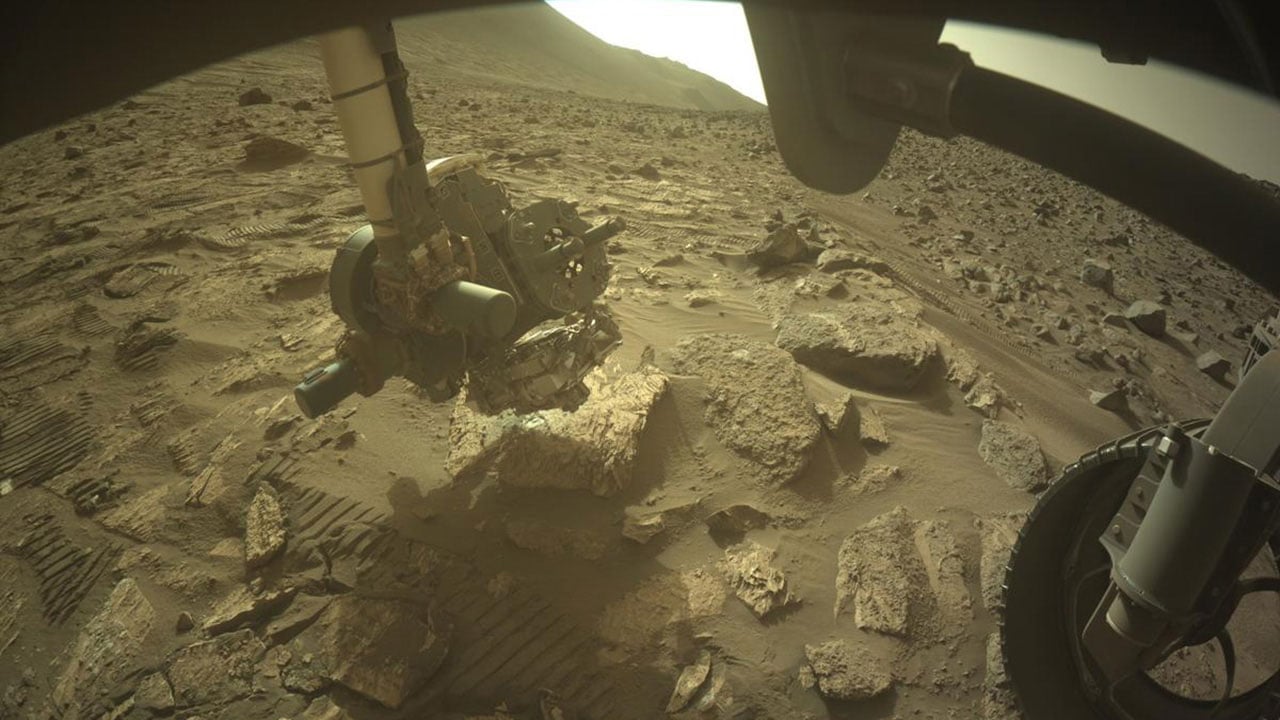
Perseverance has found shallow preserved organic carbon on Mars, raising new questions about ancient Martian environments.
Mars keeps offering clues that are promising enough to study, but not definitive enough to settle the biggest question. In September of last year, NASA reported that its Perseverance rover had found a potential biosignature, a substance or structure that could have a biological origin. Now, a new paper published in Science Advances has confirmed the presence of organic carbon in the same two Bright Angel formation rocks, giving scientists a clearer view of what was detected and what still cannot be concluded.
Organic carbon is one of the chemical building blocks associated with life, although it can also form through nonbiological processes. The new study was co-led by Ashley Murphy, a Planetary Science Institute postdoctoral researcher, and Kyle Uckert, Deputy Principal Investigator for the rover’s SHERLOC instrument.
Rover tools map organic carbon
The team used the Scanning Habitable Environments with Raman & Luminescence for Organics & Chemicals (SHERLOC) instrument mounted on Perseverance’s robotic arm to examine multiple rocks in Jezero Crater’s Bright Angel formation. They also collected a sample from one rock known as “Cheyava Falls.” SHERLOC uses Raman spectroscopy, a method that shines laser light on rock surfaces to identify and map minerals and organic compounds without destroying the sample.
The analysis revealed macromolecular carbon (MMC), a form of organic carbon made of large, tangled networks of carbon atoms. On Earth and in meteorites, MMC is commonly found in rocks. Its presence is scientifically important, but it is not proof of life because MMC can form through biological or nonbiological pathways.
The setting adds to the significance of the find. Billions of years ago, water and sediment flowed through a river channel into Jezero crater. Fine-grained material settled at the bottom and eventually became the mudstone rocks Perseverance examined. The MMC appeared with those fine-grained sediments and with carbonate and sulfate minerals that formed later during aqueous alteration. That pattern suggests the organic material may have been placed or preserved during two or more events across Mars’ geologic history.
“While the specific formation mechanism of the MMC detected in the Bright Angel mudstones remains unknown, this is still one of the most exciting findings to date,” Murphy said.
Organics survived near the surface
The researchers also found that the MMC was preserved only microns below the Martian surface, a depth thinner than a sheet of paper. That makes it the shallowest detection of MMC yet reported on Mars.
The result is notable because the Martian surface is hostile to organic molecules. Radiation, sunlight, and reactive chemicals can break down complex organics, especially when they are exposed near the surface. Finding MMC so close to the top of the rock suggests that either the material is unusually resistant to destruction or that surrounding minerals helped protect it.
“The Martian surface environment includes radiation and chemical oxidants that are destructive to organics, and terrestrial laboratory simulations have shown that the survival time of organics in Martian-like conditions – especially at or near the surface – depends on factors such as the type of organic molecule and the surrounding minerals,” Murphy said. “The MMC detected in the Bright Angel mudstones is either resistant to degradation and/or has been sufficiently shielded by other minerals, such as clays, or iron-rich Martian soil.”
The discovery also extends the map of Martian organics. Perseverance detected this material more than 2,000 miles from earlier organic detections made by NASA’s Curiosity rover in Gale crater.
“It is encouraging for Martian habitability,” Murphy said. “This indicates that billions of years ago, organics may have been more than just locally present and may have been more widely available in ancient lakes and rivers on Mars.”
Samples remain the key test
The findings are powerful, but they stop short of answering whether Mars ever hosted life. Neither Curiosity in Gale crater nor Perseverance in Jezero crater carries the large, energy-intensive laboratory equipment needed to determine whether Bright Angel contains fossilized microbial life.
Perseverance was designed to identify potential biosignatures like those seen in the Cheyava Falls rock, and Murphy called the result a “resounding win for Mars science.” Still, the next step requires more sensitive instruments on Earth, where scientists could test whether the organic carbon came from biology or geology.
If samples from this part of Mars are eventually returned, the team hopes to examine them at much higher resolution. More advanced mineral and organic analyses could reveal how the MMC formed, how it survived, and what it can tell scientists about the history of organic material on Mars.
Murphy continues to work with the SHERLOC science team to study the Martian surface and improve how rover data are interpreted through Mars analog research and Raman spectroscopic studies.
Reference: “Spatially distributed complex organic matter detected in an ancient river valley in Jezero crater, Mars” by Ashley E. Murphy, Kyle Uckert, Kevin P. Hand, Rohit Bhartia, Sergei V. Bykov, Keyron Hickman-Lewis, Ryan S. Jakubek, Carina Lee, Francis M. McCubbin, Michelle E. Minitti, Alyssa Pascuzzo, Sandra Siljeström, Sunanda Sharma, Andrew Steele, Kenneth H. Williford, William Abbey, Sanford A. Asher, Robert Barnes, Parker A. Barr, James F. BellIII, Olivier Beyssac, Tanja Bosak, Michael S. Bramble, Adrian Brown, Adrian P. Broz, Denise Buckner, Emily L. Cardarelli, Joseph L. Carsten, Andrea Corpolongo, Andrew Czaja, Scott G. C. Edgington, Bethany L. Ehlmann, Kenneth A. Farley, Teresa Fornaro, Marc Fries, Roxana González-Burgos, Sanjeev Gupta, Nikole C. Haney, William Hug, Joshua Huggett, Joel A. Hurowitz, Samara Imbeah, Joanna Clark, Alexander J. Jones, Linda C. Kah, Megan R. Kennedy, Steven W. Lee, Justin Maki, Brian Nixon, Jorge I. Núñez, Jeffrey T. Osterhout, Nicole D. Phelan, Yu Yu Phua, Michael A. Ravine, Joseph Razzell Hollis, Eva Scheller, Mitchell D. Schulte, Mark A. Sephton, Justin I. Simon, Anushree Srivastava, Kathryn M. Stack, Jason Van Beek, Benjamin P. Weiss, Roger Wiens, Amy J. Williams, Brittan V. Wogsland and R. Aileen Yingst, 24 June 2026, Science Advances.
DOI: 10.1126/sciadv.adx0047
Murphy’s work on SHERLOC Instrument Mars 2020 was funded by JPL Subcontract No. 1641753 to PSI.
Never miss a breakthrough: Join the SciTechDaily newsletter.
Follow us on Google and Google News.