
Close Menu
    Facebook X (Twitter) Instagram
    SciTechDaily
    • Biology
    • Chemistry
    • Earth
    • Health
    • Physics
    • Science
    • Space
    • Technology
    Facebook X (Twitter) Pinterest YouTube RSS
    SciTechDaily
    Home»Space»Martian Meteorite Reveals the Possibility of Life on Mars
    Space

    Martian Meteorite Reveals the Possibility of Life on Mars

    By University of ManchesterSeptember 15, 2014No Comments3 Mins Read
    Facebook Twitter Pinterest Telegram LinkedIn WhatsApp Email Reddit
    Share
    Facebook Twitter LinkedIn Pinterest Telegram Email Reddit
    Meteorite Reveals the Possibility of Life on Mars
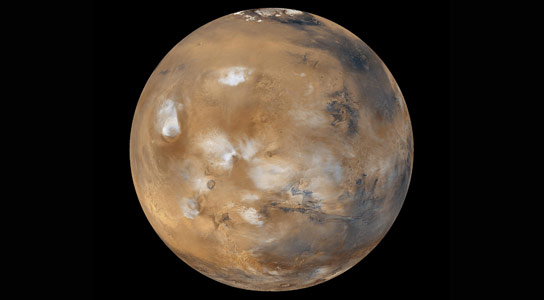
    The finding of a “cell-like” structure in a Martian meteorite adds to the growing evidence that Mars could support life. It suggests that past asteroid impacts might have created long-lasting hydrothermal fields capable of sustaining life on the planet, even in later times. Credit: Mars from Wikipedia.com

    An unusual feature embedded deep within a fragment of a Martian meteorite is helping to make the case for the possibility of life on Mars.

    The finding of a ‘cell-like’ structure, which investigators now know once held water, came about as a result of collaboration between scientists in the UK and Greece. Their findings are published in the latest edition of the journal Astrobiology.

    While investigating the Martian meteorite, known as Nakhla, Dr. Elias Chatzitheodoridis of the National Technical University of Athens found an unusual feature embedded deep within the rock. In a bid to understand what it might be, he teamed up with a long-time friend and collaborator Professor Ian Lyon at the University of Manchester.

    Professor Lyon, based in Manchester’s School of Earth, Atmospheric and Environmental Sciences, said: “In many ways, it resembled a fossilized biological cell from Earth but it was intriguing because it was undoubtedly from Mars. Our research found that it probably wasn’t a cell but that it did once hold water – water that had been heated, probably as a result of an asteroid impact.”

    These findings are significant because they add to increasing evidence that beneath the surface, Mars does provide all the conditions for life to have formed and evolved. It also adds to a body of evidence suggesting that large asteroids hit Mars in the past and produce long-lasting hydrothermal fields that could sustain life on Mars, even in later epochs, if life ever emerged there.

    As part of the research, the feature was imaged in unprecedented detail by Dr Sarah Haigh of The University of Manchester whose work usually involves high-resolution imaging for next-generation electronic devices, which are made by stacking together single atomic layers of graphene and other materials with the aim of making faster, lighter and bendable mobile phones and tablets. A similar imaging approach was able to reveal the atomic layers of materials inside the meteorite.

    Together their combined experimental approach has revealed new insights into the geological origins of this fascinating structure.

    Professor Lyon said: “We have been able to show the setting is there to provide life. It’s not too cold, it’s not too harsh. Life as we know it, in the form of bacteria, for example, could be there, although we haven’t found it yet. It’s about piecing together the case for life on Mars – it may have existed and in some form could exist still.”

    Now the team is using these and other state-of-the-art techniques to investigate new secondary materials in this meteorite and search for possible bio signatures which provide scientific evidence of life, past or present. Professor Lyon concluded: “Before we return samples from Mars, we must examine them further, but in more delicate ways. We must carefully search for further evidence.”

    Reference: “A Conspicuous Clay Ovoid in Nakhla: Evidence for Subsurface Hydrothermal Alteration on Mars with Implications for Astrobiology” by Elias Chatzitheodoridis, Sarah Haigh and Ian Lyon, 7 August 2014, Astrobiology.
    DOI: 10.1089/ast.2013.1069


    Never miss a breakthrough: Join the SciTechDaily newsletter.
    Follow us on Google and Google News.

    Astrobiology Astronomy Mars Planetary Science Popular University of Manchester
    Share. Facebook Twitter Pinterest LinkedIn Email Reddit

    Related Articles

    Scientists Discover Evidence of Methane in Martian Meteorites

    Curiosity Prepares to Take Its First Scoop of Soil for Analysis

    Curiosity Finds Ancient Streambed on Mars

    NASA’s Opportunity Discovers Geological Mystery on Mars

    NASA Data Suggests “Dry Ice” Snowfall on Mars

    “Habitable Zone” Might Help Extreme Life Forms Survive on Exoplanets

    NASA’s Curiosity Readies for First Drive on Mars

    Color HiRISE Image of Curiosity Rover on Mars

    A Connection Between Volatiles in the Subsurface of Mars and the Impact Process

    Leave A Reply Cancel Reply

    • Facebook
    • Twitter
    • Pinterest
    • YouTube

    Don't Miss a Discovery

    Subscribe for the Latest in Science & Tech!

    Trending News

    The Universe Is Expanding Too Fast and Scientists Can’t Explain Why

    “Like Liquid Metal”: Scientists Create Strange Shape-Shifting Material

    Early Warning Signals of Esophageal Cancer May Be Hiding in Plain Sight

    Common Blood Pressure Drug Shows Surprising Power Against Deadly Antibiotic-Resistant Superbug

    Scientists Uncover Dangerous Connection Between Serotonin and Heart Valve Disease

    Scientists Discover a “Protector” Protein That Could Help Reverse Hair Loss

    Bone-Strengthening Discovery Could Reverse Osteoporosis

    Scientists Uncover Hidden Trigger Behind Stem Cell Aging

    Follow SciTechDaily
    • Facebook
    • Twitter
    • YouTube
    • Pinterest
    • Newsletter
    • RSS
    SciTech News
    • Biology News
    • Chemistry News
    • Earth News
    • Health News
    • Physics News
    • Science News
    • Space News
    • Technology News
    Recent Posts
    • Scientists Overcome Major Quantum Bottleneck, Potentially Transforming Teleportation and Computing
    • Quantum Physics’ Strangest Problem May Hold the Key to Time Itself
    • Scientists Create “Liquid Gears” That Spin Without Touching
    • The Simple Habit That Could Help Prevent Cancer
    • Forgotten Medicinal Plant Shows Promise in Fighting Dangerous Superbugs
    Copyright © 1998 - 2026 SciTechDaily. All Rights Reserved.
    • Science News
    • About
    • Contact
    • Editorial Board
    • Privacy Policy
    • Terms of Use

    Type above and press Enter to search. Press Esc to cancel.