
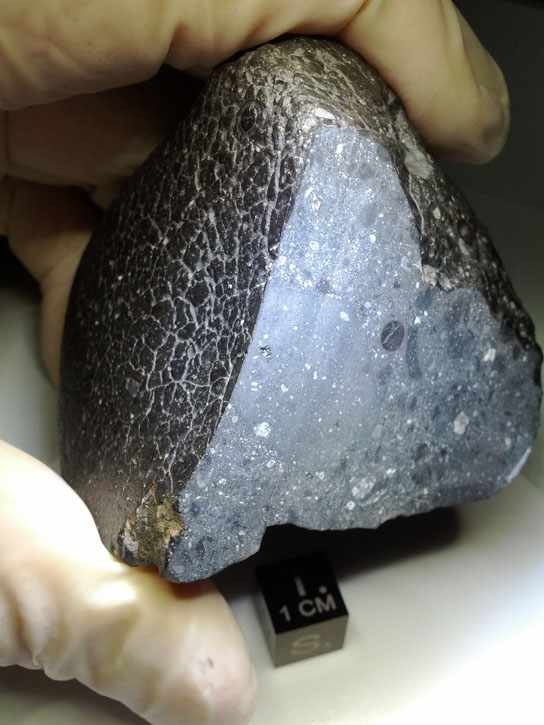
Researchers discovered a new class of Martian meteorite in the Sahara Desert that contains 10 times more water than other Martian meteorites from unknown origins, possibly providing a glimpse of the ancient surface and environmental conditions on Mars.
NASA-funded researchers analyzing a small meteorite that may be the first discovered from the Martian surface or crust have found it contains 10 times more water than other Martian meteorites from unknown origins.
This new class of meteorite was found in 2011 in the Sahara Desert. Designated Northwest Africa (NWA) 7034, and nicknamed “Black Beauty,” it weighs approximately 11 ounces (320 grams). After more than a year of intensive study, a team of U.S. scientists determined the meteorite formed 2.1 billion years ago during the beginning of the most recent geologic period on Mars, known as the Amazonian.
“The age of NWA 7034 is important because it is significantly older than most other Martian meteorites,” said Mitch Schulte, program scientist for the Mars Exploration Program at NASA Headquarters in Washington. “We now have insight into a piece of Mars’ history at a critical time in its evolution.”
The meteorite is an excellent match for surface rocks and outcrops NASA has studied remotely via Mars rovers and Mars-orbiting satellites. NWA 7034’s composition is different from any previously studied Martian meteorite. The research is published in Thursday’s edition of Science Express.
“The contents of this meteorite may challenge many long held notions about Martian geology,” said John Grunsfeld, associate administrator for NASA’s Science Mission Directorate in Washington. “These findings also present an important reference frame for the Curiosity rover as it searches for reduced organics in the minerals exposed in the bedrock of Gale Crater.”
NWA 7034 is made of cemented fragments of basalt, rock that forms from rapidly cooled lava. The fragments are primarily feldspar and pyroxene, most likely from volcanic activity. This unusual meteorite’s chemistry matches that of the Martian crust as measured by NASA’s Mars Exploration Rovers and Mars Odyssey Orbiter.
“This Martian meteorite has everything in its composition that you’d want in order to further our understanding of the Red Planet,” said Carl Agee, leader of the analysis team and director and curator at the University of New Mexico’s Institute of Meteoritics in Albuquerque. “This unique meteorite tells us what volcanism was like on Mars 2 billion years ago. It also gives us a glimpse of ancient surface and environmental conditions on Mars that no other meteorite has ever offered.”
The research team included groups at the University of California at San Diego and the Carnegie Institution in Washington. Experiments were conducted to analyze mineral and chemical composition, age, and water content.
Researchers theorize the large amount of water contained in NWA 7034 may have originated from the interaction of the rocks with water present in Mars’ crust. The meteorite also has a different mixture of oxygen isotopes than has been found in other Martian meteorites, which could have resulted from interaction with the Martian atmosphere.
Most Martian meteorites are divided into three rock types, named after three meteorites; Shergotty, Nakhla, and Chassigny. These “SNC” meteorites currently number about 110. Their point of origin on Mars is not known and recent data from lander and orbiter missions suggest they are a mismatch for the Martian crust. Although NWA 7034 has similarities to the SNC meteorites, including the presence of macromolecular organic carbon, this new meteorite has many unique characteristics.
“The texture of the NWA meteorite is not like any of the SNC meteorites,” said co-author Andrew Steele, who led the carbon analysis at the Carnegie Institution’s Geophysical Laboratory. “This is an exciting measurement in Mars and planetary science. We now have more context than ever before to understanding where they may come from.”
Reference: “Unique Meteorite from Early Amazonian Mars: Water-Rich Basaltic Breccia Northwest Africa 7034” by Carl B. Agee, Nicole V. Wilson, Francis M. McCubbin, Karen Ziegler, Victor J. Polyak, Zachary D. Sharp, Yemane Asmerom, Morgan H. Nunn, Robina Shaheen, Mark H. Thiemens, Andrew Steele, Marilyn L. Fogel, Roxane Bowden, Mihaela Glamoclija, Zhisheng Zhang and Stephen M. Elardo, 3 January 2013, Science.
DOI: 10.1126/science.1228858
The research was funded by NASA’s Cosmochemistry Program and Astrobiology Institute, part of the Planetary Science Division in the Science Mission Directorate at NASA Headquarters. The research also was supported by the New Mexico Space Grant Consortium in Las Cruces, and the National Science Foundation in Arlington, Virginia.
Never miss a breakthrough: Join the SciTechDaily newsletter.
Follow us on Google and Google News.
3 Comments
That is fine. But even moon rock bit was found earlier on earth. There could be rocks from Venus also. After all Mars and Venus are our neighbors. In the early chaotic stage of evolution of solar system all the rocks could have run helter-skelter and could have been thrown on planet’s neighbors. Next to Mars we can find an Asteroid belt where all sorts of rocks are floating. Any probe into asteroids will throw all the light of the texture of many planets. Thank You.
I got similar rock
Mars used to be ran by a group of llamas all hail, the group of llamas