
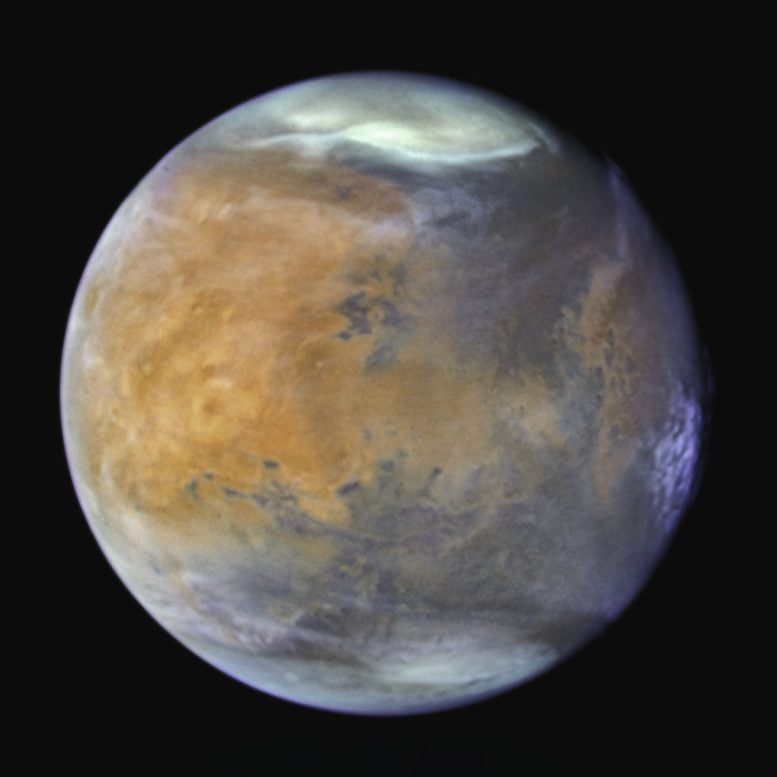
New research shows that an intense regional dust storm transported unusually high amounts of water vapor into Mars’ upper atmosphere, boosting hydrogen escape. The discovery reshapes understanding of how the planet gradually lost its water.
Today, Mars is known as a cold, dry desert. Yet its landscape tells a very different story about its distant past. Networks of channels, water-altered minerals, and other geological features show that the planet once had abundant liquid water and a far more active environment.
Scientists have spent decades trying to understand how that wetter world transformed into the barren planet we see now. Although several mechanisms have been identified that could account for part of the water loss, a large portion of it has remained unexplained.
An international team of researchers has now taken an important step toward solving that mystery. In a study published in Communications: Earth & Environment, they report the first clear evidence that an unusual, intense, but localized dust storm was able to carry water vapor into the upper atmosphere during the Northern Hemisphere summer. Previously, scientists believed this season played only a minor role in water loss.
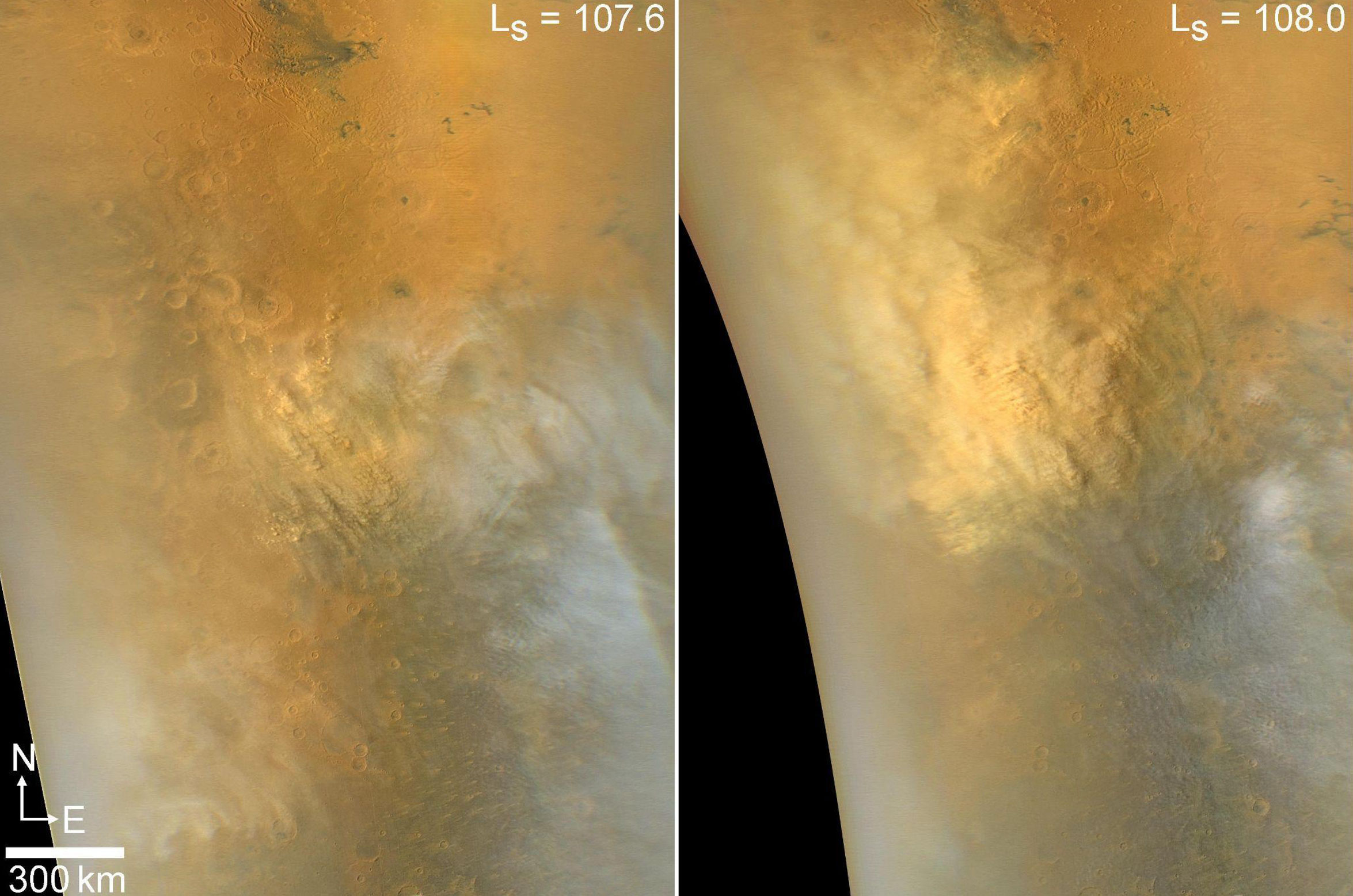
“The findings reveal the impact of this type of storm on the planet’s climate evolution and open a new path for understanding how Mars lost much of its water over time,” says Adrián Brines, a researcher at the Instituto de Astrofísica de Andalucía (IAA-CSIC) and co-lead author of the study along with Shohei Aoki, a researcher from the Graduate School of Frontier Sciences at the University of Tokyo and the Graduate School of Science at Tohoku University.
Regional Dust Storms and Unexpected Summer Effects
For years, researchers have understood that dust storms can influence how water escapes from Mars. However, most attention has centered on massive storms that engulf the entire planet. The new study shifts that focus by showing that smaller, regional storms can also propel significant amounts of water to very high altitudes, where it can more easily drift off into space.
In addition, earlier work emphasized the Southern Hemisphere summer, which is generally considered the main season for atmospheric water loss because of its warmer and more energetic conditions.
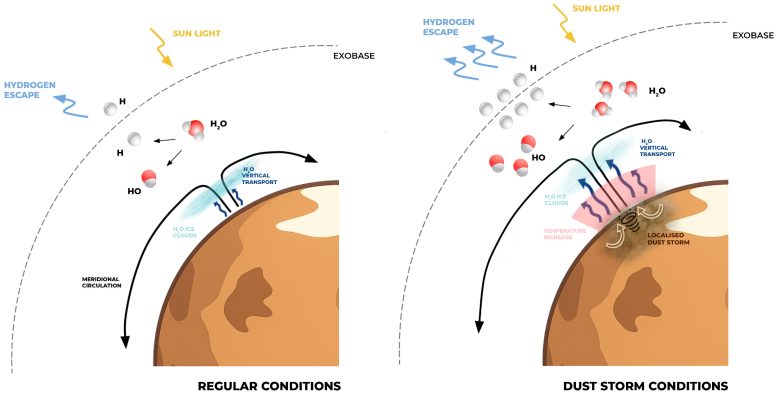
The team observed an unusual surge of water vapor in the middle layers of the Martian atmosphere during the Northern Hemisphere summer of Martian year 37 (2022-2023 on Earth). This spike was linked to an anomalous dust storm. At those heights, water concentrations were up to ten times higher than typical levels. Such an increase had not been recorded in earlier Martian years and was not anticipated by existing climate models.
Hydrogen Escape and Climate Evolution Implications
Soon after this spike in water vapor, scientists detected a marked rise in hydrogen at the exobase – the region where the atmosphere merges with space. Hydrogen levels reached 2.5 times those measured during the same season in previous years. Tracking hydrogen is crucial because when water molecules break apart in the atmosphere, hydrogen can escape into space. Measuring how much hydrogen is lost helps researchers estimate how much water the planet has permanently shed.
“These results add a vital new piece to the incomplete puzzle of how Mars has been losing its water over billions of years, and shows that short but intense episodes can play a relevant role in the climate evolution of the Red Planet,” concludes Aoki (University of Tokyo and Tohoku University).
Reference: “Out-of-season water escape during Mars’ northern summer triggered by a strong localized dust storm” by Adrián Brines, Shohei Aoki, Frank Daerden, Michael S. Chaffin, Samuel A. Atwood, Susarla Raghuram, Bruce A. Cantor, Yannick Willame, Loïc Trompet, Geronimo L. Villanueva, Michael J. Wolff, Michael D. Smith, Christopher S. Edwards, Ian R. Thomas, Giuliano Liuzzi, Lori Neary, Manish R. Patel, Miguel Angel López-Valverde, Armin Kleinböhl, Hoor AlMazmi, James Whiteway, AnnCarine Vandaele, Bojan Ristic and Giancarlo Bellucci, 2 February 2026, Communications Earth & Environment.
DOI: 10.1038/s43247-025-03157-5
Never miss a breakthrough: Join the SciTechDaily newsletter.
Follow us on Google and Google News.
14 Comments
Sounds to me like the scientists are not really sure how much water may still be on Mars, in the crust, under the surface, or anywhere else!
Mars lost its water bcause it evaporated. The fire within became to big and thats when the inhabitants left Mars. Bcause the planet still rotates the fire within is still there only very very small
Mars water evaporates from such causes as low mass and solar wind.
No planets have “fire” within but terrestrial planets and moons (such as Moon) can have hot, fluid cores. Mars core radius is about the same proportion as Earth is (50+ %).
Mars lost it’s magnetic field, which protected it’s atmosphere, leading to a vulnerable state.
Mostly it’s the low mass.
There are more than 124 elements in the Earth’s pistachio, so the surface of the Martian pistachio should also have the same amount of elements, but this is not the case. The reason is that the Milky Way has passed through the solar system and objects from the Milky Way have collided with the Earth, but Mars, due to its distance from the Sun, was not close to the Sun when the Milky Way planets collapsed. When the Milky Way planets collided with the Sun, these elements did not settle on the surface of Mars because Mars is far from the Sun.
The solar system is part of the much larger Milky Way, so what you describe is not possible.
(And Milky Way is our galaxy, if that wasn’t understood. At ~ 100,000 light years in radius it is much larger than the solar system which is about a light day in radius.)
The original inhabitants of Mars had to migrate to earth.They adapted and thrived for many years until the last of there kind finally were lost in the past,but left us with the modified life form we know as humans.
That is not possible either, by evolution all life on Earth is genetically related. Mars life would stand out.
Dear Bob, Mars has never had intelligent life, but Earth did have life exactly 65 million years ago. Humans lived with dinosaurs before us, and created the islands of the Philippines and Papua New Guinea in the form of amphibious dinosaurs. When the Milky Way, these two great spiral arms of the galaxy, passed through the solar system, life on planet Earth was destroyed. Credit: Kasiri Sahebzaman
Again, the solar system is part of the Milky Way galaxy. Which has four accepted spiral arms, by the way.
Hominids evolved about 20 million years ago, but apart from avian dinosaurs (birds) we never coexisted with the non-avian dinosaurs that went extinct 65 million years ago. To excise any remaining confusion, evolution split biology from geology an estimated 4.3-4.2 billion years ago.
[References: Wikipedia, for crying out loud! Try to use it sometimes, instead of making stuff up.)
Mars is the only planet that, by analyzing its soil, can be understood that the planets of the two large arms of the Milky Way, along with their stars and bodies, collided with the bodies of the solar system and the Sun, and the materials inside those planets were spilled onto the Earth’s surface after collapsing. This is why the Earth has more than 124 types of elements, but they did not settle on the surface of Mars. These materials inside the planets of the Milky Way are because Mars is far from the Sun. The two large spiral arms of the Milky Way galaxy have passed through the Solar System dozens of times. Credit: Kasiri Sahebzaman