

A recent study examines how fertility differs between males and females.
Birth rates are declining in most parts of the world. The fertility rate refers to the average number of children a woman would be expected to have during her lifetime if current yearly rates applied. In other words, women are having fewer children.
But the same question is rarely asked about men.
How many children do men have over their lives, and how does their fertility rate compare with women’s. Researchers from the Max Planck Institute for Demographic Research, the United Nations Population Division, and the University of Oslo examined global trends and future patterns in fertility differences between women and men, including total fertility rates.
Henrik-Alexander Schubert, Thomas Spoorenberg, Christian Dudel, and Vegard Skirbekk studied how population imbalances affect male fertility. They used data from the UN World Population Prospects along with indirect demographic and statistical methods.
“The key finding is that we are observing a shift from a higher total fertility rate among men to a higher total fertility rate among women, which has occurred globally in 2024. This shift is driven by an increase in the proportion of men in the population,” explains Schubert, a researcher at the MPIDR.
Schubert and his colleagues link this change to long-running demographic trends, including falling mortality, shrinking mortality differences between women and men, and sex selective abortions in some countries. Together, these trends can maintain or increase a male-skewed sex ratio from birth across the life course.
The transition occurred at different times worldwide
The shift from higher male fertility to higher female fertility has not happened everywhere at the same time. Its timing is connected to each region’s stage in the demographic transition. In many European and North American countries, the crossover took place decades ago, mostly during the 1960s and 1970s.
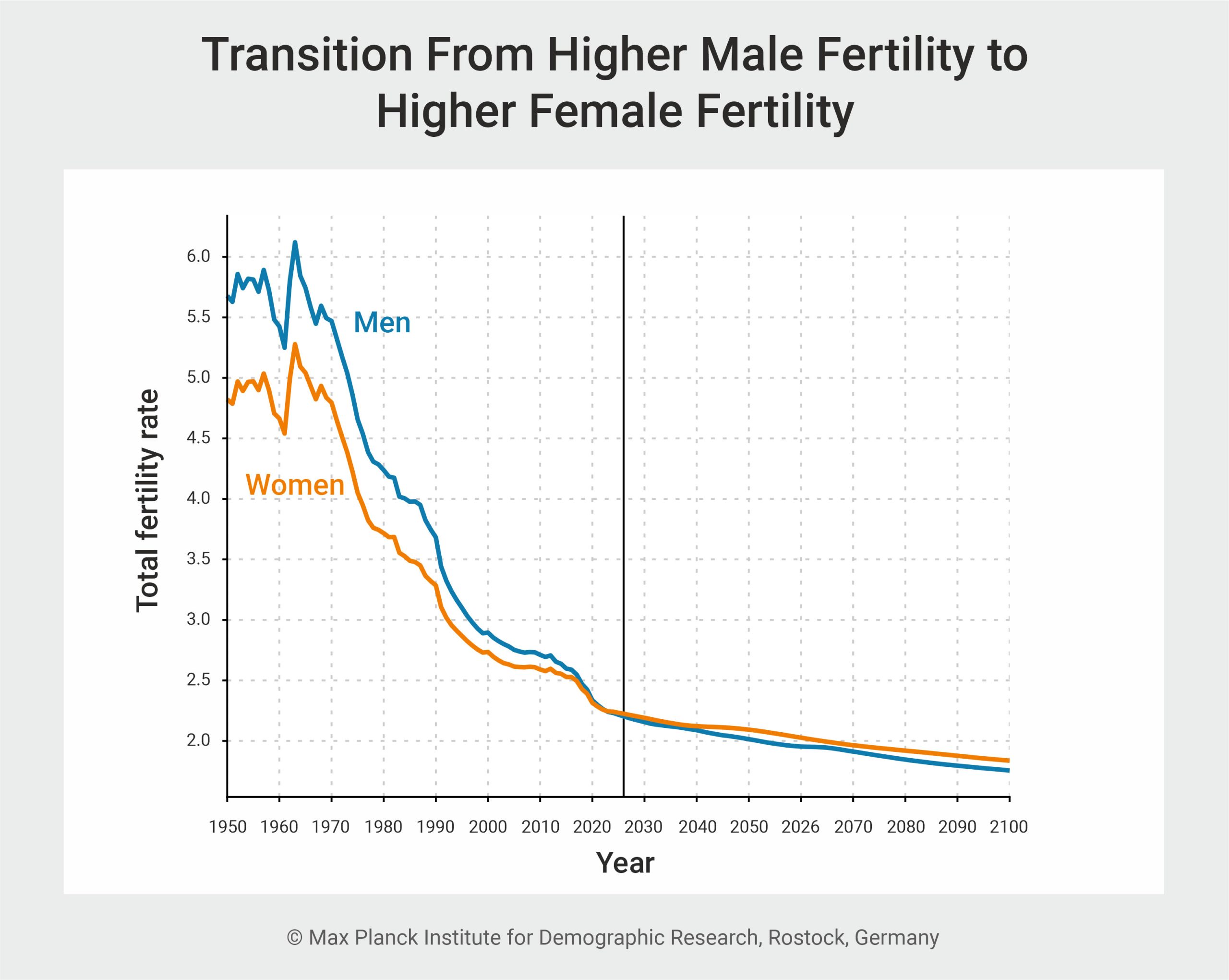
In much of Latin America, it occurred more recently. Oceania, South America, and Asia have also only recently passed this point. In sub-Saharan Africa, the shift from a higher male total fertility rate to a higher female total fertility rate is not expected before 2100, because fertility decline has stalled and mortality remains high.
Social consequences: Policies may promptly address the social consequences
As the share of men in the population rises, fertility differences between women and men are becoming larger. These changes create social challenges, but they may also open new possibilities for policy.
Schubert comments: “The challenges primarily affect men who remain childless—a status often associated with poorer health and growing dependence on professional care in old age. Urgent policy solutions are needed to counteract gender-specific differences in fertility and their consequences, such as childlessness among men.”
The researchers identify three possible responses:
- Strengthen women’s status in society, including efforts to prevent sex selective abortions.
- Expand education and job opportunities for childless and single men, giving them stronger career prospects and reducing their vulnerability to organized crime.
- Create technical and institutional support for single and childless people, including friendship circles and legal access to assisted reproductive technologies.
“If the challenges of these men are not taken into account, there is a risk of a cultural backlash against gender equality and social conflict,” warns the research team.
Reference: “Masculinization of populations reverses sex differences in fertility” by Henrik-Alexander Schubert, Thomas Spoorenberg, Christian Dudel and Vegard Fykse Skirbekk, 20 April 2026, Proceedings of the National Academy of Sciences.
DOI: 10.1073/pnas.2533317123
Never miss a breakthrough: Join the SciTechDaily newsletter.
Follow us on Google and Google News.
8 Comments
This study creates the kind of fog that was used by the US tobacco industry to confuse the public as to the cause of lung cancer. The study does not look at the fact that male production of sperm has been reduced by 50% in the past generation. This is due to the chemicals we have been exposed to in the environment. This study gives cover to the corporations who are killing off the human race. See the research of Dr. Shanna Swan. This article is part of the global coverup taking place. Guess who funded this so called the research?
ESTROGEN AND ESTROGEN MIMICKING TOXINS
Good. It’s not dropping rapidly enough.
So, we’ll have to adjust to not having overpopulation? Geee.
I’m sorry, but the chart shows that men are having fewer illegitimate children with their mistresses than in the 50’s. Think about it. It takes an equal amount of males to female to have a child, so the males are breeding with multiple females.
What about the REAL reason. Men don’t want to marry, let alone have kids when women instigate 4 out of 5 marriages.
So they’re afraid of a backlash against gender “equality”. Female careerism, empowerment over men and male emasculation, single motherhood, greater ratios of females in college and greater career success for women, are the sole drivers of this. Political enforcement of the most artificial behaviors imaginable for women is entrenched in western (especially American) culture and a generation of men are scared sexless to say or do anything about it. Nature doesn’t care if our population collapses. This disaster will continue until it’s genuinely addressed.
Good. It’s not dropping rapidly enough.
(Meant to reply here, not to a conspiracy post)