
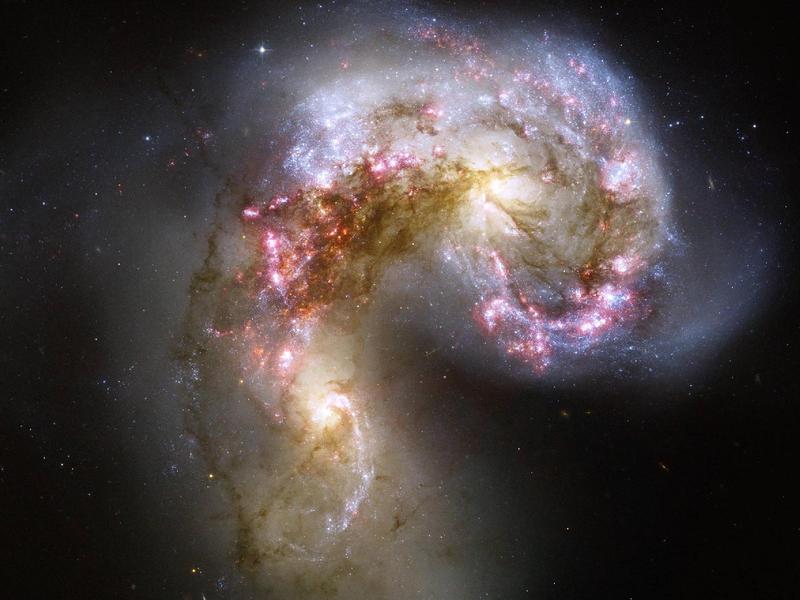
Using computer simulations, a team of astronomers found that when galaxies collide and form starbursts, the total number of star clusters decreases. Their research shows that smaller star clusters were effectively destroyed by the rapidly changing gravitational forces that typically occur during starbursts, while the brightest and largest star clusters were capable of surviving the galaxy collision due to their own gravitational attraction.
Our Milky Way galaxy is surrounded by some 200 compact groups of stars, which, viewed through small telescopes, look like snowballs. These globular clusters are 13 billion years old, which is almost as old as the universe itself. Now a team of astronomers from Germany and the Netherlands have conducted a novel type of computer simulation. Their surprising findings: these giant clusters of stars are the only survivors of a massacre that destroyed their smaller siblings.
Globular star clusters have a remarkable characteristic: the typical number of stars they contain appears to be about the same throughout the Universe. This goes against what is known about young stellar clusters in nearby galaxies, which can contain almost any number of stars, from less than 100 to many thousands. The team of scientists proposes that this difference can be explained by the conditions under which globular clusters formed early on in the evolution of their host galaxies.
The researchers ran simulations of isolated and colliding galaxies, in which they included a model for the formation and destruction of stellar clusters. When galaxies collide, they often generate spectacular bursts of star formation (“starbursts”) and a wealth of bright, young stellar clusters. Therefore it was always thought that the total number of star clusters increases during starbursts. But the Dutch-German team found the opposite result in their simulations. While the very brightest and largest star clusters were indeed capable of surviving the galaxy collision due to their own gravitational attraction, the numerous smaller star clusters were effectively destroyed by the rapidly changing gravitational forces that typically occur during starbursts. After the starburst that lasted about two billion years had ended, the researchers were surprised to see that only star clusters with high numbers of stars had survived. These clusters had all the characteristics that should be expected for a young population of globular clusters, as they would have looked about 11 billion years ago.

Dr. Kruijssen comments: “It is ironic to see that starbursts may produce many young stellar clusters, but at the same time also destroy the majority of them. This occurs not only in galaxy collisions, but should be expected in any starburst environment. In the early Universe, starbursts were commonplace – it, therefore, makes perfect sense that all globular clusters have approximately the same number of stars. Their smaller brothers and sisters that didn’t contain as many stars were doomed to be destroyed.”
According to the simulations, most of the star clusters were destroyed shortly after their formation, when the galactic environment was still very hostile to the young clusters. After this episode ended, the surviving globular clusters have lived quietly until the present day. Most of a globular cluster’s traits were established when it formed. The fact that globular clusters are comparable everywhere thus indicates that the environments in which they formed were very similar, regardless of the galaxy they currently reside in.
The researchers have further suggestions to test their ideas. Dr. Kruijssen continues: “In the nearby Universe, there are several examples of galaxies that have recently undergone large bursts of star formation. It should therefore be possible to see the rapid destruction of small stellar clusters in action. If this is indeed found by new observations, it will confirm our theory for the origin of globular clusters. In that case, globular clusters can indeed be used as fossils to shed more light on the conditions under which the first stars and galaxies formed.”
Never miss a breakthrough: Join the SciTechDaily newsletter.
Follow us on Google and Google News.