
Close Menu
    Facebook X (Twitter) Instagram
    SciTechDaily
    • Biology
    • Chemistry
    • Earth
    • Health
    • Physics
    • Science
    • Space
    • Technology
    Facebook X (Twitter) Pinterest YouTube RSS
    SciTechDaily
    Home»Space»Using Infrared Images from Hubble & Spitzer, Scientists Discover 25 Distant Galaxies
    Space

    Using Infrared Images from Hubble & Spitzer, Scientists Discover 25 Distant Galaxies

    By Harvard Smithsonian Center for AstrophysicsMay 21, 2012No Comments3 Mins Read
    Facebook Twitter Pinterest Telegram LinkedIn WhatsApp Email Reddit
    Share
    Facebook Twitter LinkedIn Pinterest Telegram Email Reddit
    unrecognized galaxy population whose properties are significantly different from those of known galaxies
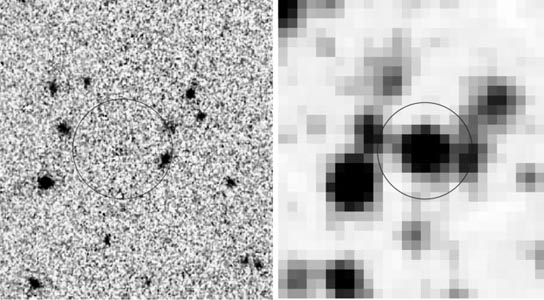
    Now you don’t see it; now you do — the image of a galaxy from a time when the universe was only a billion years old. The left image, from Hubble, sees nothing in the sky, but the longer wavelength infrared image from Spitzer (right) sees a bright source. The intense star formation activity in the galaxy, its distance, and the expansion of the universe combine to make it appear in the infrared. Credit: K. Caputi

    In an effort to further piece cosmic evolution together, astronomers have been using a combination of modern telescopes and infrared and submillimeter techniques. Using the infrared camera on the Spitzer Space Telescope in coordination with infrared images from Hubble, a team of astronomers discovered twenty-five distant galaxies, many of which date to cosmic epochs from 1.5 to 3 billion years after the Big Bang.

    The universe was born about 13.7 billion years ago in the Big Bang. The Sun and its system of planets formed about five billion years ago. What happened, then, during that long, intervening stretch of nearly nine billion years? This is one of the key questions in modern science. Astronomers think that the very first stars and galaxies appeared only a few hundreds of millions of years after the Big Bang, and have been evolving ever since. They must have been quite different from the stars and galaxies of today, however, in part because the young universe lacked most of the chemical elements present today – those elements were made gradually in the nuclear furnaces of those stars.

    Modern telescopes and infrared and submillimeter techniques have recently enabled astronomers to spot significant numbers of very distant galaxies and begin to piece together a picture of cosmic evolution. Galaxies often undergo bursts of star formation that make their dust glow in the infrared. In fact, recent results suggest that at some cosmic epochs star formation was as much as ten times more active than it is today. The power of infrared is twofold: It can measure the luminous dust, and, because cosmic expansion shifts starlight into the infrared, it can also see spectral features in that starlight that allow an estimate of the cosmic distance.

    Sensitive infrared cameras staring over large fields of view are the best way to find large numbers of very distant objects for analyses SAO astronomers Jia-Sheng Huang, Giovanni Fazio, and Matt Ashby, together with a team of colleagues, used the infrared camera on the Spitzer Space Telescope to undertake a very deep and sensitive search for distant infrared galaxies in an area of the sky one-twentieth the size of the full moon. They coordinated their study with infrared images from Hubble.

    The scientists discovered twenty-five peculiar infrared objects in their field. Follow-up analyses revealed that between eleven and nineteen of them date to cosmic epochs from 1.5 to 3 billion years after the Big Bang. These galaxies seem to be very massive and to contain significant amounts of warm dust. Two other sources just as massive seem to be even older, dating from a period only one billion years after the big bang. The latter presents a serious challenge to current theories about galaxy evolution, which predict very few such objects should exist at such an early time. The new survey is significant not only because it has discovered such distant galaxies, but also because it points to a previously unrecognized galaxy population whose properties are significantly different from those of known galaxies at similar epochs.

    Never miss a breakthrough: Join the SciTechDaily newsletter.
    Follow us on Google and Google News.

    Astronomy Astrophysics Galaxy Galaxy Evolution Harvard-Smithsonian Center for Astrophysics Spitzer Space Telescope
    Share. Facebook Twitter Pinterest LinkedIn Email Reddit

    Related Articles

    Researchers Study Early Galaxies and Their Specific Properties

    Centaurus a Hides a Gaseous Spiral at Its Core

    Rapid Star Formation Observed in the Phoenix Cluster

    Arepo Software Helps Simulate the Birth and Evolution of Galaxies

    Examining the Dust Absorption of Active Galactic Nuclei

    Discovery Solves Decades Old Discrepancies

    Patterns of Light Appear to be From the First Stars and Galaxies

    Calculations Show the Ideal Time to Study the Cosmos

    Origins of Type Ia Supernovae

    Leave A Reply Cancel Reply

    • Facebook
    • Twitter
    • Pinterest
    • YouTube

    Don't Miss a Discovery

    Subscribe for the Latest in Science & Tech!

    Trending News

    Popular Sugar-Free Sweetener Linked to Liver Disease, Study Warns

    What Is Hantavirus? The Deadly Disease Raising Alarm Worldwide

    Scientists Just Discovered How the Universe Builds Monster Black Holes

    Scientists Unveil New Treatment Strategy That Could Outsmart Cancer

    A Simple Vitamin May Hold the Key to Treating Rare Genetic Diseases

    Scientists Think the Real Fountain of Youth May Be Hiding in Your Gut

    Ravens Don’t Follow Wolves, They Predict Them

    This Common Knee Surgery May Be Doing More Harm Than Good

    Follow SciTechDaily
    • Facebook
    • Twitter
    • YouTube
    • Pinterest
    • Newsletter
    • RSS
    SciTech News
    • Biology News
    • Chemistry News
    • Earth News
    • Health News
    • Physics News
    • Science News
    • Space News
    • Technology News
    Recent Posts
    • This Mars Rock Refused To Let Go of NASA’s Curiosity Rover
    • James Webb Telescope Reveals the Universe’s Hidden Cosmic Web in Stunning Detail
    • Scientists Build a Living AI Device Using Real Brain Cells
    • Why Are So Many New Fathers Dying? Scientists Say the U.S. Has a Dangerous Blind Spot
    • Scientists Identify Simple Supplement That Greatly Reduces Alzheimer’s Damage
    Copyright © 1998 - 2026 SciTechDaily. All Rights Reserved.
    • Science News
    • About
    • Contact
    • Editorial Board
    • Privacy Policy
    • Terms of Use

    Type above and press Enter to search. Press Esc to cancel.