
Close Menu
    Facebook X (Twitter) Instagram
    SciTechDaily
    • Biology
    • Chemistry
    • Earth
    • Health
    • Physics
    • Science
    • Space
    • Technology
    Facebook X (Twitter) Pinterest YouTube RSS
    SciTechDaily
    Home»Space»Arepo Software Helps Simulate the Birth and Evolution of Galaxies
    Space

    Arepo Software Helps Simulate the Birth and Evolution of Galaxies

    By Harvard UniversityAugust 20, 2012No Comments3 Mins Read
    Facebook Twitter Pinterest Telegram LinkedIn WhatsApp Email Reddit
    Share
    Facebook Twitter LinkedIn Pinterest Telegram Email Reddit
    new computational approach that can accurately follow the birth and evolution of galaxies over billions of years
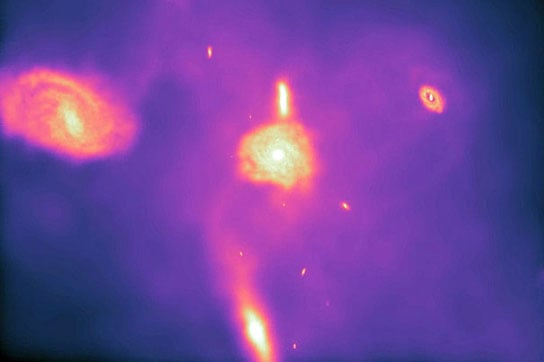
    This still frame is taken from the Arepo-generated animation. It demonstrates Arepo’s key ability to produce realistic spiral galaxies. Previous simulations tended to yield bloblike galaxies lacking distinct spiral structure. Credit: CfA/UCSD/HITS/M. Vogelsberger (CfA) and V. Springel (HITS)

    By using Harvard’s Odyssey high-performance supercomputer and new software called Arepo, a team of scientists developed a new computational approach that can accurately follow the birth and evolution of galaxies.

    Scientists at the Harvard-Smithsonian Center for Astrophysics (CfA) and their colleagues at the Heidelberg Institute for Theoretical Studies (HITS) have invented a new computational approach that can accurately follow the birth and evolution of thousands of galaxies over billions of years. For the first time, it’s now possible to build a universe from scratch that brims with galaxies like those we observe around us.

    “We’ve created the full variety of galaxies we see in the local universe,” said CfA’s Mark Vogelsberger, a postdoctoral fellow in the Harvard College Observatory.

    Our cosmic neighborhood is littered with majestic spiral galaxies such as Andromeda, the Pinwheel, and the Whirlpool. Spirals are common, but previous simulations had trouble creating them. Instead, they produced lots of blobby galaxies clumped into balls, without the broad disks and outstretched arms of a typical spiral.

    The new software, called Arepo, solves this problem. Created by Volker Springel, group leader at HITS, Arepo generates a full-fledged simulation of the universe, taking as input only the observed afterglow of the Big Bang and evolving forward in time for 14 billion years.

    “We took all the advantages of previous codes and removed the disadvantages,” explained Springel.

    “Our simulations improve over previous ones as much as the Giant Magellan Telescope will improve upon any telescope that exists now,” said Debora Sijacki of the CfA and a fellow at the Harvard College Observatory.

    (When completed later this decade, the Giant Magellan Telescope’s 24.5-meter (80.3-foot) aperture will make it the largest telescope in the world.)

    One of Arepo’s key advantages is the geometry it uses. Previous simulations divided space into a bunch of cubes of fixed size and shape. Arepo uses a grid that flexes and moves in space to match the motions of the underlying gas, stars, dark matter, and dark energy.

    The simulations ran on Harvard’s Odyssey high-performance supercomputer, using in total 1,024 processor cores. This fast machine allowed the scientists to compress 14 billion years into only a few months — an endeavor that would have kept a desktop computer busy for hundreds of years!

    The team’s future goals include simulating much larger volumes of the universe at unprecedented resolution, thus creating the largest and most realistic model of the universe ever made.

    Never miss a breakthrough: Join the SciTechDaily newsletter.
    Follow us on Google and Google News.

    Astronomy Astrophysics Galaxy Evolution Harvard University Harvard-Smithsonian Center for Astrophysics Simulation Technology
    Share. Facebook Twitter Pinterest LinkedIn Email Reddit

    Related Articles

    Harvard Astronomers Have Revealed the True Shape of the Milky Way’s Halo of Stars

    12 Billion Year Old Explosion Illuminates a Galaxy from the Dark Ages

    The First Systematic Analysis of the Energy Distribution of Interacting Galaxies

    New Computer Simulations Help Reveal How Spiral Galaxies Get Their Arms

    Researchers Study Early Galaxies and Their Specific Properties

    Centaurus a Hides a Gaseous Spiral at Its Core

    Astronomers Measure a Black Hole’s “Point of No Return”

    Video and Sound Help Turn Astronomical Data Into Art

    Using Infrared Images from Hubble & Spitzer, Scientists Discover 25 Distant Galaxies

    Leave A Reply Cancel Reply

    • Facebook
    • Twitter
    • Pinterest
    • YouTube

    Don't Miss a Discovery

    Subscribe for the Latest in Science & Tech!

    Trending News

    Artificial Sweeteners May Harm Future Generations, Study Suggests

    Splashdown! NASA Artemis II Returns From Record-Breaking Moon Mission

    What If Consciousness Exists Beyond Your Brain

    Scientists Finally Crack the 100-Million-Year Evolutionary Mystery of Squid and Cuttlefish

    Beyond “Safe Levels”: Study Challenges What We Know About Pesticides and Cancer

    Researchers Have Found a Dietary Compound That Increases Longevity

    Scientists Baffled by Bizarre “Living Fossil” From 275 Million Years Ago

    Your IQ at 23 Could Predict Your Wealth at 27, Study Finds

    Follow SciTechDaily
    • Facebook
    • Twitter
    • YouTube
    • Pinterest
    • Newsletter
    • RSS
    SciTech News
    • Biology News
    • Chemistry News
    • Earth News
    • Health News
    • Physics News
    • Science News
    • Space News
    • Technology News
    Recent Posts
    • What if Dark Matter Has Two Forms? Bold New Hypothesis Could Explain a Cosmic Mystery
    • Researchers Expose Hidden Chemistry of “Ore-Forming” Elements in Biology
    • Geologists Reveal the Americas Collided Earlier Than We Thought
    • 20x Difference: Study Reveals True Source of Airborne Microplastics
    • Scientists Uncover Hidden Force Powering Yellowstone’s Supervolcano
    Copyright © 1998 - 2026 SciTechDaily. All Rights Reserved.
    • Science News
    • About
    • Contact
    • Editorial Board
    • Privacy Policy
    • Terms of Use

    Type above and press Enter to search. Press Esc to cancel.