
Close Menu
    Facebook X (Twitter) Instagram
    SciTechDaily
    • Biology
    • Chemistry
    • Earth
    • Health
    • Physics
    • Science
    • Space
    • Technology
    Facebook X (Twitter) Pinterest YouTube RSS
    SciTechDaily
    Home»Earth»Felix Pharand-Deschenes Maps Human Influence On Earth
    Earth

    Felix Pharand-Deschenes Maps Human Influence On Earth

    By SciTechDailyAugust 20, 2012No Comments2 Mins Read
    Facebook Twitter Pinterest Telegram LinkedIn WhatsApp Email Reddit
    Share
    Facebook Twitter LinkedIn Pinterest Telegram Email Reddit
    anthropocene-mapping-felix-pharand-deschenes
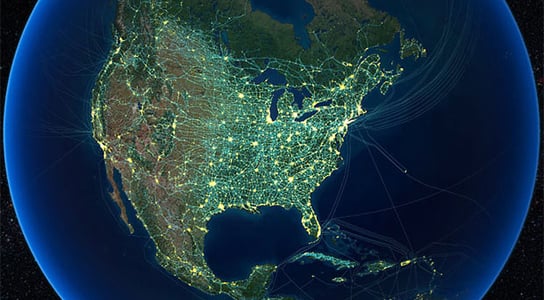
    Canadian scientist Felix Pharand-Deschenes used satellite images to map the human influence on Earth, depicting significant changes visible from space. Credit: Felix Pharand-Deschenes

    Canadian scientist Felix Pharand-Deschenes used satellite images to map the human influence on Earth, depicting how much it has changed, as seen from space. Pharand-Deschenes used data collected by various government agencies to create these striking images.

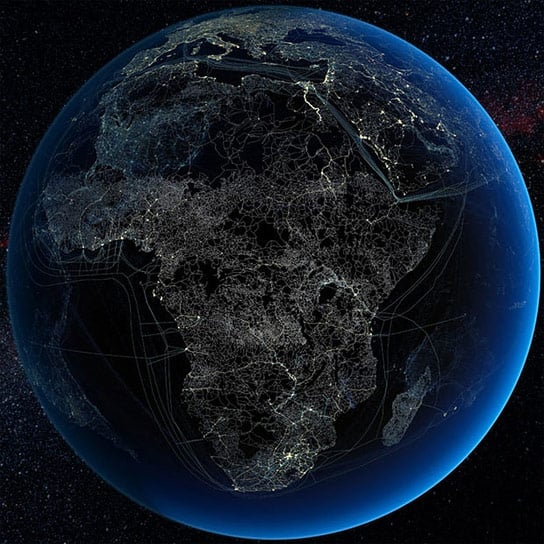
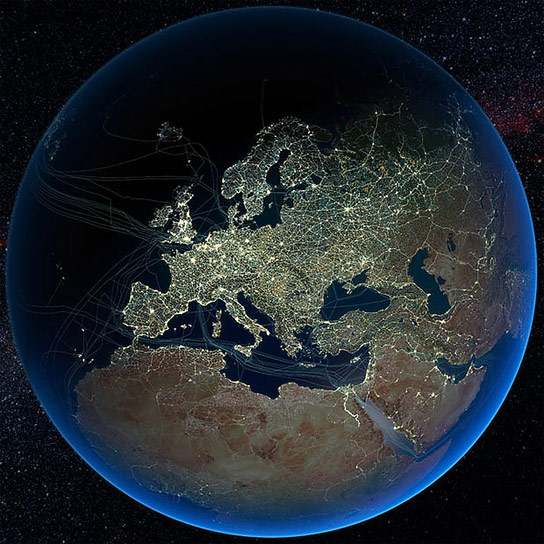
    The images show everything, from paved and unpaved roads, light pollution, railways, and electrical transmission lines, all the way to submarine cables, pipelines, shipping lanes, and air traffic.
    human-technology-africa
    Credit: Felix Pharand-Deschenes

    The images also highlight the disparity between the first and third world. London, Paris, Berlin, and parts of North America burn bright, while Africa, South America and large parts of Asia remain shrouded in darkness.
    anthropocene-mapping-felix-pharand-deschenes-europe
    Credit: Felix Pharand-Deschenes

    Pharand-Deschenes states that the patches and dots of light tell an important story about modern times. Humans are causing detrimental effects on Earth through unnecessary lighting. Japan is also a stark contrast to the rest of Asia, being brightly lit from coast to coast.

    Dark places on the maps are places where the human population density is low or where the energy infrastructures are either damaged, non-existent, or too expensive to develop.

    Never miss a breakthrough: Join the SciTechDaily newsletter.
    Follow us on Google and Google News.

    Environment Evolution Map
    Share. Facebook Twitter Pinterest LinkedIn Email Reddit

    Related Articles

    Humans Disrupting 66 Million-Year-Old Fundamental Feature of Ecosystems – “This Hasn’t Happened Before”

    Yale Researchers Create Global Map of Undiscovered Life

    Alterations in Seawater Chemistry Linked With Past Climate Change

    Particulate Pollution Created ‘Warming Hole’ that Delayed Climate Change

    Study Reports Air Pollution Causes Thousands of Premature Deaths Each Year

    Cloud Forests are at Risk of Destruction from Global Warming

    Antarctic Ecosystems Threatened by Invasive Alien Species and Climate Change

    Microbial Oasis Discovered Under Atacama Desert in Chile

    New Models Hone Picture of Climate Impact on Earth

    Leave A Reply Cancel Reply

    • Facebook
    • Twitter
    • Pinterest
    • YouTube

    Don't Miss a Discovery

    Subscribe for the Latest in Science & Tech!

    Trending News

    The Strange “Spacetime Crystal” That Can Suddenly Turn Into a Black Hole

    The Surprising Way Asteroids May Have Helped Life Begin on Earth

    Vast Hidden Structure Discovered Under Miles of Ice in East Antarctica

    A Surprising Discovery Suggests Autism Is Not One Condition

    New Alzheimer’s Discovery Could Change How Scientists Fight the Disease

    Yale Discovery Overturns Long-Held “Evolutionary Dead End” Theory

    UCLA Scientists Uncover a “Hidden Weakness” in Some of the World’s Deadliest Cancers

    Humpback Whale Stuns Scientists With 15,000 Kilometer Journey Across Oceans

    Follow SciTechDaily
    • Facebook
    • Twitter
    • YouTube
    • Pinterest
    • Newsletter
    • RSS
    SciTech News
    • Biology News
    • Chemistry News
    • Earth News
    • Health News
    • Physics News
    • Science News
    • Space News
    • Technology News
    Recent Posts
    • Meet the Artemis III Astronauts Preparing for NASA’s Boldest Moon Mission Yet
    • Scientists Develop a New Way To Measure Gravitational Waves in the Expanding Universe
    • MIT’s New Dual-Mode Rocket System Could Send Tiny Satellites to Mars
    • Scientists Discover a Biological Clock Unlike Anything Seen Before
    • This “Zombie” Sea Creature Keeps Growing After Being Cut Apart
    Copyright © 1998 - 2026 SciTechDaily. All Rights Reserved.
    • Science News
    • About
    • Contact
    • Editorial Board
    • Privacy Policy
    • Terms of Use

    Type above and press Enter to search. Press Esc to cancel.