
Close Menu
    Facebook X (Twitter) Instagram
    SciTechDaily
    • Biology
    • Chemistry
    • Earth
    • Health
    • Physics
    • Science
    • Space
    • Technology
    Facebook X (Twitter) Pinterest YouTube RSS
    SciTechDaily
    Home»Biology»Trogloraptor Marchingtoni Is a New Species of Spiders Discovered in the Pacific Northwest
    Biology

    Trogloraptor Marchingtoni Is a New Species of Spiders Discovered in the Pacific Northwest

    By SciTechDailyAugust 20, 2012No Comments2 Mins Read
    Facebook Twitter Pinterest Telegram LinkedIn WhatsApp Email Reddit
    Share
    Facebook Twitter LinkedIn Pinterest Telegram Email Reddit
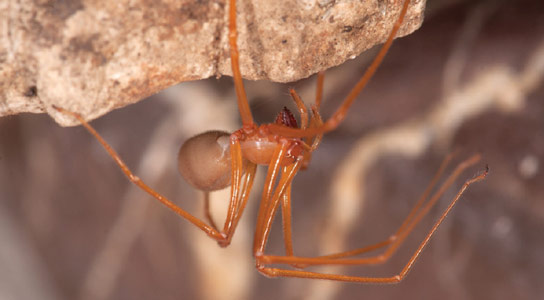
    Trogloraptor-marchingtoni-Female-captive-specimen
    Trogloraptor marchingtoni is a newly discovered species of spider found in the Pacific Northwest.

    A completely new genus and species of spiders was discovered in the Pacific Northwest by spelunkers. Trogloraptor marchingtoni was first discovered by a group of amateur spelunkers in a cave in Grants Pass, Oregon 2010. They sent specimens to the California Academy of Sciences, who confirmed that it was a new species. Since then, more specimens have been found in the Redwoods of Northern California.

    A team of entomologists led by Charles Griswold of the California Academy of Sciences, published their findings in the journal Zookeys. Griswold says that the discovery might explain the local legends of giant spiders. There have been only two other new spider families described since 1990. Norman Platnick, arachnologist, commented that the discovery was fascinating.
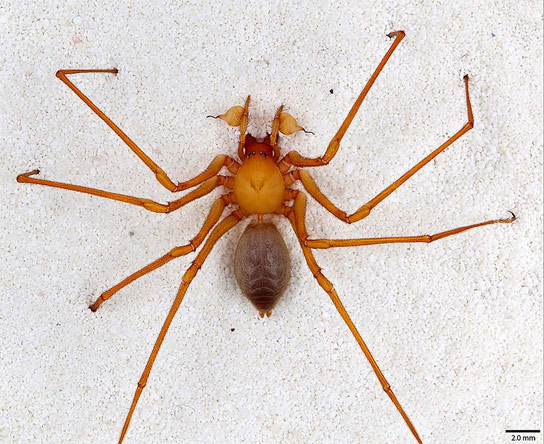
    Trogloraptor-marchingtoni

    Adult T.marchingtoni have six eyes and a body length of about 7 to 10 mm. The body is yellow-brown in color, except for a dark brown V-shaped mark on the cephalothorax. The species can spin primitive webs with only a few strands, and hang off the roof of caves. The spiders are unique because of the flexible and teethed hook-like claws on the tarsus of their legs. The elongated claws resemble the ones of the Gradungulidae family of Australia and New Zealand, but these species are only distantly related.

    The spiders use the hooked claws to capture their prey, whose exact nature remains unknown as of yet. Captured live specimens were raised in controlled conditions, but died after refusing to eat moths, crickets, and other spiders as food. This indicates that this species has a preference for a very specific yet unknown prey.
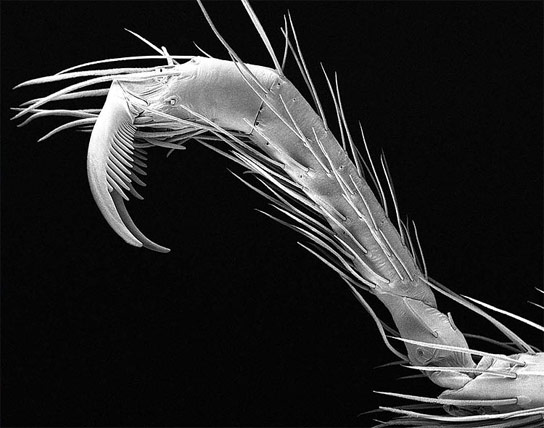
    hook-claws-trogloraptor-marchingtoni

    Reference: “An extraordinary new family of spiders from caves in the Pacific Northwest (Araneae, Trogloraptoridae, new family)” by Charles E. Griswold, Tracy Audisio and Joel M. Ledford, 17 August 2012, Zookeys.
    DOI: 10.3897/zookeys.215.3547

    Never miss a breakthrough: Join the SciTechDaily newsletter.
    Follow us on Google and Google News.

    Entomology Spiders
    Share. Facebook Twitter Pinterest LinkedIn Email Reddit

    Related Articles

    Look Out, Here Comes the Slingshot Spider!

    Toxic Masculinity: Solving the Puzzle of Why Male Funnel-Web Spiders Are So Deadly

    Wolf Spider Baby Boom in a Warmer Arctic

    Spider Building Spider Decoys Discovered in Peruvian Amazon

    Daddy Longlegs With Leg Span of 12 Inches Discovered

    European Cave Spiders Produce Extremely Stretchable Silk

    Adanson’s Jumping Spiders Hunt Using Unusual Depth Perception

    Tiny Spider Brains Overflow Into the Body and Legs

    Bearing Gifts Equals More Sex Even With Spiders

    Leave A Reply Cancel Reply

    • Facebook
    • Twitter
    • Pinterest
    • YouTube

    Don't Miss a Discovery

    Subscribe for the Latest in Science & Tech!

    Trending News

    After 50 Years, Astronomers Finally Found What the Milky Way’s Black Hole Was Hiding

    The Most Powerful Drug of All Isn’t Found in a Pill Bottle

    Scientists Capture Immune Cells Eating Live Cancer Cells for the First Time

    Why Older Adults Need To Pay Closer Attention to Vitamin B12

    Scientists Say a Daily Probiotic May Help Fight Depression in Older Adults

    This Deadly Disease Was Wiping Out Humans 5,500 Years Ago

    Beyond DNA: Scientists Discover Inheritance That Breaks the Rules of Genetics

    Scientists Just Discovered the Eye Defies a Long-Held Rule of Vision

    Follow SciTechDaily
    • Facebook
    • Twitter
    • YouTube
    • Pinterest
    • Newsletter
    • RSS
    SciTech News
    • Biology News
    • Chemistry News
    • Earth News
    • Health News
    • Physics News
    • Science News
    • Space News
    • Technology News
    Recent Posts
    • Japanese Researchers Unlock a Powerful New Way To Edit and Assemble DNA
    • Rare Goblin Shark Spotted Alive in Its Natural Habitat for the First Time
    • Scientists May Have Discovered How To Heal Damaged Kidneys
    • A Plastic Motor Just Defied a Century of Engineering Assumptions
    • Interstellar Visitor 3I/ATLAS Is Bursting With an Unexpected Chemical
    Copyright © 1998 - 2026 SciTechDaily. All Rights Reserved.
    • Science News
    • About
    • Contact
    • Editorial Board
    • Privacy Policy
    • Terms of Use

    Type above and press Enter to search. Press Esc to cancel.