
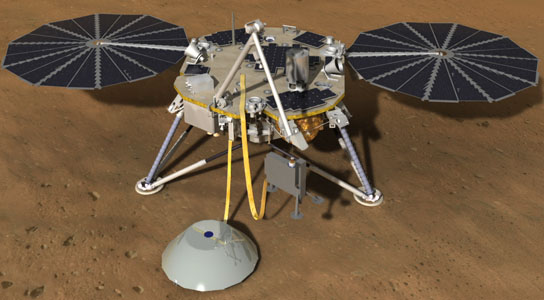
Set to launch in 2016, NASA’s new Discovery-class mission, called InSight, will probe Mars at new depths by looking into the deep interior of Mars using InSight’s Heat Flow and Physical Properties Package.
On August 20, NASA announced the selection of InSight, a new Discovery-class mission that will probe Mars at new depths by looking into the deep interior of Mars.
“We are certainly excited, but our veterans on this team know the drill,” said Tom Hoffman, project manager for InSight from NASA’s Jet Propulsion Laboratory in Pasadena, California. “Which is fortunate, because one of the great things we’ll get to do on Mars is drill below the surface.”
Drilling underneath the red Martian topsoil will be courtesy of InSight’s HP3, or Heat Flow and Physical Properties Package – one of the four instruments the Mars lander will carry. Made by the German Aerospace Center, or DLR, HP3 will get below Mars’ skin by literally pounding it into submission with a 14-inch (35-centimeter), hollowed-out, electromechanically-festooned stake called the Tractor Mole.
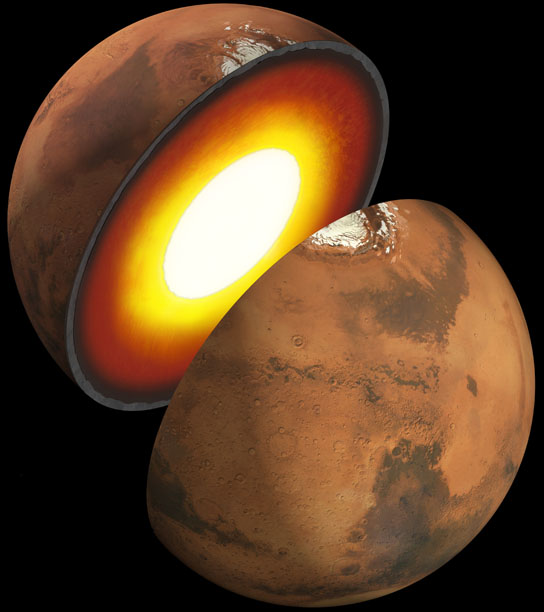
“The Tractor Mole has an internal hammer that rises and falls, moving the stake down in the soil and dragging a tether along behind it,” said Sue Smrekar, deputy project scientist for InSight from JPL. “We’re essentially doing the same thing any Boy or Girl Scout would do on a campout, but we’re putting our stake down on Mars.”
The German-built mole will descend up to 16 feet (five meters) below the surface, where its temperature sensors will record how much heat is coming from Mars’ interior, which reveals the planet’s thermal history.
“Getting well below the surface gets us away from the sun’s influence and allows us to measure heat coming from the interior,” said Smrekar. “InSight is going take heartbeat and vital signs of the Red Planet for an entire Martian year, two Earth years. We are really going to have an opportunity to understand the processes that control the early planetary formation.”
Mission team members for InSight, the new Mars lander mission selected by NASA to launch in 2016, explain how the spacecraft will advance our knowledge of Mars’ history and rocky planet evolution.
InSight stands for Interior Exploration using Seismic Investigations, Geodesy and Heat Transport. The mission is led by W. Bruce Banerdt of JPL. InSight’s science team includes U.S. and international co-investigators from universities, industry, and government agencies. Along with DLR, the French space agency Center National d’Etudes Spatiales, or CNES, is also contributing an instrument to the two-year scientific mission.
InSight builds on spacecraft technology used in NASA’s highly successful Phoenix lander mission, which was launched to the Red Planet in 2007 and determined that water ice exists near the surface in the Martian polar regions.
Along with providing an onboard geodetic instrument to determine the planet’s rotation axis, plus a robotic arm and two cameras used to deploy and monitor instruments on the Martian surface, JPL performs project management for NASA’s Science Mission Directorate. NASA’s Marshall Space Flight Center in Huntsville, Alabama, manages the Discovery Program for the agency’s Science Mission Directorate in Washington. Lockheed Martin Space Systems in Denver will build the spacecraft. JPL is a division of the California Institute of Technology in Pasadena.
Never miss a breakthrough: Join the SciTechDaily newsletter.
Follow us on Google and Google News.
1 Comment
Why does it have solar panels? You think JPL would have learned from the problems they have had with Martian dust storms.